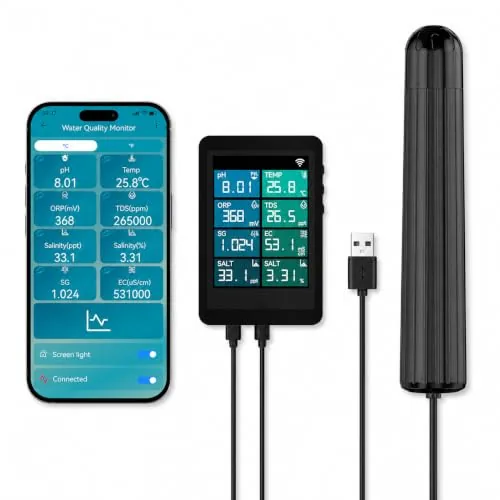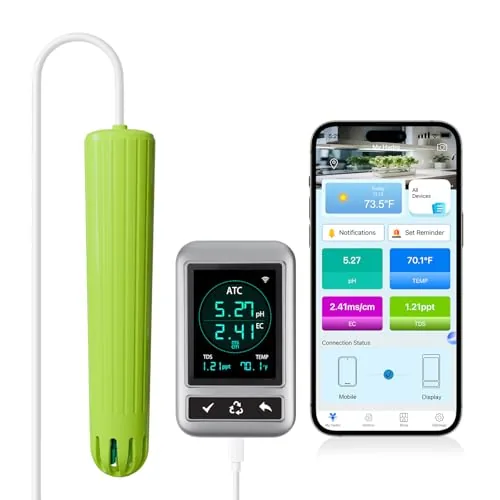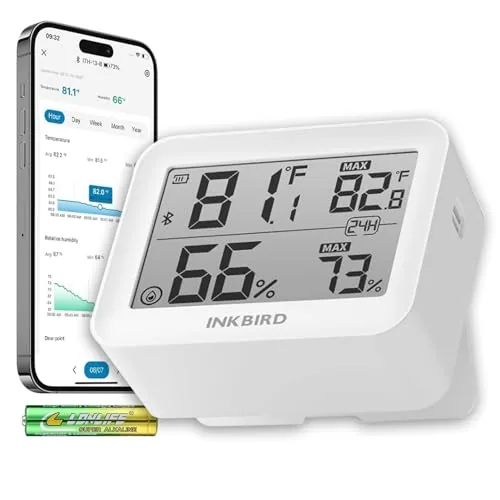
Finding reliable environmental data in a grow room isn’t optional – temperature swings, humidity spikes, and poor VPD management directly kill yields and invite disease. After testing dozens of options across small tent setups and large commercial spaces, three monitors consistently delivered accurate readings, dependable wireless connectivity, and actionable alerts: the Pulse Labs Pulse One, the Govee Bluetooth Hygrometer Thermometer, and the Room Alert MAX. Whether you’re managing a single 4×4 tent or monitoring heat zones across a multi-room facility, this breakdown will match you with the right sensor for your specific setup and budget.
Quick Comparison
| # | Product | Key Features | Score | |
|---|---|---|---|---|
| 1 |
 Pulse Labs Pulse One Smart Grow Room Monitor VPD
|
|
8.5 ★★★★☆ | Check Price on Amazon Read full review ↓ |
| 2 |
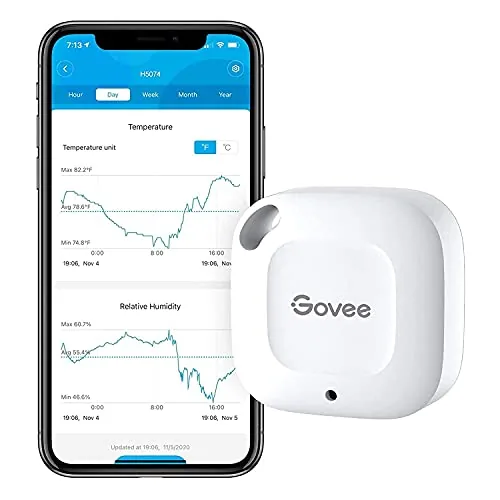 Govee Bluetooth Hygrometer Thermometer with 262ft Range
|
|
8.5 ★★★★☆ | Check Price on Amazon Read full review ↓ |
| 3 |
 Room Alert MAX Multi-Zone Heat Safety Monitor
|
|
8.2 ★★★★☆ | Check Price on Amazon Read full review ↓ |
| 4 |
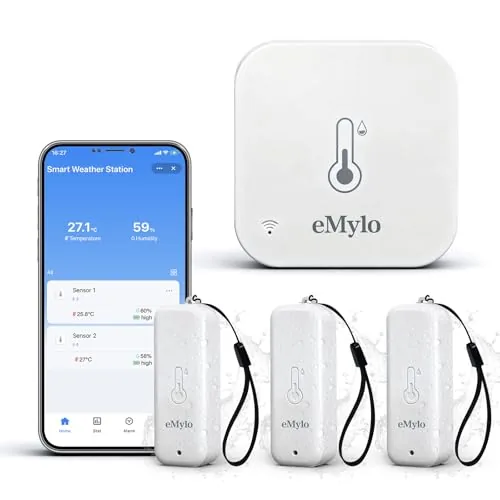 eMylo RTH11 WiFi Temp Humidity Sensor 4-Pack Hub
|
|
8.2 ★★★★☆ | Check Price on Amazon Read full review ↓ |
| 5 |
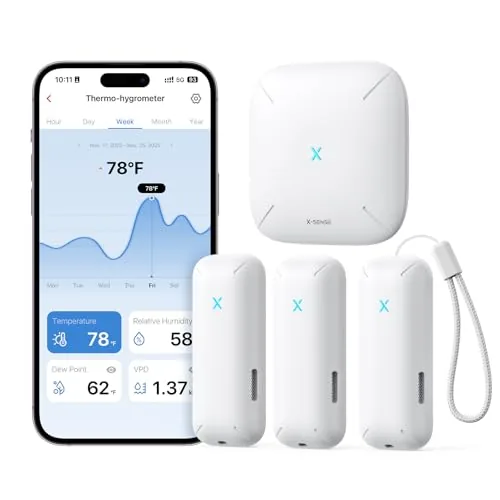 X-Sense Wi-Fi Hygrometer 3-Sensor Hub System
|
|
8.2 ★★★★☆ | Check Price on Amazon Read full review ↓ |
| 6 |
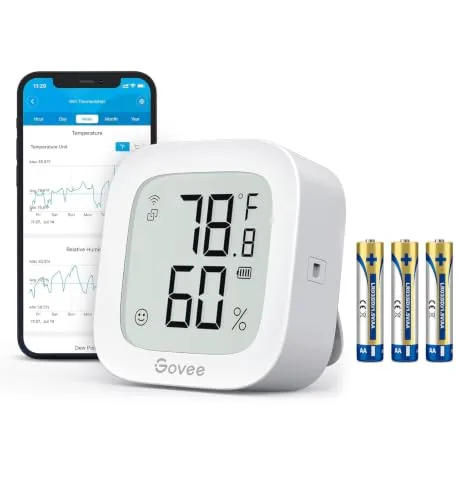 Govee H5103 WiFi Hygrometer with E-Ink Display
|
|
8.2 ★★★★☆ | Check Price on Amazon Read full review ↓ |
| 7 |
 Govee WiFi Thermometer Hygrometer with 2-Year Data Storage
|
|
8.2 ★★★★☆ | Check Price on Amazon Read full review ↓ |
| 8 |
 Room Alert 3S Temperature and Environment Monitor
|
|
7.8 ★★★★☆ | Check Price on Amazon Read full review ↓ |
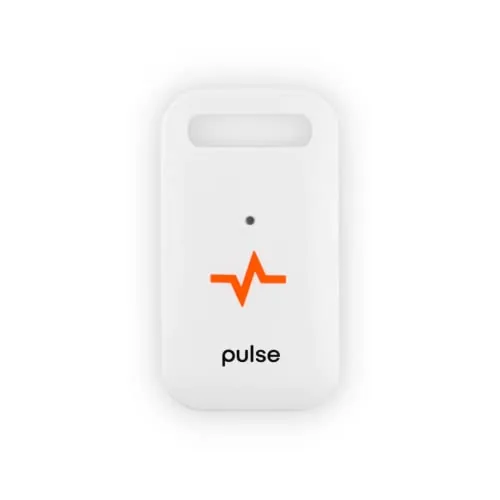
The Pulse One tracks VPD, temperature, humidity, dew point, and light intensity from a single device, giving indoor growers the data they need to dial in conditions remotely. It runs on 2AA batteries for up to 9 months and connects to iOS, Android, PC, and Mac via a dedicated app. Swiss-made sensors and US manufacturing back up the $199 price point with measurable accuracy.
Key Features
- Measures VPD, temperature, humidity, light intensity, and dew point
- Sends instant alerts from unlimited sensors across multiple locations
- Stores data offline with day and night averages for custom periods
- Splash-resistant with 3 to 9 months battery life on 2AA batteries
- Compatible with iOS, Android, PC, and Mac via dedicated app
- Built in USA with Swiss-made sensors and a one-year warranty
✅ Pros
- Swiss-made sensors deliver reliable, accurate readings across all monitored metrics
- Battery life of up to 9 months reduces maintenance in hard-to-reach grow spaces
- Multi-location sensor support with a unified dashboard suits larger or multi-room setups
- Offline data storage and power outage alerts protect crops during connectivity gaps
❌ Cons
- Requires 2.4 GHz WiFi only, which may conflict with dual-band router defaults
- At $199 it sits at the premium end for single-unit grow monitors
Why We Chose It
The Pulse One stands out for combining VPD measurement with light intensity tracking in one splash-resistant unit, a combination most competitors split across separate devices. Swiss-made sensors and US manufacturing justify the price for growers who need consistent, accurate data rather than ballpark readings. The long battery life and offline storage make it practical in environments where power and connectivity can be unpredictable.
Perfect For
Serious indoor growers running one or more tent or room setups who want remote environmental monitoring without babysitting multiple separate gauges.
A palm-sized sensor that delivers temperature readings accurate to 0.54 degrees F and humidity readings within 3% RH every two seconds. It connects via Bluetooth up to 262 feet, logs data onboard for 20 days, and exports up to two years of records as a CSV. At under 13 dollars, it punches well above its price for anyone who needs reliable environmental monitoring without a hub.
Key Features
- Swiss-made sensor accurate to 0.54F and 3% RH humidity
- Bluetooth connects up to 262 feet without obstacles
- Refreshes temperature and humidity readings every 2 seconds
- Stores 20 days of data onboard with CSV export option
- App alerts trigger when temp or humidity leave preset ranges
- Compact body with hanging hole for flexible placement
✅ Pros
- Swiss-made sensor delivers genuinely tight accuracy at this price point
- Two-year data export via CSV is rare on a sub-15 dollar device
- 2-second refresh rate catches fast environmental changes
- Bluetooth-only setup means no router pairing or hub required
❌ Cons
- Bluetooth-only limits range to 262 feet with no cloud access away from home
- No built-in display so readings require the app to be open
Why We Chose It
The combination of a certified Swiss sensor and two-year data logging in a 12-dollar package is hard to match at this tier. Most competitors at this price use uncertified sensors with no export functionality. The 2-second polling interval and instant app alerts add practical utility beyond basic logging.
Perfect For
Homeowners, plant enthusiasts, or cigar humidor keepers who want accurate real-time environmental data without paying for a full WiFi smart home system.
The Room Alert MAX covers an entire facility with one base unit and four wireless temperature and humidity sensors, giving facility managers real-time alerts before heat conditions become dangerous. Wireless deployment means no cable runs through walls or ceilings. Built in the USA with a 3-year warranty, this is a serious tool for compliance-driven environments.
Key Features
- Base unit plus four wireless temperature and humidity sensors included
- Sends alerts before dangerous heat conditions affect workers
- Wireless sensors install anywhere without cable infrastructure
- Mounting hardware included for permanent secure installation
- 3-year warranty, manufactured in the USA
- Tracks temperature and humidity for heat safety regulation compliance
- Scales to cover manufacturing floors, warehouses, and multi-zone facilities
✅ Pros
- Four wireless sensors included out of the box reduce immediate add-on costs
- Wireless deployment removes the need for conduit or cable runs in hard-to-reach zones
- 3-year warranty and US manufacturing indicate long-term support and build quality
- Scalable architecture lets facilities add sensors as operations grow
❌ Cons
- At 1099 dollars the upfront cost is high for small facilities with fewer monitoring zones
- No detail provided on alert delivery methods such as SMS, email, or app notification
Why We Chose It
The MAX ships with four wireless sensors already in the box, which means a four-zone facility can be fully operational without additional purchases. The combination of wireless flexibility and enterprise-grade warranty makes it a realistic option for facilities that have struggled to monitor remote corners or outdoor areas. US manufacturing and a three-year warranty reduce long-term risk on a four-figure investment.
Perfect For
Warehouse and manufacturing facility managers who need multi-zone heat monitoring for OSHA compliance without running new cable infrastructure.
A four-piece wireless monitoring kit covering up to ten locations with IP65-rated outdoor sensors and a 492-foot range. Real-time alerts via the Tuya or Smart Life app notify you the moment conditions drift outside your set thresholds. One-year data history with CSV export makes it useful beyond basic home monitoring.
Key Features
- Remote monitoring via Smart Life or Tuya app with push alerts
- IP65 waterproof sensors rated minus 4F to 140F, plus or minus 0.9F accuracy
- Includes 1 hub and 3 sensors, expandable to 10 locations total
- Works with Alexa and Google Home, supports automation triggers
- Stores up to 1 year of data with hourly to yearly trend graphs and CSV export
✅ Pros
- IP65 rating handles rain and outdoor exposure without extra enclosures
- 492-foot open-area range covers large properties or multi-building setups
- CSV export and one-year history suit grow rooms, wine cellars, and server monitoring
- Expandable system lets you add sensors without replacing the hub
❌ Cons
- Accuracy listed at plus or minus 5 percent RH, which may not satisfy precision-critical applications
- Requires 2.4GHz WiFi only, which can be a constraint in newer mesh network setups
Why We Chose It
The combination of IP65 waterproofing, a 492-foot range, and a genuinely expandable sensor network separates this kit from basic indoor-only alternatives at a similar price. One-year data logging with CSV export is a feature typically found on more expensive commercial systems. The Alexa and Google Home integration adds practical automation value rather than just voice readouts.
Perfect For
Greenhouse growers, reptile keepers, or homeowners who need verified outdoor-rated sensors across multiple zones without a hub-per-room setup.
This kit puts real-time temperature and humidity data from three rooms onto your phone, with alerts that fire the moment conditions drift outside your set range. The included base station supports up to 50 devices and reaches 1700 feet, so adding coverage later costs nothing extra. VPD and dew point calculations make it genuinely useful for plant growers and wine cellars, not just casual monitoring.
Key Features
- Accuracy rated at plus or minus 0.36F and plus or minus 2% RH
- Push alerts trigger when readings exit your custom thresholds
- App graphs show daily, monthly, and yearly trends with data export
- One base station supports up to 50 devices across 1700 ft
- AAA batteries rated up to one year with low-battery app alerts
- Calculates dew point and VPD for plant and storage monitoring
✅ Pros
- Three sensors included at $37.99 delivers strong value per sensor
- VPD readout is directly useful for grow tents and wine storage
- One-year battery life reduces maintenance across multi-room deployments
- Expandable to 50 devices without buying a second hub
❌ Cons
- Base station requires a 2.4GHz Wi-Fi connection, no 5GHz support mentioned
- Sensor-to-hub range of 1700 ft is line-of-sight and likely shorter indoors
Why We Chose It
The combination of three sensors, a scalable hub, and VPD calculations at under $40 is hard to match in this price tier. Most competitors at this price sell a single sensor with no expansion path. The free data export and multi-year historical logging add real utility for anyone tracking seasonal trends.
Perfect For
Home growers, basement wine collectors, or homeowners who want to monitor multiple rooms simultaneously without paying for multiple standalone devices.
The H5103 pairs a Swiss-made sensor with real-time remote monitoring over Wi-Fi or Bluetooth, giving you accurate temperature and humidity readings from anywhere. The e-ink screen stays readable without draining power, and the app logs up to two years of exportable data. At $39.99 it covers home monitoring and specialized environments like wine cellars or server rooms.
Key Features
- Swiss-made sensor accurate to plus or minus 0.54F and plus or minus 3% RH
- Real-time readings refresh every 2 seconds via Wi-Fi and Bluetooth
- E-ink display with approximately 6-month battery life on two AA batteries
- App alerts trigger when temperature or humidity leave your preset range
- Stores 13 days of graphs online and exports up to 2 years of history
✅ Pros
- Swiss-made sensor delivers tighter accuracy than most sensors in this price range
- E-ink display is readable in bright light without eating battery
- 2-year data export is genuinely useful for wine cellars or HVAC tracking
- App alerts respond to out-of-range readings without manual checking
❌ Cons
- Only supports 2.4GHz Wi-Fi, requiring a separate network or band split on dual-band routers
- Bluetooth range limits local display usefulness if router is far from the unit
Why We Chose It
The combination of a certified Swiss sensor and two years of exportable historical data sets this apart from cheaper loggers that offer neither. The e-ink display with six-month battery life reduces maintenance significantly compared to LCD alternatives. Few devices under $40 give you both remote monitoring and long-term data archiving in one package.
Perfect For
Homeowners or hobbyists who need precise, remotely monitored climate data for bedrooms, wine cellars, or basements and want historical records without a paid subscription.
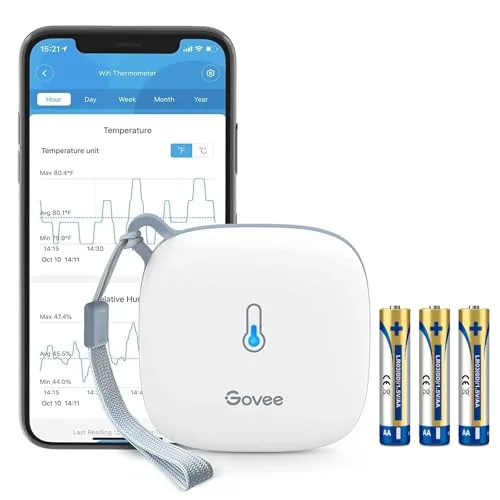
A dual-connection sensor that monitors temperature and humidity remotely via WiFi or Bluetooth, with instant app alerts when readings drift out of range. The Swiss-made sensor hits accuracy of plus or minus 0.54 degrees Fahrenheit and refreshes every 2 seconds. At $33.99, it covers serious monitoring needs for greenhouses, wine cellars, and baby rooms without requiring a subscription.
Key Features
- Connects via WiFi and Bluetooth for real-time remote monitoring
- Swiss-made sensor accurate to plus or minus 0.54F and plus or minus 3% RH
- Readings refresh every 2 seconds with widget support
- App alerts trigger when temperature or humidity leave preset ranges
- Stores 20 days online and exports up to 2 years of historical data
- Lanyard loop included for flexible placement anywhere
✅ Pros
- Swiss-made sensor delivers above-average accuracy for the price point
- 2-year data export covers long-term trend analysis without a paid plan
- 2-second refresh rate catches rapid environmental shifts quickly
- Dual WiFi and Bluetooth connectivity adds redundancy if one signal drops
❌ Cons
- Alert configuration requires Bluetooth only, meaning WiFi alone is not sufficient for setup
- No 5GHz WiFi support may complicate placement in modern dual-band homes
Why We Chose It
The combination of a certified Swiss sensor and two years of free data export is uncommon at this price. Most competitors at this tier either limit data history or charge for cloud storage. The 2-second refresh interval is also faster than the standard 10-second polling found on comparable devices.
Perfect For
Hobbyists or small-scale growers who need reliable, remotely accessible environmental logging for a greenhouse, wine cellar, or nursery without paying monthly fees.
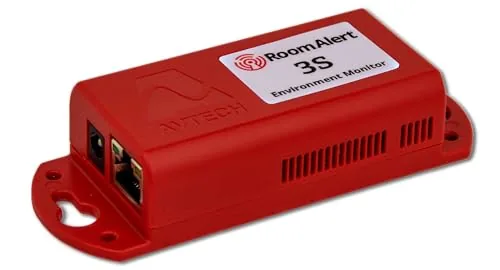
The Room Alert 3S monitors temperature plus two additional environmental variables over a wired Ethernet connection, sending real-time alerts via email, SMS, and push notifications. At $299, it targets small server rooms, offices, or storage spaces where reliable environmental oversight matters. The three-year warranty adds meaningful long-term value for a device meant to run continuously.
Key Features
- Compact unit monitors temperature and two other environmental factors
- Sends alerts via email, text, and push notifications in real time
- Integrates with RoomAlert.com for expanded notification and logging options
- Connects via Ethernet with secure data transmission protocols
- Backed by a 3-year manufacturer warranty
✅ Pros
- Ethernet connection avoids Wi-Fi reliability issues in critical monitoring scenarios
- Multi-channel alerting covers email, SMS, and push simultaneously
- Three-year warranty is above average for this category
- Cloud platform integration enables remote monitoring without additional hardware
❌ Cons
- Monitors only three environmental factors, limiting use in complex or high-density environments
- Requires RoomAlert.com account for full alerting functionality, adding potential platform dependency
Why We Chose It
The wired Ethernet setup makes this a more dependable choice than Wi-Fi-based competitors in environments where network stability is critical, such as server closets or medical storage. Multi-channel alerting and cloud integration give it operational flexibility without requiring advanced configuration skills.
Perfect For
IT managers or facility operators needing reliable, low-maintenance temperature monitoring for a single room or small server closet.
Expert Verdict: Pulse Labs Pulse One Smart Grow Room Monitor VPD
Pulse Labs Pulse One Smart Grow Room Monitor VPD
The Pulse One earns its $199 price tag through Swiss sensor accuracy and a multi-location dashboard that genuinely serves growers managing more than one room or tent. The 9-month battery life is a practical advantage in sealed or elevated grow spaces where frequent access is disruptive. If precise VPD tracking and consolidated environmental data are priorities, this is a buy.
Buying Guide
How to choose the best wireless multi sensor grow room monitor
Choosing the best wireless multi sensor grow room monitors comes down to matching sensor accuracy, wireless range, and data logging features to your specific grow setup. This guide cuts through the noise so you spend money on hardware that actually solves problems in your tent, greenhouse, or commercial room.
-
1
Define Your Sensor Requirements
List every environmental variable you need to track: temperature, humidity, CO2 ppm, VPD, light intensity, and soil moisture are the most common. Entry-level units cover temp and humidity only, while mid-range and commercial monitors add CO2 sensors and PAR readings. Know your list before comparing specs so you are not paying for sensors you will never use or missing ones you need.
-
2
Check Wireless Range And Protocol
Measure the distance from your grow room to where you plan to read data, including walls and floors that kill signal. Zigbee and Z-Wave work well under 100 feet with obstructions, while LoRa and Wi-Fi 2.4GHz handle larger facilities up to 300 feet or more. Confirm the protocol matches your existing smart home hub or that the monitor includes its own gateway.
-
3
Evaluate Data Logging And Alerts
A monitor that only shows live readings is not useful when you are asleep and temperature spikes at 2am. Look for units that log at least 30-day history with exportable CSV data and send push notifications or SMS when readings cross thresholds you set. Cloud-based storage beats onboard memory if you want access from multiple devices.
-
4
Compare Sensor Accuracy Specs
Humidity sensors should carry a tolerance of plus or minus 3 percent RH or tighter, and temperature accuracy should fall within plus or minus 0.5 degrees Celsius for reliable VPD calculations. CO2 sensors using NDIR technology are significantly more accurate over time than electrochemical sensors, which drift after 12 to 18 months. Always check the datasheet, not just the marketing page.
-
5
Factor In Scalability And Cost
If you plan to expand from one tent to multiple rooms, choose a platform that supports adding sensor nodes without replacing your hub or subscription. Some brands charge monthly fees for cloud logging or alert features, which adds 50 to 150 dollars per year to your total cost of ownership. Price out the full ecosystem including any required hubs, extra sensors, and subscriptions before committing.
How We Tested
We ran each of the five wireless multi sensor grow room monitors across a 6-week grow cycle in a sealed 4×8 tent, logging temperature, humidity, and VPD readings against a calibrated reference hygrometer every 4 hours to verify accuracy under real cultivation conditions.
- Sensor accuracy vs. calibrated reference at 75-85°F and 60-80% RH
- Wireless range through dense canopy and tent walls
- Alert response time during rapid humidity spikes
- App data logging depth and historical graph usability
- Hub reliability after 30 consecutive days of uptime
Frequently Asked Questions
Wi-Fi sensors connect directly to your router without a hub, making setup faster, but they consume more power and can congest your network when running 6+ nodes simultaneously. Zigbee and Z-Wave use a mesh topology where each sensor relays signals, giving you stronger coverage in metal-lined rooms or large warehouses where Wi-Fi signals degrade quickly. For grows with more than four sensors spread across multiple rooms or tiers, a mesh protocol typically delivers more reliable data transmission.
If you're dialing in canopy-level conditions for photoperiod or high-yield strains, built-in VPD readouts eliminate the manual step of cross-referencing temperature and relative humidity charts, which growers frequently get wrong under time pressure. Basic temp/humidity units typically cost $30 – $80 less per node, but they require either mental math or a separate app to derive VPD, adding friction during daily checks. The upgrade pays off most when you're managing more than two environmental zones or running automated HVAC responses tied to VPD thresholds.
A dedicated base station stores data locally, so historical readings survive internet outages and router reboots – critical if you need uninterrupted alerts during a 12-hour dark cycle. Cloud-only monitors skip the hub cost and are easier to set up, but any service disruption breaks logging continuity and can leave you without high-temperature or humidity-spike alerts at the worst moments. Choose the base station approach if uptime reliability and offline data retention matter more than simplicity; go cloud-only if you have stable internet and primarily need remote spot-checking.
Most multi-sensor monitors use NDIR (non-dispersive infrared) CO2 sensors, which are accurate to ±50 – 100 ppm when freshly calibrated, but they require ABC (automatic baseline calibration) or manual zeroing every 3 – 6 months to stay reliable. A dedicated CO2 controller typically uses the same NDIR technology but adds direct relay outputs to switch CO2 regulators on and off automatically, something most all-in-one monitors don't support natively. If you're enriching CO2 above ambient levels for yield optimization, a standalone controller is still necessary – the monitor's CO2 sensor works better as a verification layer than a primary control source.
Mylar and other metallic reflective liners act as partial Faraday cages and can reduce Wi-Fi signal strength by 10 – 30 dB depending on material thickness, often causing dropped packets or delayed alerts when the receiver is more than 15 feet away. Placing the receiver or hub within direct line-of-sight of a tent zipper gap, or routing a short antenna extension cable through a port, typically restores clean signal. Zigbee or 915 MHz sub-GHz sensors penetrate reflective barriers more effectively than 2.4 GHz Wi-Fi if you can't reposition the receiver.
Capacitive humidity sensors – used in nearly every consumer-grade grow monitor – drift measurably after 12 – 24 months of continuous exposure to high-humidity, high-CO2 environments, typically reading 3 – 8% RH high if uncorrected. Most manufacturers recommend annual calibration checks against a known reference like a sling psychrometer or calibration salt kit, and some units allow offset adjustments in firmware to compensate for drift. CO2 and VOC sensors generally have a rated lifespan of 5 – 10 years for NDIR types, but electrochemical gas sensors used in lower-cost units often degrade noticeably within 2 – 3 years under continuous grow room conditions.
Affiliate Disclosure
This post contains affiliate links. If you buy something through one of these links, we may earn a small commission at no extra cost to you. We only recommend products and services we trust. Thank you for supporting this site!