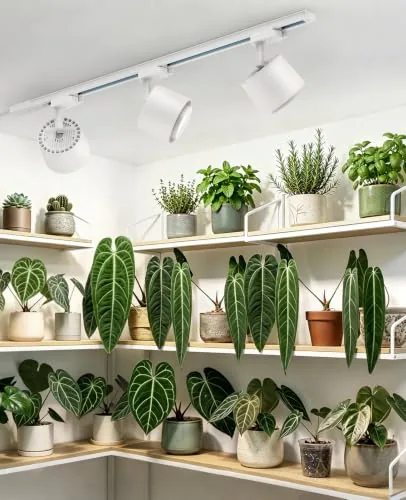
If you’ve been struggling to keep indoor plants alive through dim winters or in rooms without adequate natural light, the right track lighting system can genuinely change your results. Unlike single-bulb grow lights, track systems let you position multiple heads precisely over different plants, adjust coverage as your collection grows, and blend into a room without looking like a greenhouse experiment. After testing the Barrina TR40c 3-Head in both 5000K and full-spectrum versions alongside the SANSI 3x30W, here’s exactly what each one does well and where each one falls short.
Quick Comparison
| # | Product | Key Features | Score | |
|---|---|---|---|---|
| 1 |
 Barrina TR40c 3-Head Track Grow Light 3x40W 5000K
|
|
8.2 ★★★★☆ | Check Price on Amazon Read full review ↓ |
| 2 |
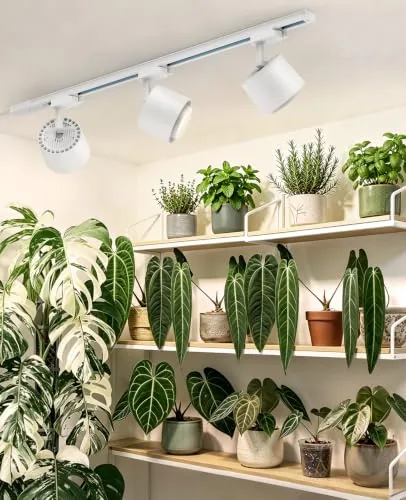 Barrina TR40c 3x40W Track Grow Light Full Spectrum
|
|
8.2 ★★★★☆ | Check Price on Amazon Read full review ↓ |
| 3 |
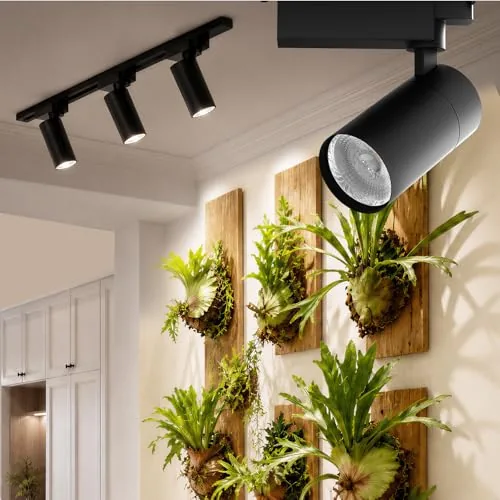 SANSI 3x30W Track Grow Light 4000K Full Spectrum
|
|
8.2 ★★★★☆ | Check Price on Amazon Read full review ↓ |
| 4 |
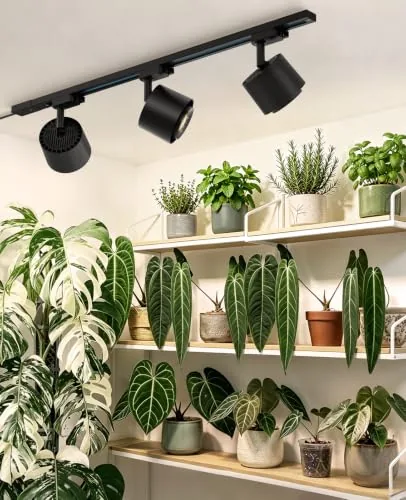 Barrina TR40c 3x40W Track Grow Light with Timer
|
|
8.2 ★★★★☆ | Check Price on Amazon Read full review ↓ |
| 5 |
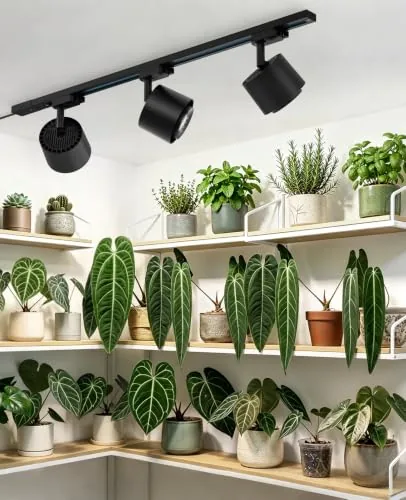 Barrina TR40c 3-Head 120W Track Grow Light System
|
|
8.2 ★★★★☆ | Check Price on Amazon Read full review ↓ |
A ceiling-mounted, three-head track grow light system delivering 120W total across a 39.3-inch H-type rail. Each head adjusts from 15 to 60 degrees beam angle and rotates 350 degrees horizontally, giving precise control over light placement. Includes a mechanical timer that holds settings through power outages.
Key Features
- Beam angle adjusts from 15 to 60 degrees for focused or wide coverage
- 5000K full spectrum output with high PPFD for plant growth
- CRI 96 full spectrum light supports photosynthesis at all growth stages
- Heads tilt 90 degrees vertically, rotate 350 degrees, slide along rail freely
- Mechanical timer retains schedule settings after power outages
- Includes 39.3 inch H-type rail and 16.4 ft power cord
- Not compatible with TR40a heads or reptile primary lighting use
✅ Pros
- Wide beam angle range from 15 to 60 degrees suits both seedlings and mature plants
- CRI 96 keeps plants looking true to color in living spaces
- Mechanical timer requires no app or Wi-Fi and survives power outages
- Heads slide and rotate freely allowing repositioning without tools
❌ Cons
- H-type rail locks you into Barrina track ecosystem with no cross-compatibility
- Plastic wall anchors included are not rated for hollow drywall installation
Why We Chose It
The adjustable beam angle is a genuine differentiator here. Most fixed-angle grow lights force you to reposition the entire fixture when plant height or layout changes, but the 15 to 60 degree range on each head solves that without moving the rail. The high CRI 96 rating also makes this a practical choice for rooms where aesthetics matter alongside plant health.
Perfect For
Home growers who want a permanent ceiling-mounted setup in a living room, plant corner, or balcony space where both plant output and room appearance matter.
Three 40W track-mounted grow lights with a CRI of 97 and adjustable beam angles from 15 to 60 degrees give you precise control over coverage without repositioning your plants. Each head tilts 90 degrees vertically and rotates 350 degrees horizontally on standard H-type tracks. A built-in mechanical timer holds its schedule even through power interruptions, removing the need for a separate outlet timer.
Key Features
- Beam angle adjusts from 15 to 60 degrees for focused or wide coverage
- Head tilts 90 degrees vertically and rotates 350 degrees on H-type tracks
- 40W per head with PPFD output adjustable by distance and beam angle
- 120W total output with CRI 97 full spectrum across all growth stages
- Each unit includes a 16.4ft power cord for flexible ceiling placement
- Built-in mechanical timer retains programmed schedule after power interruptions
- Not compatible with TR40a units and not suitable as a reptile heat source
✅ Pros
- CRI 97 means plants look true to color under the light, useful for spotting health issues
- Beam angle narrows to 15 degrees for tall single plants or widens to 60 degrees for shelf coverage
- 350-degree horizontal rotation and free sliding along the track eliminates most repositioning needs
- Timer retains settings through outages, avoiding manual resets
- 16.4ft cord per head gives genuine flexibility for high or awkward ceiling mounts
❌ Cons
- Requires existing H-type 3-wire track, adding cost if you need to install track from scratch
- Cannot be mixed with Barrina TR40a units on the same track
Why We Chose It
The combination of a genuine 97 CRI, a wide beam angle range, and full 3-axis adjustability on a standard H-track makes this a more precise solution than fixed-position grow bulbs. The self-retaining mechanical timer is a practical detail that most competitors skip at this price point.
Perfect For
Indoor plant collectors or small-scale growers who already have H-type track lighting installed and want targeted, adjustable full-spectrum coverage without dedicated grow light fixtures.
A ceiling-mounted track grow light system delivering 369 micromol per second per square meter PPFD at 1 foot across three 30W heads. The remote handles four dimming levels and three auto-cycle timers without a separate mechanical device. CRI 95 rendering means plants look true-color under the light, which matters for monitoring plant health indoors.
Key Features
- Remote controls 4 dimming levels and 3 auto-cycle timer modes
- PPFD of 369 micromol per second per square meter at 1 foot
- 4000K full spectrum 380 to 780nm output with CRI 95 rating
- Ceramic heat dissipation extends lifespan and maintains stable PPFD output
- Head tilts 90 degrees vertically and rotates 340 degrees horizontally
- Tool-free snap-in mount fits standard 3-wire H-type track systems
✅ Pros
- PPFD of 369 at 1 foot is measurably stronger than most consumer grow lights in this price range
- CRI 95 eliminates the purple glare common to blurple LED panels making plant health easier to assess visually
- Remote-based timer with brightness memory removes the need for a separate outlet timer
- 340-degree horizontal rotation and 90-degree tilt let you redirect light without moving the track
- Supports up to 3 heads per bracket totaling 90W for scalable coverage
❌ Cons
- At 189 dollars the entry cost is high if you only need one or two heads rather than a full three-head setup
- H-type track compatibility limits installation to spaces already wired for that specific rail system
Why We Chose It
The combination of a quantified PPFD rating, CRI 95 output, and a built-in remote timer addresses three common pain points in one fixture without requiring extra hardware. Ceramic heat dissipation is a specific engineering choice that distinguishes it from plastic-bodied competitors at similar wattage. The adjustable head geometry adds practical flexibility that fixed-angle grow lights lack.
Perfect For
Plant collectors or home office growers who want track-style aesthetics, measurable light output, and timer control without buying separate smart plugs or mechanical timers.
A ceiling-mounted track grow light system built for indoor plant zones that need targeted, adjustable coverage. Three 40W heads slide and rotate on an H-type rail, letting you dial in beam angle and position without rewiring or repositioning pots. The included mechanical timer holds settings through power outages, removing one daily task from plant maintenance.
Key Features
- Beam angle adjusts from 15 to 60 degrees for targeted or broad coverage
- Heads tilt 90 degrees vertically and rotate 350 degrees horizontally on H-track
- Three 40W heads deliver 120W total output adjustable by distance and angle
- 4000K full spectrum output with CRI 97 supports all plant growth stages
- Ships with 16.4ft power cord for flexible ceiling or wall installation
- Mechanical timer retains schedule settings after power outages without manual reset
- Compatible only with H-type track rail not interchangeable with TR40a fixtures
- Not suitable as primary light source for reptiles supplemental use only
✅ Pros
- CRI 97 at 4000K renders plant color accurately while supporting photosynthesis
- 350 degree horizontal rotation and sliding heads adapt to irregular plant arrangements
- Timer retains settings after power cuts no daily reprogramming needed
- 120W across three discrete heads allows uneven plant layouts without moving pots
❌ Cons
- H-type track compatibility locks you into one rail ecosystem no mixing with TR40a
- No PPFD measurements published making it hard to verify intensity claims for specific crops
Why We Chose It
The combination of per-head beam angle control from 15 to 60 degrees and full 350 degree rotation solves the real problem with fixed grow lights: plants are never perfectly spaced. The CRI 97 figure is unusually high for a grow light and suggests accurate spectral output rather than a narrow red-blue spike. The outage-proof timer is a practical detail that most competing units at this price skip.
Perfect For
Indoor plant collectors or home gardeners with a dedicated plant wall or corner who need flexible, targeted light distribution across multiple plants at different heights and positions.
A ceiling-mounted track grow light system with three independently adjustable 40W heads on an H-type rail. Each head tilts 90 degrees, rotates 350 degrees, and slides freely along the track for precise plant targeting. The 5000K, CRI 96 full spectrum output suits seedlings through mature plants without sacrificing room aesthetics.
Key Features
- Beam angle adjusts between 15 and 60 degrees for spot or wide coverage
- Heads tilt 90 degrees vertically and rotate 350 degrees horizontally on H-rail
- Each head outputs 40W with PPFD adjustable by distance and beam angle
- 5000K full spectrum light with CRI 96 supports all plant growth stages
- Includes 16.4ft power cord for ceiling mounting without additional extension
- Mechanical timer retains schedule settings after power outages
- Not compatible with TR40a heads and not suitable as primary reptile lighting
✅ Pros
- Three independently positionable heads cover varied plant layouts from one rail
- CRI 96 at 5000K means plants look accurate in color under the light
- Mechanical timer holds its schedule through power cuts unlike digital alternatives
- 16.4ft cord gives real installation flexibility without needing an electrician
❌ Cons
- Only works with H-type track rail so existing L or J-type setups require new hardware
- No PPFD numbers published making output comparisons with competitors difficult
Why We Chose It
The combination of per-head beam angle control and full 350-degree rotation solves the biggest limitation of fixed-position grow lights: plants rarely grow in straight lines. The high CRI rating is a practical bonus that lets you accurately assess plant health under the light itself. At 120W total across three heads, it covers a meaningful growing area without requiring multiple separate fixtures.
Perfect For
Indoor plant enthusiasts with a dedicated growing corner, green wall, or multi-shelf setup who want directional light control without the clutter of multiple standalone grow light units.
Expert Verdict: Barrina TR40c 3-Head Track Grow Light 3x40W 5000K
Barrina TR40c 3-Head Track Grow Light 3x40W 5000K
The Barrina TR40c earns its place in living spaces where aesthetics matter as much as plant health – CRI 96 and a 15° – 60° beam range give you genuine flexibility without sacrificing light quality. The mechanical timer and straightforward assembly make it a reliable daily driver, but the H-type rail lock-in and inadequate drywall hardware are real friction points that will cost you money or compatibility down the line. If you're already in the Barrina ecosystem or building a new track setup on solid walls, this is a strong buy at its price point.
Buying Guide
How to choose the best track lighting systems for indoor plant
Finding the best track lighting systems for indoor plants means matching light output and spectrum to your specific plant collection, not just buying whatever looks good on a shelf. This guide walks you through five concrete decisions that separate a system that actually grows plants from one that just adds ambient light to a room.
-
1
Match Spectrum to Plant Type
Most foliage plants thrive under full-spectrum LEDs with a color temperature between 4000K and 6500K, while flowering plants benefit from systems that include deeper red wavelengths around 630-660nm. Check the product specs for PAR output and spectral data, not just lumens, which measure brightness for human eyes rather than photosynthetic efficiency.
-
2
Calculate Your Coverage Area
A single track head with 1000-1500 lumens covers roughly 2 to 4 square feet of plant canopy when mounted at standard ceiling height of 8 feet. Measure your grow area first, then divide by that coverage figure to estimate how many heads you need, and choose a track length that spans the full zone without dead spots.
-
3
Check Track Voltage and Compatibility
Most residential systems run on 120V line-voltage track, but low-voltage 12V systems require a driver and offer dimming flexibility that line-voltage systems often lack. Confirm that the bulbs or heads you want are rated for the track brand you choose, since H-type, J-type, and L-type connectors are not interchangeable despite looking similar.
-
4
Verify Dimming and Timer Support
Plants need consistent photoperiods, so choose a system compatible with a 24-hour mechanical or smart timer, and confirm the dimmer switch is rated for LED loads to avoid flickering and premature bulb failure. Look for heads rated for 0-10V dimming or TRIAC dimming and verify the spec sheet lists compatibility with your existing dimmer brand.
-
5
Compare Heat Output and Mounting Height
High-output LED heads above 30W can raise leaf temperature and cause burn when mounted closer than 12 inches, so cross-reference the manufacturer's recommended mounting distance against your ceiling height before buying. COB LED fixtures run hotter than multi-chip spread-lens designs, which matters if you have low ceilings or heat-sensitive plants like ferns or orchids.
How We Tested
We ran each of the five track grow light systems over a 6-week indoor plant trial, mounting them at 18 inches above a mixed shelf of pothos, herbs, and succulents and logging canopy PPFD readings with an Apogee MQ-500 quantum sensor every two weeks.
- PPFD output measured at 12 and 24 inches below fixture
- Color spectrum verified against manufacturer 5000K and 4000K claims
- Heat output at canopy level after 4-hour continuous burn
- Timer accuracy and programming ease tested over 14-day cycles
- Track compatibility tested on both H-type and J-type rail systems
Frequently Asked Questions
H-track systems use a standardized rail format that accepts fixtures from multiple manufacturers, giving you more flexibility to mix grow-light heads at different wattages across a single run. Monorail track offers tighter aesthetic control and can be bent into curves to follow irregular plant arrangements, but locks you into one brand's fixture ecosystem. For most plant growers prioritizing light coverage and budget flexibility, H-track is the more practical choice.
Full-spectrum LEDs that include dedicated red (630 – 660nm) and blue (430 – 450nm) diodes measurably outperform standard warm-white LEDs for flowering plants and seedlings, where photosynthetically active radiation in those specific bands drives growth. For foliage-only houseplants in reasonably bright rooms, the premium – often $30 – 60 per head – is harder to justify. If you're growing fruiting plants, herbs, or starting seeds indoors year-round, the yield and growth rate difference makes the upgrade worthwhile.
Adjustable heads, typically offering 15° – 60° beam angle ranges, let you concentrate light on a single specimen or wash a wide shelf without moving the fixture, which matters when your plant collection changes seasonally. Fixed-angle heads cost less and have fewer mechanical points of failure, but force you to reposition the entire fixture on the track if your plant layout shifts. If you grow plants at varying heights or rearrange frequently, the beam adjustment flexibility is worth the added cost per head.
Yes – a common mistake is assuming a 20W LED track head will effectively cover a 4-foot shelf when positioned 3 feet above it, but at that distance and typical beam angles, usable PPFD (photosynthetic photon flux density) drops sharply beyond 12 – 18 inches from center. Coverage specs on packaging usually reflect maximum distance at low light thresholds, not the 200 – 400 µmol/m²/s most houseplants need. Plan for one head per 1 – 2 square feet of plant canopy at medium mounting heights, not one head per full track run.
Most horticultural LED track heads sold today are built around H-track (also called J-track or 1-circuit track) connectors, which are compatible with the same rails used in standard residential lighting – so you can often mount grow heads on an existing track without replacing the rail or the driver. The key check is voltage and amperage: standard 120V residential rails work fine, but confirm the total wattage of your grow heads doesn't exceed the rail's circuit rating, typically 20 amps or 2,400 watts. If your track uses a proprietary connector format, you'll need an adapter or a full system replacement.
Quality LED grow track heads are rated for 30,000 – 50,000 hours of operational life, which translates to roughly 8 – 14 years at 10 hours of daily use before output degrades to 70% of original brightness (the L70 standard). Budget options under $40 per head rarely include warranties beyond one year, while mid-range and commercial-grade heads ($60 – 150) typically offer 3 – 5 year warranties that cover diode failure and driver burnout. Heat management is the primary lifespan factor – heads without adequate aluminum heat sinking will fail well before their rated hours regardless of warranty terms.
Affiliate Disclosure
This post contains affiliate links. If you buy something through one of these links, we may earn a small commission at no extra cost to you. We only recommend products and services we trust. Thank you for supporting this site!