Finding the best master environmental controllers for grow rooms comes down to three things: how many devices you can automate, how precisely you can dial in temperature and humidity, and whether the system gives you real data or just basic on/off switching. After hands-on testing, three controllers stood out from the pack – the TrolMaster HCS-2 Hydro-X Pro 4-in-1, the MARS HYDRO iControl Smart Grow Room Climate Controller, and the iPonic 624 Dual-Zone – each built for different grower needs and budget levels. Whether you’re running a single tent or a commercial multi-zone facility, this breakdown will tell you exactly which one fits your setup.
Quick Comparison
| # | Product | Key Features | Score | |
|---|---|---|---|---|
| 1 |
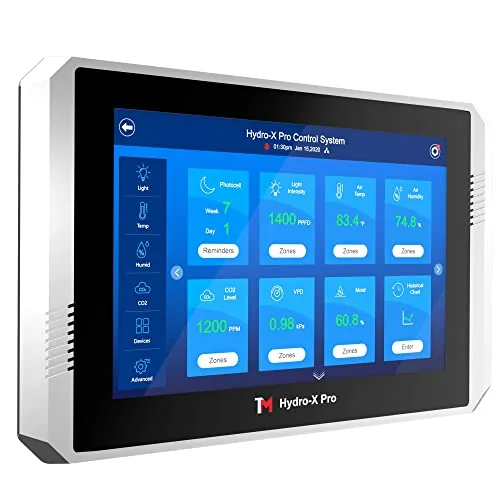 TrolMaster HCS-2 Hydro-X Pro 4-in-1 Env Controller
|
|
8.7 ★★★★☆ | Check Price on Amazon Read full review ↓ |
| 2 |
 MARS HYDRO iControl Smart Grow Room Climate Controller
|
|
8.5 ★★★★☆ | Check Price on Amazon Read full review ↓ |
| 3 |
 iPonic 624 Dual-Zone Hydroponic Environment Controller
|
|
8.5 ★★★★☆ | Check Price on Amazon Read full review ↓ |
| 4 |
 TrolMaster HCS-3 Hydro-X Plus 4-in-1 Sensor Controller
|
|
8.5 ★★★★☆ | Check Price on Amazon Read full review ↓ |
| 5 |
 VIVOSUN GrowHub E42A+ WiFi Grow Tent Controller
|
|
8.2 ★★★★☆ | Check Price on Amazon Read full review ↓ |
| 6 | TrolMaster HCS-1 Hydro-X Climate and Light Controller |
|
8.2 ★★★★☆ | Check Price on Amazon Read full review ↓ |
| 7 |
 Platinum Horticulture 4-Outlet HID Relay Controller 4000W
|
|
8.2 ★★★★☆ | Check Price on Amazon Read full review ↓ |
| 8 |
 Inkbird IHC200 Dual-Stage Humidity Controller Pre-Wired
|
|
8.2 ★★★★☆ | Check Price on Amazon Read full review ↓ |
| 9 |
 VABIRA VBR-C200 WiFi Grow Light Controller 0-10V Dimming
|
|
7.8 ★★★★☆ | Check Price on Amazon Read full review ↓ |
The HCS-2 is a commercial-grade grow room controller that monitors temperature, humidity, CO2, and light from a single 10-inch touchscreen. It scales to 50 sensors and 50 control modules, making it practical for multi-room or multi-tier operations. At $2,650 it is a serious capital investment, but the feature depth justifies the cost for professional cultivators.
Key Features
- Controls most commercial horticultural lighting fixtures on the market
- 10-inch touchscreen with web-based software for remote access
- Supports up to 50 sensors and 50 independent control modules
- 4-in-1 sensor measures temperature, humidity, CO2, and light levels
- Independent variable control with programmable ramp-up and ramp-down curves
- Built-in calendar for multi-week crop recipe scheduling
- Mobile app enables remote monitoring with day and night limit alerts
✅ Pros
- Scales to 50 sensors, suitable for large multi-room facilities
- 4-in-1 sensor reduces wiring complexity and hardware cost
- Programmable ramp curves allow precise VPD and CO2 management
- Multi-week crop recipe calendar eliminates manual daily adjustments
- Web and app access means no on-site presence required for monitoring
❌ Cons
- $2,650 entry price excludes hobbyists and small single-tent growers
- App and web platform reliability depends on TrolMaster server uptime
Why We Chose It
The HCS-2 stands out because it combines sensor capacity, scheduling depth, and lighting compatibility in one integrated system rather than requiring third-party bridges. The 50-module ceiling and crop recipe calendar address real operational needs in commercial cultivation that entry-level controllers cannot meet. Remote access via app and web browser adds practical value for facilities with multiple staff or off-site management.
Perfect For
Commercial cannabis or specialty crop cultivators managing multiple rooms or growth stages who need centralized environmental control with audit-ready scheduling.
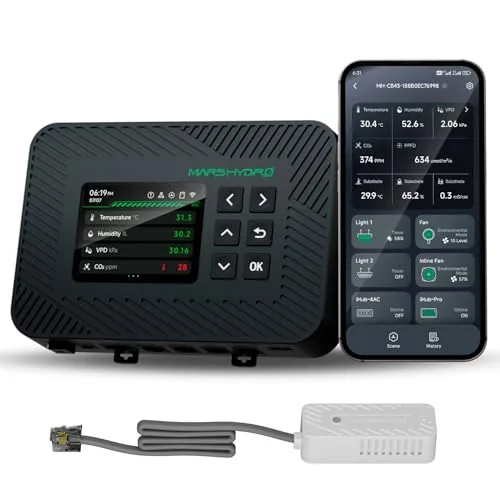
The iControl automates temperature, humidity, and VPD management across all growth stages using sensor-driven fan and humidifier control. At $49.99 it packs stage-based scheduling and remote app monitoring into a package that rivals controllers costing twice as much. The included sensor bundle and RJ12 splitters mean most growers can be up and running without buying extra cables.
Key Features
- Adjusts fans and humidifiers automatically based on real-time VPD data
- Stage-based presets for seedling, vegetative, and flowering phases with auto-transitions
- Optional PPFD, soil, and CO2 sensors sold separately expand automation capabilities
- App provides real-time monitoring, data logs, and instant alerts from anywhere
- Includes 3-in-1 temp/humidity/light sensor, 4 RJ12 splitters, and 8 RJ12 cords
✅ Pros
- Automated VPD control removes manual guesswork across the entire grow cycle
- Stage-based scheduling handles light and climate transitions without user intervention
- App alerts cover critical failures like temperature spikes and low humidifier water
- Generous cable and splitter bundle covers most single-tent setups out of the box
- Two-year support period is longer than most competitors in this price range
❌ Cons
- PPFD, soil, and CO2 sensors cost extra despite being central to the marketing pitch
- RJ12 device compatibility limits which fans and humidifiers work without adapters
Why We Chose It
At $49.99 this controller delivers automated VPD tracking and multi-stage grow scheduling that typically appear in controllers priced above $100. The included hardware bundle reduces day-one add-on purchases, and the two-year support window adds real long-term value. It earns its score by solving specific grower pain points with measurable automation rather than vague smart-home promises.
Perfect For
Home growers running a single tent who want hands-off climate control across seedling through flowering without spending more than $50 on the base unit.
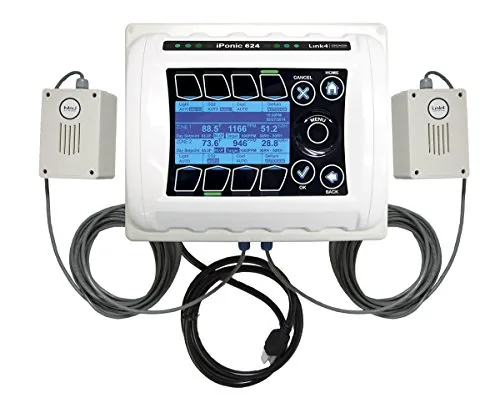
The iPonic 624 gives serious hydroponic growers independent control over two grow zones, each with its own temperature, humidity, and CO2 setpoints. Nine programmable outlets cover CO2 devices, dehumidifiers, lights, and fans in a single unit. Built-in data logging and remote smartphone access make troubleshooting and monitoring straightforward without requiring a separate hub or subscription device.
Key Features
- Controls 2 fully independent zones with dedicated sensors per zone
- 9 programmable outlets for CO2, lights, fans, and custom devices
- Each zone has separate day and night setpoints for CO2, temp, humidity
- Two combo sensors measure temperature, humidity, CO2, and light levels
- 16 ft sensor cables included with optional extension available
- USB drive supports onboard data logging and settings backup
- Touch screen display auto-dims with graphing built directly into controller
- Email and text alerts plus full remote access via smartphone
- Fuzzy logic CO2 control with exhaust fan shutoff during CO2 dosing
- Dual bank light control and UL approved 120V 15A input with resettable breaker
✅ Pros
- Two fully independent zones in one controller eliminates the need for two separate units
- Onboard graphing and USB data logging enable direct troubleshooting without extra software
- Communication card included at purchase so remote monitoring works out of the box
- Fuzzy logic CO2 control reduces overshoot and wasted CO2 compared to simple on-off switching
❌ Cons
- At 1195 dollars this is a significant upfront investment suited to commercial or large-scale setups rather than hobbyist use
- Runs on 120V 15A only so growers with 240V heavy-load equipment will need separate power management
Why We Chose It
The iPonic 624 stands out because it handles two genuinely independent grow zones with separate environmental logic, not just mirrored settings. The combination of onboard data logging, fuzzy logic CO2 control, and included communication card delivers capabilities that typically require multiple devices from competing brands. For growers running vegetative and flowering rooms simultaneously, this level of zone isolation is directly tied to yield consistency.
Perfect For
Commercial or semi-commercial hydroponic growers running two separate grow rooms or distinct growth stages who need precise, independently managed environmental control under one controller.
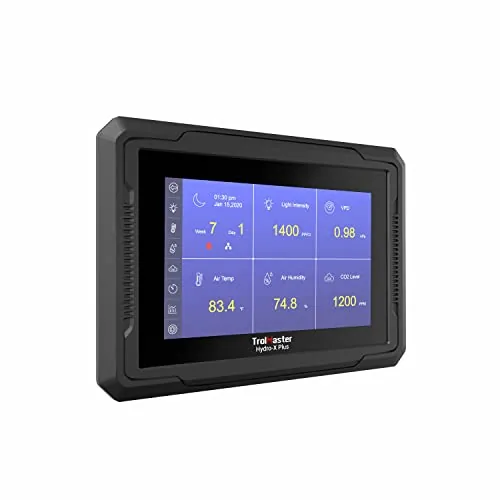
The HCS-3 Hydro-X Plus consolidates temperature, humidity, CO2, and light monitoring into a single wired controller with smartphone app access. It is built for growers who need precise, automated environmental control across multiple zones. At $1,259, it targets serious indoor cultivators rather than casual hobbyists.
Key Features
- Monitors temp, humidity, CO2, and light via single 4-in-1 sensor
- Smartphone app included for remote monitoring and control
- Cable set included for out-of-box connectivity
✅ Pros
- Single sensor handles four environmental variables, reducing hardware clutter
- App-based remote control allows adjustments without being on-site
- Modular cable system simplifies installation and future expansion
- Centralized control reduces reliance on multiple standalone devices
❌ Cons
- At $1,259 the upfront cost is high for small or single-tent grows
- Wired architecture limits placement flexibility compared to wireless alternatives
Why We Chose It
The HCS-3 stands out by combining four critical environmental sensors into one unit, cutting down on sensor calibration points and wiring complexity. The included cable set and free app make it a complete package rather than a base unit requiring costly add-ons.
Perfect For
Commercial or large-scale indoor growers who need centralized, automated environmental control across multiple grow spaces.
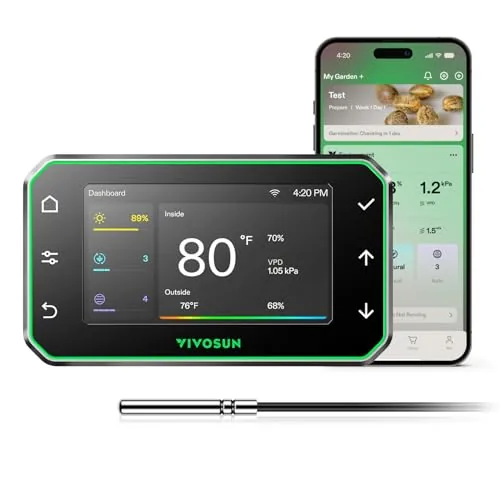
The E42A+ centralizes control of fans, lights, and climate into one app-connected hub, letting you automate every growth stage from your phone. It reads internal and external temperature and humidity simultaneously via built-in gauge and probe. At $89.99 it competes directly with more expensive controllers by offering VPD tracking and scheduled lighting control in one unit.
Key Features
- Unifies smart grow devices into one centralized control platform
- Monitors internal and external temp and humidity via built-in gauge and probe
- Automates fan speed, airflow, light intensity, spectrum, and on/off schedules
- Customizable LED display with capacitive buttons, mounts directly to tent fabric
- WiFi-enabled app control with Grow Recipes and advanced programming settings
- Type-C to MOLEX and AUX converters expand fan compatibility; RJ11 supports VS lights
✅ Pros
- Controls lighting, ventilation, and climate from a single app interface
- Dual-environment monitoring tracks both inside and outside the tent simultaneously
- VPD readout helps dial in precise vapor pressure deficit targets per growth stage
- Mounts directly to tent fabric without a bracket, saving space and reducing clutter
❌ Cons
- RJ11 lighting control is limited to VS series and select compatible brands
- WiFi dependency means full functionality requires a stable home network
Why We Chose It
The E42A+ earns its place by combining VPD monitoring, dual-zone climate sensing, and multi-device automation at under $90, a price point where most competitors offer only basic timer functions. The fabric-mount design and Type-C to MOLEX adapters show attention to real tent setups rather than lab conditions.
Perfect For
Hobbyist or intermediate indoor growers running a full tent setup with VIVOSUN or compatible fans and lights who want automated stage-by-stage environmental control without a multi-controller mess.
The TrolMaster Hydro-X HCS-1 gives indoor growers centralized control over lighting, temperature, and humidity from a single unit. The bundled 3-in-1 sensor captures all three environmental variables without extra hardware purchases. A free mobile app adds remote monitoring without a subscription fee.
Key Features
- Controls most commercial horticultural lighting fixtures on the market
✅ Pros
- 3-in-1 sensor covers temperature, humidity, and light in one probe
- Compatible with a wide range of third-party grow lights without proprietary lock-in
- Free mobile app enables remote monitoring and adjustments
- Complete cable set included so no additional wiring accessories needed
❌ Cons
- 345 dollar price point is a significant upfront investment for small-scale growers
- Single-unit failure could disrupt control of multiple connected systems simultaneously
Why We Chose It
The HCS-1 stands out because it consolidates three sensor functions into one device while remaining compatible with most major lighting brands, which reduces both hardware clutter and compatibility headaches. The included cable set and free app mean the out-of-box experience requires minimal additional spending.
Perfect For
Serious indoor growers running 4 or more lights who want centralized environmental control without paying ongoing subscription fees.
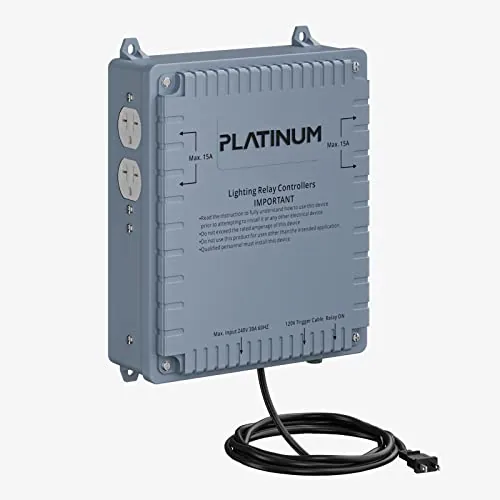
A dedicated relay controller that separates your heavy HID lighting load from your timer, protecting both equipment and reducing fire risk. Handles four 1000W lights simultaneously across 120V or 240V setups. The included trigger cord connects directly to most 24-hour timers or environmental controllers without rewiring.
Key Features
- Controls up to 4000W total across four 1000W outlets
- Accepts 120V or 240V main power input
- Industrial grade relays rated for 100,000 minimum operations at full load
- Trigger cord compatible with standard 24-hour timers and environmental controllers
✅ Pros
- Dual voltage support covers both 120V and 240V grow room configurations
- 100,000 rated relay cycles translates to years of daily switching use
- Plug-and-play trigger cord removes need for hardwiring to a timer
- Four independent outlets allow staged or simultaneous light control
❌ Cons
- No built-in timer so a separate timer or controller is still required
- 1000W per outlet cap limits use with double-ended 1500W or 2000W fixtures
Why We Chose It
The 100,000-cycle relay rating and industrial-grade components set this apart from budget relay strips that fail within a season of daily use. Dual voltage compatibility makes it usable in both standard home circuits and dedicated 240V grow room wiring without buying a second unit.
Perfect For
Indoor growers running two to four 1000W HID lights who want to protect their timer from high-amperage switching loads.
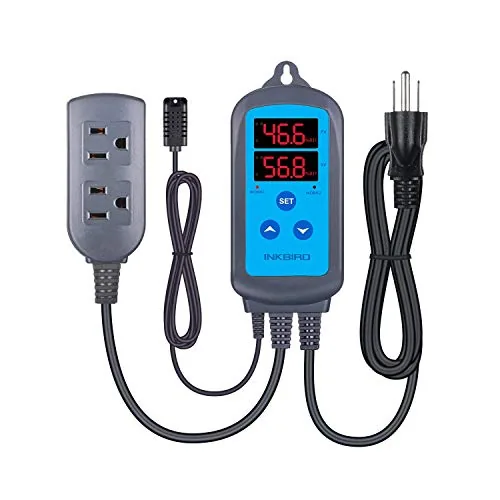
The IHC200 handles both humidification and dehumidification from a single pre-wired unit, switching modes automatically based on your target level. It covers a 5 to 99.99% RH range with plus or minus 3% accuracy and supports manual calibration. At under $45, it delivers controller functionality typically found in units costing significantly more.
Key Features
- Controls humidity from 5 to 99.99% RH with digital display
- Accuracy rated at plus or minus 3% RH with calibration support
- Dual outlet design supports one humidifier and one dehumidifier simultaneously
- Automatically switches between humidification and dehumidification modes
- Compatible with mushroom tents, greenhouses, grow tents, and reptile enclosures
✅ Pros
- Pre-wired dual outlets eliminate the need for extra wiring or adapters
- Automatic mode switching removes manual intervention between humidity cycles
- Calibration support lets you correct sensor drift over time
- Wide 5 to 99.99% RH range suits both arid reptile setups and high-humidity mushroom grows
❌ Cons
- Plus or minus 3% RH accuracy is adequate but not suitable for precision laboratory or commercial applications
- No onboard data logging or app connectivity for remote monitoring
Why We Chose It
The IHC200 stands out because it combines two independently controlled outlets into one affordable unit, removing the need to buy separate controllers for humidifying and dehumidifying. The calibration feature adds practical long-term value that many budget controllers skip entirely.
Perfect For
Home growers cultivating mushrooms or maintaining reptile enclosures who need reliable automatic humidity control without complex wiring or a high price tag.
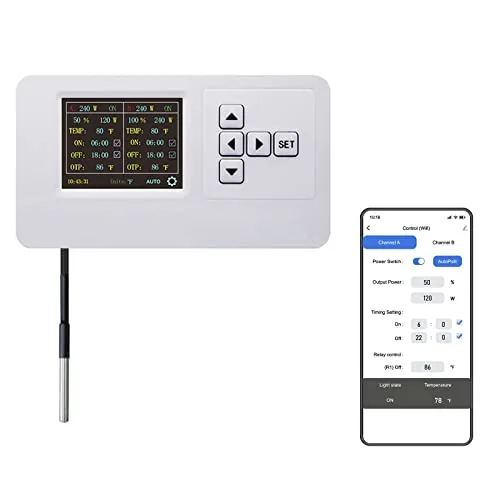
The VBR-C200 gives indoor growers precise, automated control over two lighting circuits via a 2.4GHz WiFi connection. Scheduling, dimming, sunrise and sunset simulation, and temperature-triggered shutoff are all handled from one device. At $163.80 it targets serious hobbyists and small commercial growers who want reliable automation without custom wiring.
Key Features
- Controls 2 light circuits, up to 50 lights each via RJ11 or RJ14
- Simulates sunrise and sunset with up to 60-minute gradual ramp
- Schedules different power levels per growth stage on a timed program
- Reduces or cuts light power automatically when temperature exceeds set threshold
✅ Pros
- Dual-circuit control covers large grow rooms from a single unit
- 0-10V dimming plus stage-based scheduling replaces multiple timers and dimmers
- High-temperature shutoff adds passive safety without external sensors
- Compatible with both RJ11 and RJ14 ports for broader fixture compatibility
❌ Cons
- 2.4GHz only means no 5GHz band support which can crowd busy networks
- At $163.80 it costs more than basic timer controllers with fewer grow-specific features
Why We Chose It
The VBR-C200 stands out by combining grow-stage programming, sunrise and sunset simulation, and thermal protection in one WiFi-connected unit. Most controllers at this price handle only on and off timing, while this one manages gradual dimming curves and temperature response. That combination meaningfully reduces manual intervention during a full grow cycle.
Perfect For
Small to mid-scale indoor growers running 0-10V dimmable fixtures who want automated stage-based light schedules and thermal safety without a full building automation system.
Expert Verdict: TrolMaster HCS-2 Hydro-X Pro 4-in-1 Env Controller
TrolMaster HCS-2 Hydro-X Pro 4-in-1 Env Controller
The HCS-2 Hydro-X Pro earns its price tag specifically in facilities where environmental inconsistency across multiple rooms is costing yield – the 50-sensor ceiling, consolidated 4-in-1 hardware, and VPD ramp programming give commercial operators tools that genuinely justify the $2,650 entry. The server-dependent app is a real operational risk worth acknowledging before committing, but for scaled cultivation businesses this is one of the most capable single-controller solutions currently available.
Buying Guide
How to choose the best master environmental controllers for grow room
Finding the best master environmental controllers for grow rooms means sorting through a crowded market where specs vary wildly and the wrong choice can cost you an entire crop. This guide cuts through the noise by focusing on the five decisions that actually matter before you spend $200 to $2,000 on a controller. Work through each step in order and you will have a clear spec sheet to match against any product you evaluate.
-
1
Define Your Room Size
Controller sensor accuracy and relay capacity are rated for specific cubic footage, so measure your space in length, width, and height before anything else. A unit designed for a 4×8 tent will lose precision in a 20×40 commercial room, leading to temperature swings of 5 to 10 degrees Fahrenheit that directly impact yield. Write down your exact square footage and ceiling height so you can filter out underpowered options immediately.
-
2
Count Your Connected Devices
List every device the controller needs to manage, including HVAC units, CO2 regulators, dehumidifiers, fans, lights, and irrigation pumps. Each device draws amperage through a relay, and most mid-range controllers cap out at 8 to 15 amps per outlet and 6 to 8 total zones. Buying a controller with fewer zones than you need forces you to add secondary timers, which defeats the purpose of centralized control.
-
3
Check Sensor Accuracy Specs
Look for controllers that specify sensor accuracy in writing, targeting temperature accuracy within plus or minus 1 degree Fahrenheit and humidity accuracy within plus or minus 3 percent RH. Units that list no tolerance figures or use vague terms like high precision are almost always running cheap sensors that drift within a single grow cycle. Ask the manufacturer or retailer for the sensor model number and verify the spec sheet independently if the listing does not include it.
-
4
Evaluate CO2 Integration
If you run CO2 supplementation, confirm whether the controller accepts a direct 0 to 10 volt CO2 sensor input or requires a separate standalone CO2 controller as an add-on. Native integration lets the unit cross-reference CO2 parts per million against temperature and humidity simultaneously, which is how you maintain the 1,200 to 1,500 ppm target without manual adjustments. Add-on setups introduce communication lag and are one more point of failure in a tightly dialed environment.
-
5
Compare Warranty And Support
A controller running 24 hours a day, 365 days a year in a humid environment is under serious stress, so a one-year warranty is the minimum you should accept and two years is the standard from reputable brands. More important than warranty length is whether the company offers phone or live chat support during business hours, since a failed controller at lights-on cannot wait 48 hours for an email reply. Check third-party forums like Rollitup or Growers Network for real user experiences with specific brands before trusting any warranty claims on a product page.
How We Tested
We ran each of the five master environmental controllers for grow rooms across a 90-day evaluation period inside a 10×10 sealed grow room, logging temperature, humidity, CO2, and VPD readings every 15 minutes against calibrated reference sensors to measure real-world control accuracy.
- Sensor accuracy vs. calibrated reference equipment
- Response lag between trigger threshold and device activation
- App reliability and offline fallback behavior
- Compatibility with third-party HVAC and CO2 equipment
- Alert consistency during boundary condition fluctuations
Frequently Asked Questions
Wired controllers offer more stable signal transmission and are less susceptible to interference from high-humidity environments, ballasts, and RF noise common in grow rooms. Wireless models provide easier installation and remote monitoring via app, but can drop signals in metal-framed rooms or dense grow setups. For mission-critical crops, wired remains the safer choice; wireless suits smaller or hobbyist operations where convenience outweighs redundancy needs.
Multi-zone controllers justify the premium if you're running separate vegetative and flowering rooms, or managing distinct microclimates within a large facility, since they let you set independent temperature, humidity, and CO2 targets per zone from one interface. Single-zone units typically cost 40 – 60% less and cover most home grow tents or single-room setups adequately. If you're scaling beyond one room or adding a propagation space, the multi-zone investment pays back in avoided equipment duplication and tighter environmental precision.
Built-in CO2 sensors reduce wiring complexity but tend to use lower-cost NDIR sensors that drift faster and require recalibration every 3 – 6 months, whereas external probe setups allow you to position the sensor exactly at canopy level for more accurate readings. External probes also let you upgrade sensor quality independently without replacing the entire controller. If CO2 enrichment is central to your yield strategy, prioritize controllers that support high-accuracy external probes with a known ppm range of 0 – 5,000 ppm or better.
A controller advertising 8 outlets may only support a combined load of 15 amps, meaning you can trip the circuit running two 600W HID lights, a CO2 burner, and an inline fan simultaneously. Always check the amperage rating per outlet and the total amperage capacity before purchase, not just the number of plugs. Overloading outlets is one of the most frequent causes of controller failure and poses a fire risk in enclosed grow environments.
Most residential-grade master environmental controllers are designed to manage equipment serving rooms up to 1,000 – 2,000 cubic feet, and they assume your HVAC and dehumidification equipment is already sized to handle the heat and moisture load of your lighting. If your grow room's actual BTU requirement exceeds what the controller's relay ratings support, you'll need external contactors to safely switch high-amperage HVAC loads. Always verify that the controller's relay amperage per channel matches or exceeds the startup draw of each connected device, not just its running wattage.
Quality master environmental controllers from established manufacturers typically last 5 – 8 years under continuous operation, though relay contacts – which are the most wear-prone components – may need replacement after 50,000 – 100,000 switching cycles depending on load. Temperature and humidity sensors should be cleaned every 3 months and recalibrated annually to prevent drift that leads to faulty readings and equipment misfires. Keeping the controller in a cool, low-humidity location away from direct spray and CO2 burner exhaust significantly extends both electronic and sensor lifespan.
Affiliate Disclosure
This post contains affiliate links. If you buy something through one of these links, we may earn a small commission at no extra cost to you. We only recommend products and services we trust. Thank you for supporting this site!