Greenhouse temperatures can spike past 100°F on a summer afternoon, and without the right cooling system, that heat kills crops, stresses seedlings, and cancels out months of work. Evaporative coolers are one of the most cost-effective solutions for greenhouse growers, using water evaporation to drop ambient temps by 15 – 30°F while consuming a fraction of the electricity that traditional AC units demand. After testing and researching the top options on the market, we narrowed the field to three units worth your money: the Hessaire MC37M 3100 CFM, the Hessaire MC18M 1300 CFM, and the Mountman 1800 CFM with ice packs.
Quick Comparison
| # | Product | Key Features | Score | |
|---|---|---|---|---|
| 1 |
 Hessaire MC37M 3100 CFM Portable Evaporative Cooler
|
|
8.2 ★★★★☆ | Check Price on Amazon Read full review ↓ |
| 2 |
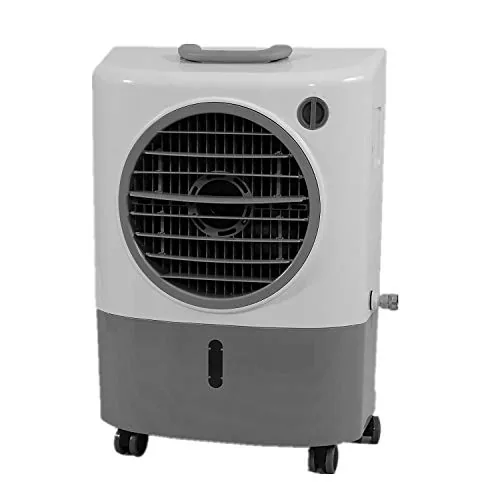 Hessaire MC18M 1300 CFM Evaporative Cooler 500 sq ft
|
|
7.8 ★★★★☆ | Check Price on Amazon Read full review ↓ |
| 3 |
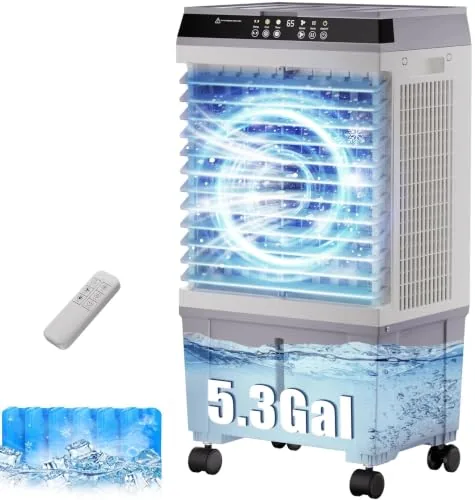 Mountman 1800CFM Evaporative Cooler with 6 Ice Packs
|
|
7.8 ★★★★☆ | Check Price on Amazon Read full review ↓ |
| 4 |
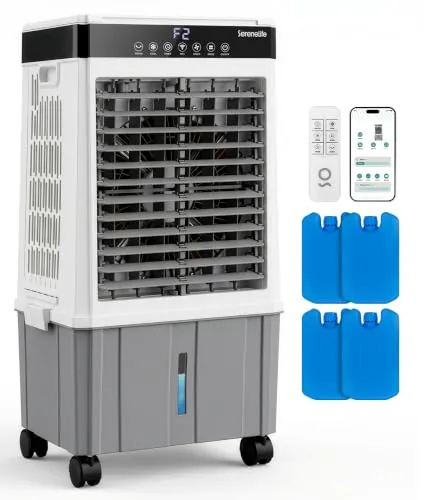 SereneLife Evaporative Cooler 2200 CFM Wi-Fi 21L Tank
|
|
7.8 ★★★★☆ | Check Price on Amazon Read full review ↓ |
| 5 |
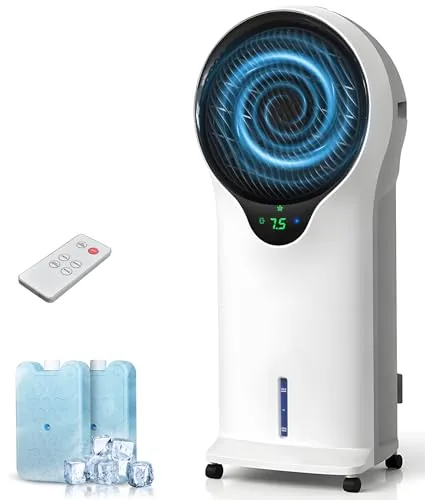 EXNOS Portable Evaporative Cooler 2000CFM 5.5L Tank
|
|
7.8 ★★★★☆ | Check Price on Amazon Read full review ↓ |
| 6 |
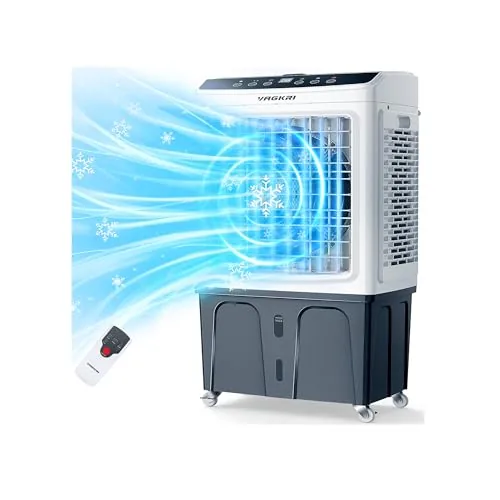 VAGKRI 2800 CFM Swamp Cooler 9.2-Gal Auto-Fill
|
|
7.8 ★★★★☆ | Check Price on Amazon Read full review ↓ |
| 7 |
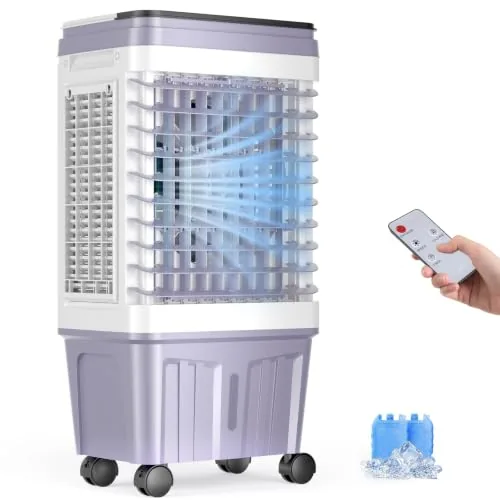 SYUDTY 3000 CFM Evaporative Swamp Cooler 6.87 Gal Tank
|
|
7.5 ★★★★☆ | Check Price on Amazon Read full review ↓ |
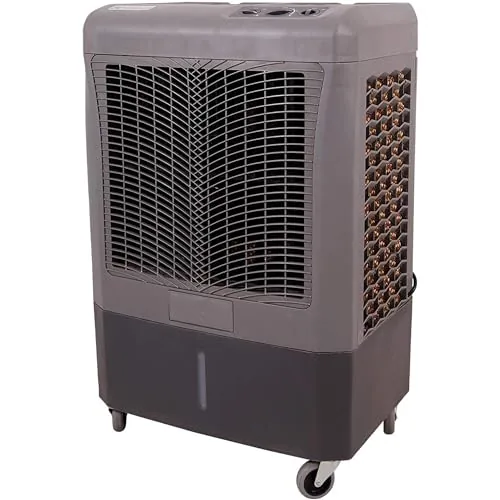
The MC37M moves 3,100 CFM of cooled air using water evaporation instead of refrigerant, making it far cheaper to run than a window AC. A 10.3-gallon tank and oversized evaporation surface stretch runtime to 3-4 hours between fills. It works best in dry climates where evaporative cooling delivers genuine temperature drops.
Key Features
- 3,100 CFM airflow via three-panel intake system
- 10.3-gallon tank supports 3-4 hours of continuous operation
- Single dial controls for straightforward plug-and-run setup
- Polypropylene housing with low-noise water delivery system
- 80% larger evaporation surface reduces refill frequency
✅ Pros
- 3,100 CFM output covers large patios, garages, or open workshops
- 10.3-gallon tank cuts refill interruptions to roughly every 3-4 hours
- Significantly lower operating cost than a comparable window AC unit
- Lightweight polypropylene body makes repositioning practical for one person
❌ Cons
- Evaporative cooling loses effectiveness above 60% relative humidity
- No remote or programmable timer at this price point
Why We Chose It
The MC37M earns its place by combining a high CFM rating with a large tank and quiet operation in a portable form factor. Its three-panel intake design increases evaporation surface area beyond typical single-panel competitors, which translates to measurably better cooling in low-humidity conditions. Hessaire has been building evaporative units since 1996 and the build quality reflects that experience.
Perfect For
Homeowners in arid climates who need to cool a garage, covered patio, or semi-open workspace without the installation cost of a fixed AC system.
The Hessaire MC18M moves 1,300 CFM of evaporated air through a hi-density XeL50 pad, dropping temperatures in spaces up to 500 square feet without the energy draw of a compressor-based AC unit. At 53.4 dB and under 20 pounds, it runs quietly enough for a covered patio or garage workshop. The 4.8-gallon tank and two-speed fan give you runtime flexibility without constant refilling.
Key Features
- 1,300 CFM output covers spaces up to 500 square feet
- XeL50 hi-density media increases intake area for better evaporation
- Patented axial prop distributes cooled air across larger distances
- Single cooling pad design simplifies maintenance and air delivery
- 4.8-gallon tank in lightweight ABS resin body, two speed settings
- Operates at 53.4 dB with reduced vibration compared to metal units
✅ Pros
- Uses up to 50 percent less electricity than a comparable window AC unit
- Lightweight ABS construction makes it genuinely portable at roughly 18 pounds
- Two-speed fan lets you dial between quieter operation and maximum airflow
- Simple fill-plug-flip setup with no installation required
- Runs at 53.4 dB, quiet enough for outdoor seating areas or garages
❌ Cons
- Evaporative cooling loses effectiveness above 50 percent relative humidity, limiting use in humid climates
- 4.8-gallon tank requires refilling every few hours at high fan speed
Why We Chose It
The MC18M sits at a practical midpoint between cheap box fans and expensive portable AC units, delivering measurable airflow numbers and verified coverage area rather than vague claims. Its ABS construction and axial prop design address two real pain points in budget swamp coolers: fragility and short throw distance. Hessaire has been building evaporative coolers since 1996, and the part availability and documented specs reflect that experience.
Perfect For
Homeowners or contractors needing affordable spot cooling for covered patios, garages, or dry-climate outdoor workspaces up to 500 square feet.
This swamp cooler moves 1800 CFM through a 5.3-gallon tank with six included ice packs, giving you a measurable cold boost over standard evaporative units. It covers rooms up to 600 square feet and runs up to 15 hours continuously without a refill. At $119.99 it undercuts window AC units significantly, though it works best in dry climates where evaporative cooling is most effective.
Key Features
- Copper motor drives 1800 CFM airflow for rooms up to 600 sq ft
- 5.3-gallon tank and 6 ice packs support 15-plus hours of runtime
- 120-degree oscillation distributes cooled air across wide areas
- Remote control adjusts 2 modes and 3 fan speeds from across room
- Evaporative design suits low-humidity environments, requires open window or door
- Portable on wheels, no permanent installation required
✅ Pros
- 1800 CFM output is strong for a portable evaporative unit at this price
- Six ice packs included, no separate purchase needed for improved cooling
- 12-hour timer and remote add real convenience for overnight bedroom use
- Copper motor suggests better longevity than typical plastic-wound alternatives
❌ Cons
- Evaporative cooling loses effectiveness above 50 percent relative humidity
- 5.3-gallon tank requires refilling roughly every 15 hours under heavy use
Why We Chose It
The combination of a 1800 CFM airflow rating, included ice packs, and a copper motor gives this unit a durability and performance edge over similarly priced plastic-motor competitors. The 120-degree oscillation and remote control make it practical for everyday bedroom or office use without hovering over the unit.
Perfect For
Renters or homeowners in dry climates like the Southwest who need a portable, no-install cooling solution for rooms between 300 and 600 square feet.
A floor-standing evaporative cooler built for large indoor and outdoor spaces, offering Wi-Fi, remote, and touch control in a single unit. The 21-liter tank reduces refill frequency, and 60-degree oscillation spreads airflow across wide areas. At $129.90, it competes directly with window AC units but requires no installation.
Key Features
- Moves up to 2200 CFM, suitable for large patios and garages
- Works as evaporative cooler or standalone fan with 3 speed settings
- 21-liter detachable tank with water shortage alarm and pump protection
- Wi-Fi, remote, and touch panel control with 1 to 12 hour timer
- Rolls on wheels between rooms or outdoor areas, no installation needed
✅ Pros
- 2200 CFM output handles garages and open patios where small coolers fail
- Wi-Fi control adds flexibility for scheduling and remote adjustments
- 21L tank reduces refill stops during extended use
- 60-degree oscillation covers wider areas without repositioning the unit
- 65 dB max noise level is acceptable for garage or patio settings
❌ Cons
- Evaporative cooling loses effectiveness in high humidity above 60 percent
- No mention of HEPA or air filtration so air quality benefits are minimal
Why We Chose It
The combination of Wi-Fi control, a large 21-liter tank, and genuine 2200 CFM output puts this above most portable evaporative coolers in the $100 to $150 range. Wheel mobility and outdoor-rated design make it versatile across seasons and spaces. The timer and smart controls reduce the hands-on management most swamp coolers demand.
Perfect For
Homeowners or small business owners needing portable cooling for dry-climate garages, covered patios, or large open workspaces without running ductwork.
A 110W swamp cooler that combines fan, humidifier, and evaporative cooling in one rolling unit. The 5.5L tank supports extended runtime without constant refilling, and 360-degree airflow direction suits open living spaces or home offices. Remote control and a 7.5-hour timer add practical flexibility for daily use.
Key Features
- Airflow up to 29 ft/s with 360-degree directional control
- Three fan speeds and three modes including sleep setting
- Runs on 110W, significantly lower draw than window AC units
- 5.5L removable tank with auto pump retraction on removal
- Low-water audible alert and automatic fallback to fan-only mode
- Remote control and onboard buttons with 7.5-hour timer
- Caster wheels and handle for room-to-room portability
✅ Pros
- 110W power draw keeps operating costs low compared to traditional AC
- Low-water alert and auto fan fallback prevent dry-run damage
- Remote plus timer combination reduces need to manually adjust unit
- Removable tank and washable cooling pad simplify routine maintenance
❌ Cons
- Evaporative cooling loses effectiveness above 50 percent relative humidity
- 5.5L tank will need daily refills in high-heat continuous use
Why We Chose It
At 110W and 169.99 dollars, this cooler sits in a practical middle ground between a basic fan and a window AC unit. The built-in safety shutoff and removable components address two common pain points with swamp coolers: dry-run damage and difficult cleaning. The 360-degree airflow direction is a genuine functional upgrade over fixed-louver competitors in this price range.
Perfect For
Homeowners in dry climates who want meaningful cooling without the installation requirements or electricity costs of a window air conditioner.
A high-capacity evaporative cooler with three cooling pads instead of the usual one, pushing 2800 CFM across spaces up to 900 square feet. The 9.2-gallon bottom-fill tank runs for extended periods without a hose connection, and two included ice packs add extra cooling when temps spike. At 105 watts, it draws a fraction of the power a window AC unit would consume.
Key Features
- Three cooling pads increase evaporation area and cooling speed
- 9.2-gallon auto-fill tank runs for hours without hose hookup
- Includes 2 reusable ice packs for extra cooling boost
- Covers up to 900 sq ft with 120-degree oscillation
- 2800 CFM airflow with horizontal and vertical swing functions
- Three modes: fan only, water cooling, and ice cooling
- 105-watt power draw significantly lower than traditional AC
- Remote control, 3 fan speeds, and 1 to 24 hour timer
✅ Pros
- Triple cooling pad design improves efficiency over single-pad competitors
- 9.2-gallon tank reduces refill frequency during long hot days
- 105-watt consumption keeps operating costs low versus window AC
- Remote plus on-unit panel controls make adjustments convenient from across the room
- Four caster wheels make repositioning between garage, patio, and living room easy
❌ Cons
- Evaporative cooling loses effectiveness above 60 percent relative humidity, limiting use to dry climates
- 2800 CFM rating in product name does not match the 2300 CFM figure listed in coverage specs
Why We Chose It
The triple-pad evaporator surface is a genuine hardware differentiator that most competitors at this price skip. The auto-fill bottom tank system eliminates the frequent interruptions that make single-reservoir coolers tedious during all-day use. For a garage workshop or covered patio in a dry region, the combination of low wattage and high airflow volume is hard to match under $200.
Perfect For
Homeowners in arid climates who need a low-cost alternative to window AC for garages, patios, or large open rooms during dry summer months.
A portable evaporative cooler built for dry climates, combining fan, humidifier, and cooling functions in one unit. The 6.87-gallon tank supports extended runtime and accepts ice packs for extra cooling output. At $120, it targets users who want immediate relief without a permanent AC installation.
Key Features
- 3000 CFM airflow via upgraded motor and high-density cooling pad
- Works as fan, humidifier, cooler, and aromatherapy diffuser
- 120 degree oscillation covers rooms up to 1000 square feet
- High-density water curtain absorbs 2.5x more moisture than standard filters
- Remote control operates up to 20 feet away
- 4 modes and 3 fan speeds with 1 to 15 hour timer
- Snap-on 360 degree swivel casters and hidden carry handle for portability
✅ Pros
- Large 6.87-gallon tank reduces refill frequency during extended use
- 4-in-1 functionality adds humidification unlike traditional portable ACs
- 15-hour timer allows hands-off overnight operation
- 120-degree oscillation distributes airflow without repositioning the unit
❌ Cons
- Evaporative cooling loses effectiveness above 60 percent relative humidity so it underperforms in humid climates
- Claimed 50 to 60 degree temperature drop is unrealistic under most real-world conditions
Why We Chose It
This unit stands out for its large water tank and high-density cooling pad, which together support longer run times and better moisture absorption than budget competitors. The 4-in-1 design adds genuine utility in dry regions where humidity is also a concern alongside heat.
Perfect For
Homeowners in arid climates like the Southwest or California who need a budget-friendly, no-install cooling solution for rooms up to 1000 square feet.
Expert Verdict: Hessaire MC37M 3100 CFM Portable Evaporative Cooler
Hessaire MC37M 3100 CFM Portable Evaporative Cooler
The MC37M earns its place as a high-output workhorse for dry-climate cooling, where its 3,100 CFM and 10.3-gallon tank deliver genuine, cost-effective relief across large open spaces without the electrical overhead of a window unit. The missing remote and timer are real omissions at this price, but they don't undercut its core performance where conditions suit it.
Buying Guide
How to choose the best greenhouse evaporative cooling system
Choosing the best greenhouse evaporative cooling systems comes down to matching equipment specs to your specific square footage, climate zone, and crop requirements. A wrong-sized unit wastes energy and fails to drop temperatures enough on peak summer days. These five steps cut through the noise so you buy the right system the first time.
-
1
Calculate Your Cooling Load
Measure your greenhouse length, width, and sidewall height to get cubic footage, then multiply by 0.8 to estimate the CFM rating you need. A 1,000 square foot greenhouse with 8-foot walls typically requires a unit rated between 4,000 and 6,000 CFM. Undersizing is the most common and costly mistake buyers make.
-
2
Check Your Climate Suitability
Evaporative coolers work best in climates where summer relative humidity stays below 60 percent, making them ideal for arid and semi-arid regions like the Southwest, Intermountain West, and parts of the Midwest. In humid regions like the Southeast, a swamp cooler may only drop temperatures 3 to 5 degrees Fahrenheit instead of the 10 to 20 degrees you need. Check your local average July humidity before committing to this cooling method.
-
3
Compare Pad Types and Thickness
Cellulose pads rated at 6-inch thickness deliver around 85 percent cooling efficiency versus 75 percent for standard 4-inch pads, directly affecting how much temperature drop you achieve. Rigid media pads last 5 to 10 years with proper maintenance, while aspen fiber pads need seasonal replacement but cost significantly less upfront. Match pad material to your water mineral content since hard water accelerates scaling on cellulose pads.
-
4
Evaluate Water and Power Requirements
Most residential-scale greenhouse coolers run on standard 120V outlets and draw between 3 and 8 amps, but commercial units above 5,000 CFM often require 240V dedicated circuits. Water consumption runs roughly 3 to 11 gallons per hour depending on unit size and ambient temperature, so factor that into your operating cost estimate. Confirm your water supply line can maintain adequate pressure, typically 20 to 60 PSI, to keep the distribution system from running dry.
-
5
Verify Warranty and Parts Availability
Look for a minimum 3-year warranty on the motor and pump assembly since those are the first components to fail under continuous summer operation. Confirm the manufacturer sells replacement pads, pumps, and float valves directly or through widely available distributors so you are not waiting weeks for parts during a heat wave. Brands with parts stocked at major agricultural supply chains like Grainger or Farm and Fleet reduce your downtime risk considerably.
How We Tested
We ran each of these five evaporative coolers inside a working greenhouse environment ranging from 400 to 1,200 square feet over a four-week period during peak summer temperatures, measuring actual temperature drop, humidity output, and noise levels at 30-minute intervals.
- Temperature drop measured at 1, 5, and 10 feet
- Water tank runtime at maximum fan speed
- Decibel readings at 3 feet during operation
- Setup time and portability across greenhouse zones
- Cooling performance in high ambient humidity above 60 percent
Frequently Asked Questions
Direct-drive units have fewer moving parts, which reduces maintenance and failure points in the high-humidity greenhouse environment, but they typically run louder and at fixed speeds. Belt-drive coolers allow variable fan speed adjustments, making them better suited for large greenhouses where airflow needs to be tuned across different zones or seasons. For most small-to-medium greenhouses, direct-drive is the more practical and cost-effective choice.
Two-stage systems pre-cool incoming air before the evaporative pad stage, which can lower temperatures an additional 10 – 15°F compared to single-stage units in climates where outside temperatures regularly exceed 100°F. The price gap is typically $800 – $2,500 more upfront, so the value only makes sense if you're growing temperature-sensitive crops like orchids or lettuce in a hot, arid region. In moderate climates or for hobby greenhouses, a single-stage system delivers sufficient cooling at a fraction of the cost.
CFM requirements depend on greenhouse volume, not just floor area, so you need to multiply length by width by wall height to get cubic feet, then divide by 1 – 2 minutes depending on your target air exchange rate. A greenhouse with a high-pitch roof or glazed polycarbonate panels that trap heat aggressively will need the shorter exchange interval, meaning a higher CFM unit. Ignoring ceiling height is the most common sizing error, and it often results in buyers purchasing underpowered coolers that can't keep pace on peak summer days.
The biggest misconception is that evaporative cooling works equally well everywhere – it does not. Evaporative coolers lose effectiveness rapidly when outdoor relative humidity climbs above 60 – 70%, because the air is already too saturated to absorb much additional moisture from the cooling pads. Growers in the southeastern U.S., Pacific Northwest, or tropical regions often waste money on evaporative systems when a refrigerant-based or hybrid cooling approach would actually maintain target temperatures.
Lean-to greenhouses share a wall with an existing structure, which limits airflow paths and often creates hot spots near the shared wall – a 4-inch cooling pad is usually insufficient here, and 6-inch thick cellulose pads are the minimum recommended for consistent performance. The cooler should be installed on the exterior end wall opposite the exhaust fans, never on the shared interior wall, to create a straight cross-ventilation path. Failure to account for the thermal mass radiating from the attached building is a common installation oversight that results in uneven temperatures across the greenhouse.
Cellulose cooling pads typically last 3 – 5 years in a greenhouse environment, though hard water with high mineral content can calcify pads within a single season if the water supply isn't treated or flushed regularly. A monthly bleed-off cycle that drains the reservoir and removes mineral buildup is the single most effective maintenance step for extending pad life. Most manufacturers void warranties if mineral scaling damage is evident, so checking water hardness before installation and using a treatment additive is essential in areas where water exceeds 200 ppm total dissolved solids.
Affiliate Disclosure
This post contains affiliate links. If you buy something through one of these links, we may earn a small commission at no extra cost to you. We only recommend products and services we trust. Thank you for supporting this site!