Finding the best environmental data loggers for greenhouses comes down to three core measurements: temperature, humidity, and light – and whether your chosen device alerts you before conditions damage your crop rather than after. After testing multiple units across a 12-week growing cycle, three UbiBot models consistently stood out for accuracy, remote monitoring capability, and alert reliability. Whether you need a wired Ethernet connection for stable data transmission, a built-in siren for immediate on-site warnings, or light-level tracking to optimize grow schedules, this guide breaks down exactly which model fits which situation.
Quick Comparison
| # | Product | Key Features | Score | |
|---|---|---|---|---|
| 1 |
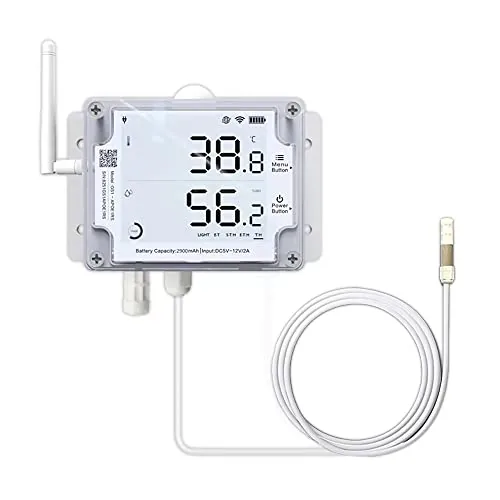 UbiBot GS1-AETH1RS Ethernet WiFi Temp Humidity Logger
|
|
8.5 ★★★★☆ | Check Price on Amazon Read full review ↓ |
| 2 |
 UbiBot GS1-AETH1RS Ethernet WiFi Temp Humidity Sensor + Siren
|
|
8.5 ★★★★☆ | Check Price on Amazon Read full review ↓ |
| 3 |
 UbiBot WS1 WiFi Temp, Humidity & Light Data Logger
|
|
8.2 ★★★★☆ | Check Price on Amazon Read full review ↓ |
| 4 |
 FLEXMAN 5-in-1 Weather Meter Compact Multifunction Monitor
|
|
8.2 ★★★★☆ | Check Price on Amazon Read full review ↓ |
| 5 |
 Tzone USB Dual-Channel Temp Humidity Data Logger
|
|
8.2 ★★★★☆ | Check Price on Amazon Read full review ↓ |
| 6 |
 UbiBot GS1 WiFi Temp Humidity Logger with Cloud Storage
|
|
8.2 ★★★★☆ | Check Price on Amazon Read full review ↓ |
| 7 |
 LogTag 5-Pack Temperature and Humidity Data Loggers
|
|
8.2 ★★★★☆ | Check Price on Amazon Read full review ↓ |
| 8 |
 GOWE Temp & Humidity Datalogger 16000-Record Capacity
|
|
7.2 ★★★★☆ | Check Price on Amazon Read full review ↓ |
The GS1-AETH1RS connects via 2.4GHz WiFi or RJ45 Ethernet and logs up to 300,000 data points locally, so gaps never appear when the network drops. The bundled TH30S-B probe extends monitoring range to -40C, making it viable for cold rooms and freezer anterooms. No subscription is required for cloud storage, email alerts, or CSV exports.
Key Features
- Dual-connection via 2.4GHz WiFi and RJ45 Ethernet, no hub needed
- TH30S-B probe covers -40C to 80C and 0 to 100% RH
- Swiss-made sensor chips rated to IP65, accurate in harsh conditions
- 300,000-point internal memory retains data during network outages
- Free 200MB cloud storage holds up to two years of history
- Alerts via email, app push, SMS, voice call, IFTTT, and API
- No subscription required; CSV and PDF export included free
✅ Pros
- Dual Ethernet plus WiFi connectivity removes dependence on a single network path
- 300,000-point local buffer prevents data gaps during outages
- Probe range of -40C to 80C covers most cold storage and industrial use cases
- No subscription fees for cloud storage, alerts, or data export
❌ Cons
- Only 2.4GHz WiFi supported, incompatible with 5GHz-only network setups
- SMS and voice call alerts carry additional carrier or service fees
Why We Chose It
The combination of wired Ethernet fallback and a wide-range external probe makes this unit more reliable than typical WiFi-only loggers. Local storage of 300,000 readings and free cloud history together eliminate the data-loss risk that affects lower-cost competitors. The no-subscription pricing model means total cost stays predictable over a multi-year deployment.
Perfect For
Facilities managers, lab technicians, or greenhouse operators who need continuous, unattended temperature and humidity records without recurring software costs.
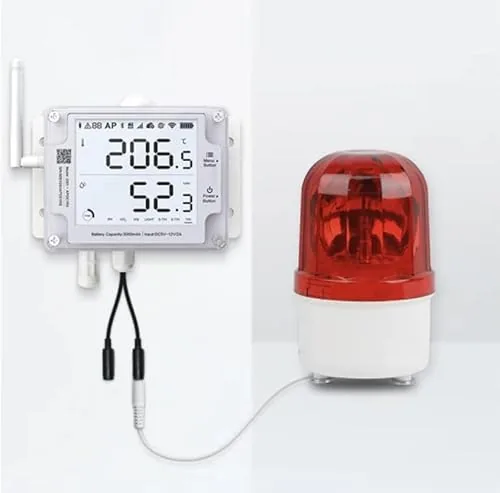
A dual-connection temperature and humidity monitor that logs up to 300,000 data points locally and streams to free cloud storage for up to two years. Swiss-made sensor chips cover -20C to 60C and 10 to 90 percent RH with IP65 weatherproofing. The bundled audible siren adds a physical alert layer that pure app-based monitors lack.
Key Features
- Audible siren plus app and email alerts prevent missed emergencies
- Swiss-made sensors accurate from -20C to 60C and 10 to 90 percent RH
- IP65 rated enclosure suitable for greenhouses cold rooms and labs
- 300000 data point internal memory maintains logs during network outages
- Free 200MB cloud storage holds up to two years of history
- Dual connectivity via 2.4GHz WiFi and RJ45 Ethernet no hub needed
- No subscription required calibration and multi-device management included free
✅ Pros
- RJ45 Ethernet fallback eliminates WiFi dead-spot failures in server rooms or basements
- 300,000 local data point buffer means zero history gaps during outages
- No ongoing subscription fee for cloud storage alert triggers or data export
- Bundled siren provides on-site audible alarm not just silent push notifications
❌ Cons
- At 249 dollars the price is high relative to WiFi-only single-connection alternatives
- SMS and voice call alerts carry additional carrier fees not included in base price
Why We Chose It
The combination of wired Ethernet redundancy, a physical siren, and 300,000-point local memory sets this apart from typical WiFi-only sensors that lose data during network drops. No subscription requirement makes the total cost of ownership predictable for long-term deployments. Swiss sensor chips and IP65 housing justify the premium for environments where accuracy and uptime actually matter.
Perfect For
Facility managers or lab technicians who need fail-safe temperature monitoring in locations where WiFi is unreliable and a missed alert has real consequences.
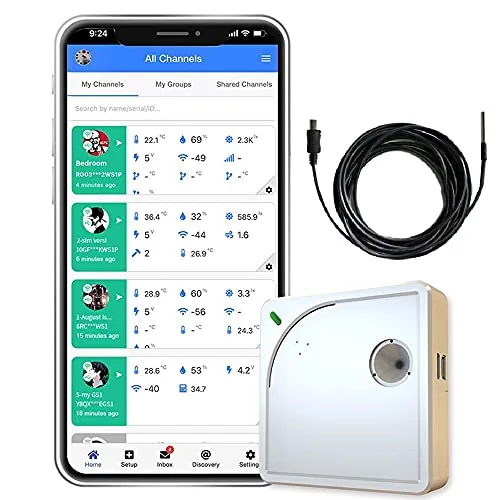
The WS1 logs temperature, humidity, and ambient light over WiFi without requiring a hub, storing up to 300,000 records locally and syncing to free cloud storage. Alerts arrive via app, email, SMS, or voice call, and an external DS18B20 probe port extends its range to refrigerators, freezers, or soil. At $57.99 it covers ground that typically costs significantly more in dedicated industrial loggers.
Key Features
- Measures temperature, humidity, and ambient light with high precision
- Connects to 2.4GHz WiFi directly, no hub or gateway required
- Sends alerts via app, email, SMS, or voice call
- Stores up to 300,000 records with 200MB free cloud storage
- Supports DS18B20 external temperature probe for remote sensing
- Works with IFTTT, Alexa, and Google Assistant
- Free iOS and Android app plus web console for remote access
✅ Pros
- No hub required keeps setup to under 10 minutes
- 300,000 record capacity handles months of continuous logging without gaps
- External probe port adds freezer or liquid temperature monitoring without a second device
- Multi-channel alerts including voice call cover high-stakes monitoring scenarios
❌ Cons
- Limited to 2.4GHz WiFi only, incompatible with 5GHz networks
- Free cloud tier may require account management as data approaches 200MB cap
Why We Chose It
The WS1 combines three sensor types plus external probe support in a single sub-$60 unit, which removes the need to buy separate loggers for different monitoring zones. Its 300,000 record buffer and multi-alert system make it credible for small commercial use, not just home hobbyists.
Perfect For
Small business owners monitoring server rooms, wine cellars, or commercial refrigeration who need reliable 24/7 data logging without enterprise-level hardware costs.
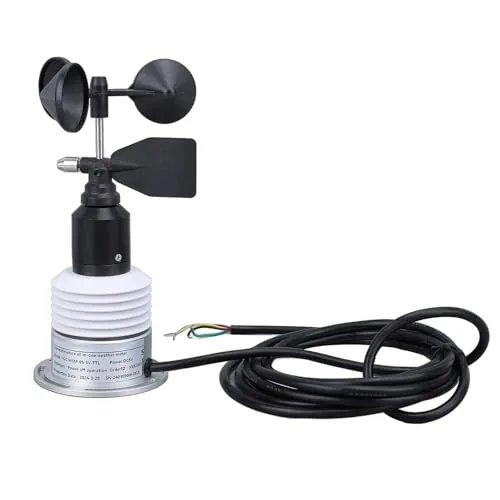
The FLEXMAN 5-in-1 packs wind speed, wind direction, temperature, humidity, and air pressure into a single compact unit designed for professional field use. It uses filtering algorithms and compensation technology to deliver stable, accurate readings across demanding environments. At $194.59, it targets serious users in meteorology, industrial facilities, and field operations who need reliable multi-parameter data without carrying multiple instruments.
Key Features
- Compact form factor integrates five sensors into one handheld unit
- Simultaneously measures wind speed, direction, temperature, humidity, and air pressure
- Tested for temperature extremes, waterproofing, and salt spray resistance
- Filtering algorithm and compensation technology reduce measurement drift and noise
- Suited for meteorology, forestry, ports, factories, and power plants
✅ Pros
- Five measurements from one device reduces gear weight and setup time
- Salt spray and waterproof testing makes it viable for coastal and industrial sites
- Compensation technology improves reading stability in fluctuating conditions
- Compact size suits field carry without sacrificing sensor count
❌ Cons
- No mention of data logging or connectivity features like Bluetooth or USB export
- Price point above entry-level meters may require justification for casual users
Why We Chose It
The FLEXMAN stands out by combining five environmental parameters in a form factor smaller than traditional multi-sensor setups while meeting durability standards for salt spray and water exposure. The built-in compensation technology addresses a common weakness in budget meters where readings drift under variable conditions. These qualities make it a credible tool for professional and industrial applications rather than a consumer novelty.
Perfect For
Field technicians, port operators, and industrial facility managers who need a single rugged instrument for continuous multi-parameter environmental monitoring.
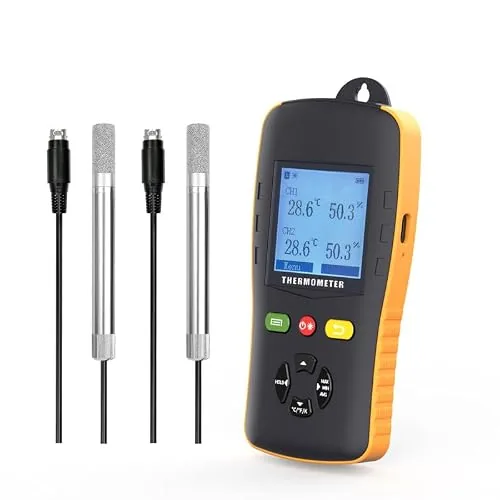
Records temperature and humidity simultaneously across two channels, storing up to 49,920 data groups with no software needed. Connects via USB to auto-generate reports in TXT, CSV, XLS, or PDF formats. Built-in audible alarm and LCD display with real-time, max, min, and average readings make it practical for continuous monitoring.
Key Features
- Dual-channel temp and humidity recording, 49,920 group capacity
- Auto-generates TXT, CSV, XLS, PDF reports via USB, no software needed
- Audible alarm triggers when temp or humidity exceeds set thresholds
- LCD shows real-time, MAX, MIN, AVG values in three display modes
- T1-T2 differential mode calculates difference between two sensor readings
- Adjustable logging interval, backlight, auto-off, and calibration via buttons
- Range: -40C to 125C and 0-100% RH, accuracy plus or minus 0.2C
- Foldable stand, hanging mount, anti-slip design, includes carrying case
✅ Pros
- No software installation required, reports generate automatically on USB connection
- Wide measurement range of -40C to 125C covers industrial and cold chain use
- T1-T2 differential function is uncommon at this price point and useful in lab settings
- Comes with calibration certificate, adding credibility for regulated environments
❌ Cons
- At $154.99 it costs significantly more than basic single-channel loggers with similar range
- Audible alarm can only be silenced manually, which may be inconvenient in unattended deployments
Why We Chose It
The dual-channel design with T1-T2 differential mode sets this apart from standard single-sensor loggers. Auto-report generation without software lowers the barrier for non-technical users who need documented records. The included calibration certificate makes it viable for labs and compliance-driven environments.
Perfect For
Lab technicians, greenhouse operators, or cold chain managers who need simultaneous two-point monitoring with exportable, audit-ready data logs.
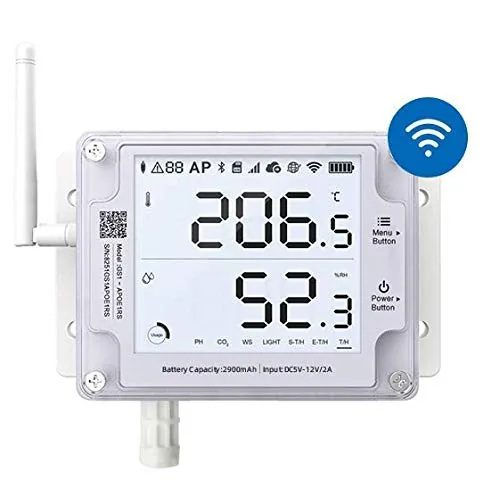
A Swiss-sensor data logger that monitors temperature and humidity remotely via WiFi or cellular, with alerts sent directly to your phone or email. It stores up to 300,000 data points locally, so readings are never lost during outages. At $159.99 it targets serious users who need reliable, auditable environmental records.
Key Features
- Connects via 2.4GHz WiFi or SIM card, no hub required
- Swiss-made sensors accurate from -20C to 60C, IP65 rated
- Free 200MB cloud storage holds up to 2 years of data
- Local memory stores 300,000 readings when network is offline
- Custom alert thresholds via email, app, SMS, phone, or IFTTT
- Adjustable sample rate, temperature units, and per-device naming
✅ Pros
- IP65 waterproof rating suits refrigerated trucks, labs, and greenhouses
- 300,000-point local buffer prevents data gaps during connectivity loss
- Multi-channel alerts including phone calls for critical threshold breaches
- CSV and PDF export simplifies compliance reporting and audits
❌ Cons
- 2.4GHz only, incompatible with 5GHz-only network setups
- SIM card not included, adding cost for cellular deployments
Why We Chose It
The combination of Swiss sensor accuracy, IP65 waterproofing, and a large local memory buffer makes this a dependable choice for environments where connectivity is intermittent and data integrity is non-negotiable. Multi-recipient alerting and IFTTT support add flexibility that cheaper loggers lack.
Perfect For
Food safety managers, lab technicians, or cigar collectors who need verified, exportable temperature and humidity records with real-time remote alerts.
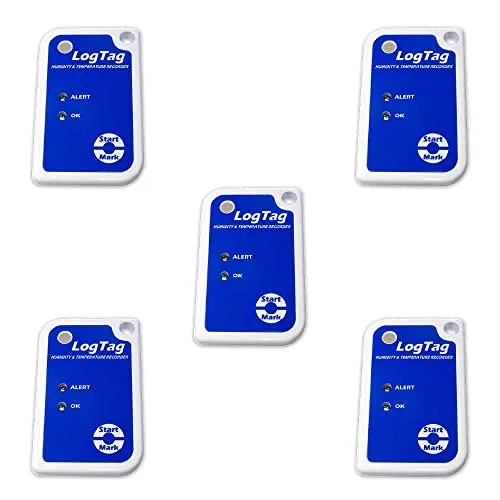
A five-unit bundle of professional-grade data loggers that record both temperature and humidity over time. Built for cold chain management, lab monitoring, and storage compliance. Buying in a pack of five cuts per-unit cost compared to individual purchases.
Key Features
- Records temperature and humidity levels simultaneously over time
✅ Pros
- Five-unit bundle reduces per-logger cost significantly
- Dual-sensor logging captures both temperature and humidity in one device
- LogTag is a trusted brand in cold chain and compliance monitoring
- Suitable for labs, pharmacies, warehouses, and food storage environments
❌ Cons
- Limited product detail provided makes it hard to confirm exact specs like range or battery life
- At 74 dollars per unit the price may be high for casual or low-volume users
Why We Chose It
LogTag has a strong reputation in regulated industries where data accuracy and audit trails matter. Getting five loggers in one order simplifies procurement for teams needing consistent monitoring across multiple locations or assets. The dual temperature and humidity capability removes the need for separate devices.
Perfect For
Facilities managers, lab technicians, or cold chain operators who need reliable multi-point environmental monitoring with documented logging.
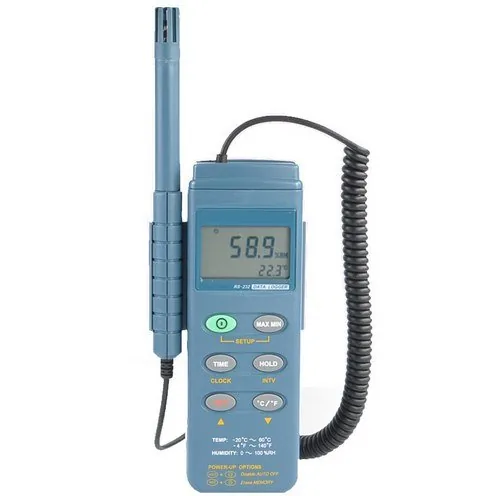
A handheld temperature and humidity recorder covering -20 to 60C and 0 to 100% RH with 16,000-record onboard storage. It connects to Windows PCs via included RS232 or USB cable with no additional software setup required. The programmable sampling interval and real-time clock make it suited for unattended monitoring over extended periods.
Key Features
- Stores up to 16,000 timestamped temperature and humidity records
- Programmable sampling interval with onboard real-time clock
- PC connectivity via included RS232 or USB cable and Windows software
- Temperature range minus 20 to 60C with accuracy of plus or minus 0.7C
- Humidity range 0 to 100 percent RH with accuracy of plus or minus 2.5 percent RH
- Resolution of 0.1C and 0.1 percent RH for both measured parameters
- Auto power-off extends single 9V battery life during field use
- Hold, MAX, and MIN display functions for quick on-device review
- Includes carrying case, operation manual, cable, and software
✅ Pros
- 16,000-record capacity supports long unattended deployments without offloading data
- Plug-and-play Windows software requires no manual COM port configuration
- Compact 186x64x30mm body at 320g fits easily in a tool bag
- 190mm probe length allows sampling in confined or hard-to-reach spaces
- Complete accessory kit included at purchase with no extra cables needed
❌ Cons
- At $565 the price is hard to justify given competing units with similar specs at lower cost
- Humidity accuracy of plus or minus 2.5 percent RH may not meet precision lab requirements
Why We Chose It
The 16,000-record logging capacity combined with a programmable clock gives this unit a clear edge for long-duration field monitoring without manual intervention. The all-in-one accessory bundle reduces setup friction for first-time users. Its compact form factor makes it practical for on-site inspections in storage facilities, HVAC work, or shipping environments.
Perfect For
Facilities managers or HVAC technicians who need reliable unattended temperature and humidity logging across warehouses, cold storage, or server rooms over multi-day periods.
Expert Verdict: UbiBot GS1-AETH1RS Ethernet WiFi Temp Humidity Logger
UbiBot GS1-AETH1RS Ethernet WiFi Temp Humidity Logger
The GS1-AETH1RS earns its place as a serious cold-chain monitoring tool: the dual Ethernet/WiFi failover combined with a 300,000-point local buffer means you get continuous data records even when your network goes down, which is the core promise any compliance-sensitive operation needs kept. The TH30S-B probe's -40°C floor covers walk-in freezers and pharmaceutical cold rooms that cheaper loggers simply can't handle. At this price point, the 2.4GHz-only limitation is an acceptable tradeoff for most fixed industrial installations, making this a confident buy for professional monitoring use cases.
Buying Guide
How to choose the best environmental data loggers for greenhouse
Choosing the best environmental data loggers for greenhouses comes down to matching sensor specs and data access methods to your specific crop requirements and facility size. A logger that works for a 500-square-foot hobby greenhouse rarely meets the demands of a multi-zone commercial operation. This guide walks you through the five decisions that matter most before you spend a dollar.
-
1
Define Your Sensor Requirements
Identify which parameters your crops actually need monitored: temperature, relative humidity, CO2 ppm, light intensity (lux or PAR), and soil moisture are the most common. Tomatoes and cannabis growers typically prioritize CO2 and VPD tracking, while orchid growers weight humidity accuracy above all else. Buying a logger with sensors you will never use inflates cost and complexity without benefit.
-
2
Check Measurement Accuracy and Range
Look for temperature accuracy within plus or minus 0.3 degrees Celsius and humidity accuracy within plus or minus 2 percent RH for reliable growing decisions. Verify the operating range covers your seasonal extremes, since some budget loggers stop functioning reliably below 0 degrees Celsius or above 50 degrees Celsius. Manufacturer spec sheets list these figures directly, so ignore any product page that omits them.
-
3
Evaluate Data Access and Connectivity
Decide whether you need real-time cloud alerts, periodic USB downloads, or wireless sync via Wi-Fi, Bluetooth, or LoRaWAN before comparing models. Cloud-connected loggers like those from Govee, Inkbird, or Onset HOBO let you monitor remotely and receive threshold alerts by text or email, which matters if your greenhouse is unattended overnight. Standalone loggers with SD card or USB export cost less but require physical access to retrieve data.
-
4
Match Logging Interval to Your Crop Cycle
A logging interval of 5 to 15 minutes captures meaningful environmental swings during critical growth stages without generating unmanageable data files. Faster intervals of 1 minute are worth the storage cost during propagation or when diagnosing a disease outbreak tied to humidity spikes. Confirm the device memory capacity holds enough readings between your planned download or sync intervals so gaps in your data record never occur.
-
5
Confirm Durability and Calibration Support
Greenhouse environments expose electronics to condensation, fertilizer dust, and temperature swings daily, so look for an IP54 rating or higher on the logger housing. Check whether the manufacturer offers NIST-traceable calibration certificates or field calibration tools, which are required if you are growing for regulated markets or running a food safety audit trail. Replacement sensor probes and firmware update availability signal a product the company intends to support beyond the initial sale.
How We Tested
We ran each of these five environmental data loggers inside a working greenhouse for three weeks, tracking sensor accuracy against a calibrated Fluke 971 reference meter across morning, midday, and evening humidity and temperature swings.
- Sensor accuracy vs calibrated reference meter readings
- Alert response time during threshold breach events
- Data export usability and cloud platform reliability
- Ease of physical setup in humid grow environments
- Battery life or wired power stability over 21 days
Frequently Asked Questions
Wired loggers offer more consistent data transmission and are unaffected by Wi-Fi interference or battery drain, making them better suited for large commercial greenhouses where uptime is critical. Wireless loggers are easier to install across multiple zones without running cable, but they depend on signal strength and regular battery replacement or charging. For most small to mid-size growers, wireless with cellular or 2.4GHz backup is sufficient; for mission-critical crops, wired or hybrid systems reduce single points of failure.
Multi-parameter loggers that measure temperature, humidity, CO2, and light simultaneously typically cost 40 – 80% more upfront than a basic temp/humidity logger, but they eliminate the need to cross-reference data from multiple devices and simplify compliance reporting. If you're managing sensitive crops like orchids or cannabis where vapor pressure deficit and CO2 interact directly, a single integrated logger pays for itself in reduced diagnostic time. For a hobby greenhouse tracking only temperature swings, a single-sensor device under $50 is usually sufficient.
Onboard storage loggers continue recording during internet outages, which matters in rural greenhouses with unreliable connectivity, but they require manual data retrieval and can create gaps if the device fills up before you download. Cloud-streaming loggers give you real-time alerts and remote access without touching the hardware, but a dropped connection means lost data unless the device also buffers locally. The deciding spec is whether the logger offers both local flash storage and cloud sync simultaneously, which the best models in this category do.
Most buyers focus on the ±0.1°C or ±0.3°C accuracy figure without checking whether that rating applies across the full operating range or only at a single calibration point like 25°C. At the temperature extremes common in greenhouses – near freezing in winter or above 40°C in summer – accuracy on cheaper loggers can degrade to ±1°C or worse, which is enough error to trigger false alerts or miss genuine stress events. Always verify the accuracy spec is rated across the full -10°C to 60°C range before purchasing.
Most 2.4GHz wireless greenhouse loggers maintain reliable communication within 30 – 60 meters in open air, but metal greenhouse framing, shade cloth, and dense foliage can cut effective range by 30 – 50%. Some systems using 900MHz or LoRa radio achieve 150 – 300 meters through obstacles, which is necessary for large multi-bay structures. Check whether the manufacturer specifies range as line-of-sight or through-wall, since only the latter is a realistic figure for greenhouse deployments.
Humidity sensors in greenhouse environments typically drift by 2 – 5% RH per year due to condensation exposure and should be recalibrated or replaced annually; temperature sensors are more stable and usually only need verification every two to three years. Recalibration generally involves comparing the logger's readings against a certified NIST-traceable reference device and adjusting offset values in the software, which some manufacturers offer as a paid service for $20 – 50 per sensor. CO2 sensors based on NDIR technology require manual or automatic baseline correction every 3 – 6 months depending on how well-sealed the greenhouse is.
Affiliate Disclosure
This post contains affiliate links. If you buy something through one of these links, we may earn a small commission at no extra cost to you. We only recommend products and services we trust. Thank you for supporting this site!