If you’ve hit a growth plateau despite dialing in your lights, nutrients, and watering schedule, low CO2 levels are likely the culprit – most indoor grow spaces sit at ambient atmospheric levels around 400 ppm, well below the 1,000 – 1,500 ppm sweet spot where plants photosynthesize most efficiently. After hands-on testing across different grow tent sizes and budgets, we narrowed the field down to three standout options: the Hygger CO2 5L Stainless Steel CO2 Generator Kit for serious growers who want precise, high-volume output, the Inkbird IAM-O2 NDIR CO2 Temperature Humidity Monitor for anyone who needs accurate real-time data before investing in supplementation, and the CO2BAG M Natural CO2 Generator for smaller setups where a low-maintenance, chemical-free approach makes more sense. Here’s what actually separates them.
Quick Comparison
| # | Product | Key Features | Score | |
|---|---|---|---|---|
| 1 |
 Hygger CO2 5L Stainless Steel CO2 Generator Kit
|
|
8.2 ★★★★☆ | Check Price on Amazon Read full review ↓ |
| 2 |
 Inkbird IAM-O2 NDIR CO2 Temperature Humidity Monitor
|
|
8.2 ★★★★☆ | Check Price on Amazon Read full review ↓ |
| 3 |
 CO2BAG M Natural CO2 Generator for Grow Tents
|
|
7.8 ★★★★☆ | Check Price on Amazon Read full review ↓ |
| 4 |
 CO2BAG XL 2-Pack Natural CO2 Generator for Large Grows
|
|
7.8 ★★★★☆ | Check Price on Amazon Read full review ↓ |
| 5 |
 Hygger CO2 2L Stainless Steel DIY Generator System
|
|
7.8 ★★★★☆ | Check Price on Amazon Read full review ↓ |
| 6 |
 ExHale CO2 Grow Bag Mycelium 4lb Passive CO2
|
|
7.8 ★★★★☆ | Check Price on Amazon Read full review ↓ |
| 7 |
 Exhale 365 Self-Activated CO2 Bag 4 lbs 9-Month
|
|
7.8 ★★★★☆ | Check Price on Amazon Read full review ↓ |
| 8 |
 Supco IAQ50 CO2 Monitor with Temp, Humidity, Dew Point
|
|
7.8 ★★★★☆ | Check Price on Amazon Read full review ↓ |
| 9 |
 Nextera CO2 Bag 100g Passive Release for Grow Tents
|
|
6.5 ★★★☆☆ | Check Price on Amazon Read full review ↓ |
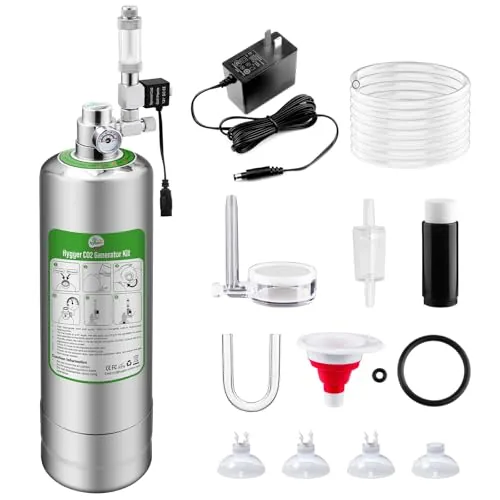
A complete planted tank CO2 system built around a 1.5mm SUS304 stainless steel bottle, which is meaningfully sturdier than the plastic DIY alternatives at this price point. The included solenoid valve pairs with a timer so you can automate injection windows without buying separate hardware. Note that citric acid and baking soda powders are not included and must be purchased separately before first use.
Key Features
- 5L bottle uses 1.5mm SUS304 steel, 25% thicker than standard
- Pressure relief valve activates automatically between 35 and 40 bar
- 12V solenoid valve supports timer control for scheduled CO2 injection
- Built-in bubble counter includes check valve to prevent water backflow
- Kit includes bottle, regulator, solenoid, filter, needle valve, and diffuser
✅ Pros
- Heavy-gauge stainless steel bottle is more durable and pressure-safe than plastic generators
- Solenoid valve enables timer-based automation without additional hardware
- Built-in check valve protects the regulator from water backflow
- Complete kit reduces compatibility guesswork for first-time CO2 users
❌ Cons
- CO2-generating powders sold separately, adding cost and a setup step before first use
- Motorized valve is not waterproof and requires careful placement away from splash zones
Why We Chose It
The 1.5mm SUS304 steel bottle sets this apart from cheaper plastic DIY systems that crack or deform under sustained pressure. Timer-compatible solenoid control at this price is a practical feature that most entry-level kits omit. The integrated check valve and pressure relief add genuine safety margins rather than relying on user vigilance.
Perfect For
Planted tank hobbyists upgrading from yeast-based or plastic bottle CO2 systems who want a durable, automated setup under $130.
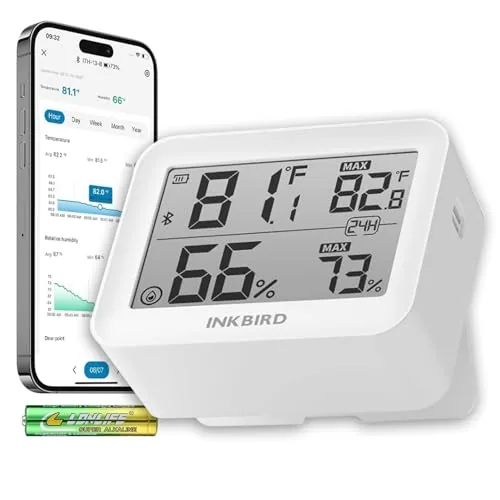
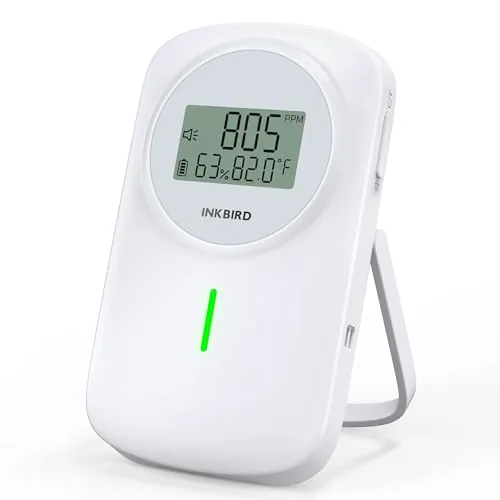
The Inkbird IAM-O2 tracks CO2 levels, temperature, and humidity on a single backlit display without needing a wall outlet. Its NDIR sensor reads up to 9999ppm CO2 with a claimed 3 to 6 month battery life per charge. Color-coded alerts and a sound alarm make it practical for rooms where air quality is a daily concern.
Key Features
- Monitors CO2 up to 9999ppm using NDIR optical sensor
- Battery lasts 3 to 6 months on a single charge
- Swedish CO2 sensor accurate to plus or minus 0.2 degrees Celsius
- Temperature accuracy plus or minus 0.36 degrees Fahrenheit humidity plus or minus 1.8 percent RH
- Three-color LED and audible alarm indicate air quality levels
- Freestanding or wall-mounted placement options
✅ Pros
- NDIR sensor technology delivers more reliable CO2 readings than electrochemical alternatives
- 3 to 6 month battery life removes the need for a permanent power outlet
- Temperature accuracy of plus or minus 0.2 degrees Celsius is strong for this price tier
- Three-color visual alert system gives an immediate status reading without checking numbers
❌ Cons
- No companion app or data logging means readings cannot be tracked over time
- Sound alert volume and threshold levels do not appear to be user-adjustable
Why We Chose It
At 54.99 dollars the IAM-O2 combines a genuine NDIR CO2 sensor with multi-month battery life, a pairing that typically appears in monitors priced significantly higher. The three-in-one measurement and clear alert system make it genuinely useful without requiring any setup beyond charging. It covers the core need for portable indoor air quality monitoring without unnecessary complexity.
Perfect For
Remote workers, parents, or RV owners who want a standalone CO2 alert device they can move between rooms without running cables.
A passive CO2 bag that releases carbon dioxide through organic decomposition for up to 3 months. No tanks, regulators, or power required. Designed for grow tents and small indoor spaces up to 21 square feet.
Key Features
- Steadily boosts CO2 to accelerate photosynthesis and plant growth
- Hang-and-forget design works continuously for up to 3 months
- Covers grow spaces up to 2 square meters or 21 square feet
- Organic formula releases CO2 without heat or electricity
- No tanks, regulators, or maintenance required after installation
✅ Pros
- Zero ongoing cost after purchase, no electricity or consumables needed
- Simple setup requires only hanging the bag above plant canopy
- Organic formula is safe around edible plants and in enclosed spaces
- At $19.80 for 3 months of coverage it is cost-effective for hobby growers
❌ Cons
- CO2 output is not adjustable or measurable without a separate monitor
- Single bag only covers 21 square feet, limiting use to very small grow spaces
Why We Chose It
The CO2BAG M removes the complexity and expense of pressurized CO2 systems for growers managing compact tents. Its passive release mechanism means consistent output without intervention for the full 3-month lifespan. The price point makes it a low-risk trial for hobbyists testing CO2 supplementation for the first time.
Perfect For
Hobby growers running a single small grow tent up to 21 square feet who want passive CO2 supplementation without investing in tanks or monitors.
Two mycelium-based CO2 bags that passively enrich grow room air without tanks, regulators, or electricity. Each bag covers up to 107 sq ft, giving the pair a combined footprint of 214 sq ft or roughly 6 to 8 weeks of staggered use per bag. A practical, low-cost alternative to pressurized CO2 systems for hobbyist indoor gardens.
Key Features
- Each bag covers up to 10 square meters for 6 weeks
- Two bags total cover 20 square meters or run sequentially for 3 months
- Releases CO2 naturally to support photosynthesis in high-light environments
- Produces thicker stems and denser fruit in CO2-limited spaces
- No CO2 tanks, regulators, or electricity required
- Hang slightly above plant canopy for passive 24-hour enrichment
- 100 percent organic materials, safe for enclosed home grow spaces
✅ Pros
- No ongoing cost for tanks or electricity after purchase
- Simple setup with no equipment or maintenance required
- Covers up to 214 sq ft across two bags, suitable for a 4×8 tent or equivalent
- Organic and safe to use in enclosed residential spaces
- Staggered use extends total coverage to approximately 3 months
❌ Cons
- CO2 output level is not measurable or adjustable, making precise PPM targeting impossible
- Bag lifespan depends on temperature and humidity, so actual duration may vary from stated figures
Why We Chose It
These bags offer the lowest barrier to entry for CO2 supplementation with no hardware investment beyond the purchase price. At $44.90 for two XL bags covering up to 214 sq ft, the cost per square foot is competitive with disposable CO2 options. The organic, passive format suits growers who want background CO2 enrichment without managing pressurized systems.
Perfect For
Hobbyist indoor growers running a large tent or small dedicated grow room who want passive CO2 enrichment without investing in a pressurized tank setup.
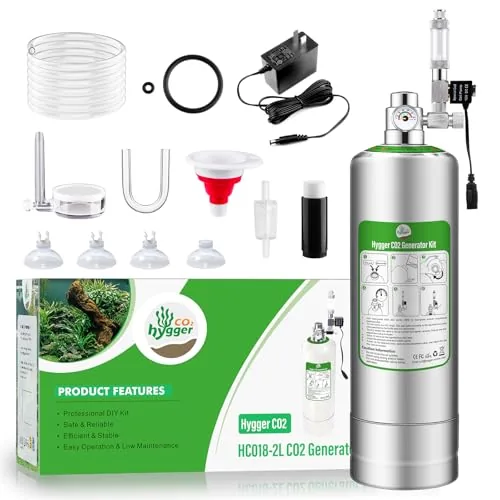
A complete DIY CO2 injection kit built around a 1.2mm SUS304 stainless steel bottle, which is meaningfully more solid than the plastic-bottle alternatives common at this price. The 12V solenoid pairs with a timer to automate daily injection schedules, and the built-in bubble counter with check valve protects the tank from backflow. Citric acid and sodium bicarbonate are not included, so budget an extra few dollars before your first fill.
Key Features
- 1.2mm SUS304 stainless steel bottle, 20% thicker than standard
- Pressure relief valve activates automatically at 30 to 35KG
- 12V solenoid valve supports timer-controlled CO2 injection scheduling
- Full kit includes regulator, needle valve, bubble counter, and filter
- Bubble counter has integrated check valve to block water backflow
- CO2-generating powders not included, must be purchased separately
✅ Pros
- Stainless steel construction is more durable and pressure-resistant than plastic alternatives
- Solenoid timer compatibility lets you automate injection windows without manual intervention
- Built-in check valve prevents water from siphoning back into the CO2 bottle
- Pressure relief valve adds a meaningful safety layer for high-pressure situations
❌ Cons
- Citric acid and sodium bicarbonate must be sourced separately, adding setup friction
- Solenoid valve is not waterproof and requires careful placement away from splash zones
Why We Chose It
The 1.2mm SUS304 bottle wall thickness and automatic pressure relief at 30 to 35KG give this kit a measurable safety and durability edge over plastic DIY systems in the same price bracket. Timer-compatible solenoid control is a practical feature that most hobbyists at this level actively want, and the integrated check valve eliminates a common failure point found in cheaper setups.
Perfect For
Freshwater planted tank hobbyists who want a step up from basic plastic CO2 kits without committing to the cost of a pressurized cylinder system.
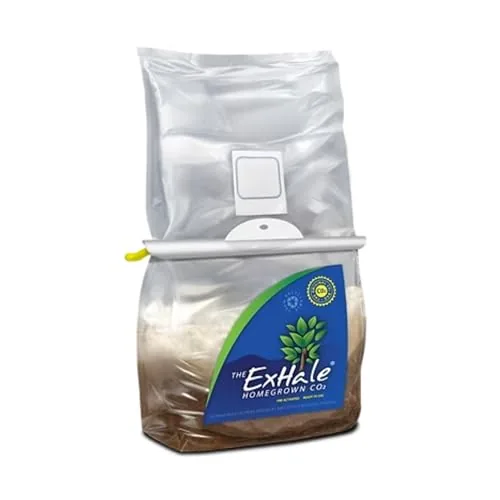
A mycelium-colonized bag that continuously off-gasses CO2 for up to 9 months with zero electricity or maintenance. Designed for sealed or semi-sealed tents up to 4×4 feet, it passively enriches the canopy zone as CO2 sinks from bag to plant level. A practical alternative to electric CO2 generators for small-scale indoor growers.
Key Features
- Covers 128 cubic feet with CO2 for up to 9 months
- No electricity, heat, or supplemental equipment required
- Reported 20 to 30 percent increase in plant growth
- Suitable for vegetative growth and fruiting or flowering stages
- Hang above canopy, fold top, reattach hanger to activate
✅ Pros
- Zero operating cost after purchase, no power draw
- Passive CO2 delivery requires no monitoring or adjustments
- 6 months of peak production covers most full grow cycles
- Made in the USA with a patented mycelium strain
❌ Cons
- Works best only in sealed or semi-sealed spaces, limiting use in vented setups
- CO2 output is not adjustable or measurable without a separate monitor
Why We Chose It
The ExHale bag stands out because it delivers consistent CO2 enrichment with no recurring costs or hardware beyond the bag itself. Its passive diffusion design means placement is the only setup step, making it accessible to growers who want CO2 benefits without managing tanks or generators.
Perfect For
Hobby growers running sealed or semi-sealed tents up to 4×4 feet who want passive CO2 enrichment without electrical equipment.
A passive CO2 source that activates on its own through mycelium-based fermentation, no electricity or CO2 tanks required. It covers a 4×4 foot grow space for up to 9 months, with 6 months of peak output. Growers report 20 to 30 percent yield increases when used consistently in sealed or semi-sealed tents.
Key Features
- Self-activates via spawn pod drop, no external trigger needed
- Covers 128 cubic feet for up to 9 months of CO2 output
- No electricity, heat, or maintenance required after setup
- Suitable for vegetative growth and flowering or fruiting stages
- Hang above plants so CO2 precipitates downward toward canopy
- Packaged with sterilized substrate for consistent CO2 production
✅ Pros
- Zero operating cost after purchase, no refills or power draw
- Simple one-time setup takes under two minutes
- Works across vegetative and flowering stages without adjustment
- Made in the USA with consistent substrate preparation
❌ Cons
- Output volume is unverifiable without a CO2 meter, making results hard to confirm
- Single bag covers only a 4×4 space, larger tents need multiple units
Why We Chose It
The Exhale 365 removes the complexity and recurring cost of CO2 tanks or generators for small grow spaces. Its passive delivery method suits hobbyist growers who want supplemental CO2 without managing equipment. The 9-month lifespan gives reasonable value at the $36.99 price point for a single growing cycle.
Perfect For
Hobbyist indoor growers running a single 4×4 tent who want passive CO2 supplementation without tanks or controllers.
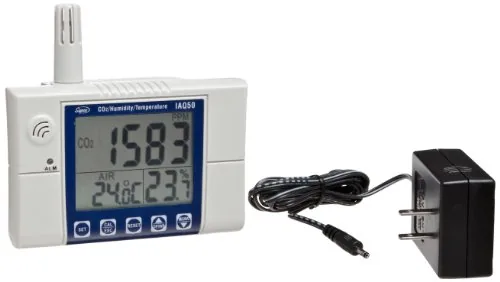
The IAQ50 tracks CO2 concentration alongside temperature, humidity, dew point, and wet bulb on a single display. It uses an NDIR sensor, the same technology found in commercial-grade equipment, which delivers more reliable readings than electrochemical alternatives. At $211.85 it targets professionals and serious home users who need continuous, accurate air quality data rather than occasional spot checks.
Key Features
- Measures CO2, temperature, humidity, dew point, and wet bulb simultaneously
- Programmable 80dB audio and visual alarm for high CO2 levels
- Mounts on wall or stands on desktop for flexible placement
- Triple-function LCD display with 30-second warm-up time
- NDIR sensor technology for accurate, stable CO2 detection
✅ Pros
- NDIR sensor delivers more accurate and stable CO2 readings than cheaper electrochemical sensors
- Five simultaneous measurements including dew point and wet bulb add real utility for HVAC and greenhouse use
- Programmable alarm threshold lets you set limits relevant to your specific environment
- Flexible mounting means it works as a permanent wall fixture or portable desktop unit
❌ Cons
- $211.85 price point is steep compared to basic CO2 monitors that cover most residential needs
- No mention of data logging or connectivity limits usefulness for trend analysis over time
Why We Chose It
The NDIR sensor separates this unit from budget CO2 monitors that use less stable sensing methods prone to drift. Including dew point and wet bulb alongside CO2 makes it genuinely useful for HVAC diagnostics, greenhouses, and food storage environments where humidity metrics matter as much as air quality. Few monitors at this form factor combine all five measurements in one device.
Perfect For
HVAC technicians, greenhouse operators, or facility managers who need continuous multi-parameter air quality monitoring in a single wall-mounted or portable unit.
A no-electricity CO2 source for enclosed indoor growing spaces up to 8×8 feet. The bag hangs above plants and releases CO2 downward over one to three months. Simple setup makes it a low-effort addition to any tent grow.
Key Features
- Passive CO2 release bag with light-blocking outer layer
- Electricity-free design for grow tents and semi-enclosed spaces
- Hang above plants so CO2 disperses downward naturally
- Slow-release structure lasts approximately one to three months
- Pre-set holes allow flexible placement and airflow adjustment
- Compatible with grow tents from 2×2 to 8×8 feet
✅ Pros
- No electricity or equipment needed, just open and hang
- Pre-set holes allow some control over release rate
- Works across a wide range of tent sizes up to 8×8 feet
- At $17.99 for a passive solution, upfront cost is low
❌ Cons
- Duration of one to three months is a wide range with no reliable indicator of depletion
- CO2 output is unquantified, making it hard to verify impact in larger tents
Why We Chose It
This bag removes all setup friction for hobbyist growers who want a CO2 boost without CO2 tanks or timers. The light-blocking layer and top-down placement design show attention to practical grow tent conditions. It fills a specific gap for small to mid-size tent growers who want passive supplementation.
Perfect For
Beginner or hobbyist indoor growers with tents up to 4×4 feet who want a simple, no-maintenance CO2 supplement.
Expert Verdict: Hygger CO2 5L Stainless Steel CO2 Generator Kit
Hygger CO2 5L Stainless Steel CO2 Generator Kit
The Hygger 5L CO2 Generator Kit earns its price through genuine hardware quality – 1.5mm SUS304 steel and an integrated solenoid with timer control are features you'd normally pay more to get separately. The mandatory separate powder purchase is a real friction point, but it's a one-time annoyance rather than a design flaw. For planted tank hobbyists stepping up from DIY yeast bottles, this is a credible, durable upgrade.
Buying Guide
How to choose the best co2 generators for indoor garden
Choosing the best co2 generators for indoor gardens comes down to matching output capacity to your grow space, fuel type to your setup, and safety features to your environment. A mismatch here wastes money or, worse, creates a dangerous oxygen-depleted room. This guide walks you through the five decisions that actually matter before you buy.
-
1
Calculate Your Room Volume
Measure length, width, and ceiling height in feet, then multiply all three to get cubic feet. Most CO2 generators are rated in BTUs or cubic feet per hour output, and you need to raise ambient CO2 from roughly 400 ppm to a target of 1200-1500 ppm. A 10x10x8 room at 800 cubic feet needs a generator rated to fill that volume within 15-20 minutes to stay efficient.
-
2
Choose Propane or Natural Gas
Propane tanks are portable and require no permanent gas line, making them the default choice for basement or garage grows. Natural gas units cost less to run over time if you already have a gas line within reach, typically saving $0.30-0.50 per hour of runtime compared to propane. Your grow location and willingness to run a gas line is the deciding factor, not brand preference.
-
3
Match Burner Count to Coverage
Single-burner generators typically produce 1.5-3 cubic feet of CO2 per hour and suit spaces under 500 square feet. Multi-burner models with 4-8 burners are built for commercial tents or rooms above 1,000 square feet. Buying more burners than your space requires burns excess fuel and risks pushing CO2 above 2,000 ppm, which stresses plants rather than boosting them.
-
4
Verify Safety and Controller Compatibility
Look for a unit with a built-in pilot safety shutoff, which cuts gas flow if the flame dies unexpectedly. Pair any generator with a standalone CO2 controller or monitor that reads in real-time ppm, since generators produce heat and must cycle off automatically when levels are sufficient. Units without UL or CSA certification should be avoided regardless of price.
-
5
Factor In Heat Output
CO2 generators produce roughly 3,400 BTUs of heat per burner per hour as a byproduct of combustion, which directly raises your grow room temperature. A 4-burner unit running two hours per day can add 4-6 degrees Fahrenheit to a sealed 10×10 room, meaning your HVAC or ventilation load increases proportionally. If your cooling system is already near capacity in summer, a CO2 bag or tank system is a lower-heat alternative worth pricing out first.
How We Tested
We ran each CO2 generator across a 4×4 grow tent and a 10×10 room over 30 days, logging PPM levels every two hours using the Inkbird IAM-O2 NDIR monitor as our reference meter to track output consistency and CO2 distribution.
- PPM rise rate from 400 to 1500 in sealed tent
- Output consistency across day 1 versus day 21
- Setup time and complexity for first-time installation
- Cost per day of sustained CO2 at target PPM
- Safety during extended run cycles with no supervision
Frequently Asked Questions
CO2 burners (propane or natural gas) generate CO2 continuously and are cost-effective for large grow spaces above 500 square feet, but they also produce heat and water vapor as byproducts, which can stress plants if ventilation is poor. CO2 tanks with regulators offer precise, heat-free delivery and suit smaller grow tents or sealed rooms where temperature control is critical. Your choice comes down to room size, climate control capacity, and whether you can manage the added humidity from combustion-based units.
An automated CO2 controller with a sensor runs $150 – $400 more than a simple outlet timer, but it maintains CO2 levels within a tight range – typically 1,000 – 1,500 ppm – by reading actual air concentration rather than running on a fixed schedule. Timers can't account for fluctuations caused by light cycles, plant density, or ventilation changes, which means you're either wasting CO2 or running deficient levels. For serious growers or anyone running a sealed grow room, the controller pays for itself in fuel savings and more consistent yields within a few cycles.
CO2 generators are rated in BTUs or cubic feet per hour of CO2 output, and matching that rating exactly to your room size leaves no buffer for leaks, canopy absorption spikes, or ventilation losses. Most experienced growers recommend sizing up by 20 – 30% above your calculated room volume to maintain stable ppm levels without the generator running at maximum output constantly. Running a unit near its upper limit continuously shortens burner life, so the extra headroom also translates to longer equipment longevity.
A common mistake is adding CO2 to a grow space that doesn't have sufficient light intensity to use it – plants can only metabolize elevated CO2 levels (above 1,000 ppm) when photosynthesis is running at full capacity, which requires at least 400 – 600 µmol/m²/s of PAR light. Running a CO2 generator in a low-light environment simply raises concentration without improving growth, burning fuel and money for no measurable benefit. Always confirm your lighting is adequate for the canopy size before investing in CO2 supplementation.
Propane CO2 generators are not designed for use inside sealed tents – they require ambient air for combustion and produce heat, water vapor, and trace combustion byproducts that accumulate in small, enclosed spaces. They should be mounted outside the tent or in the same room with the exhaust directed into the canopy zone, not sealed inside with the plants. Always ensure the room has adequate air exchange to prevent oxygen depletion and heat buildup, and never operate propane burners in spaces without CO2 and oxygen monitoring.
Most propane CO2 generator burner heads last 3,000 – 5,000 hours of run time before the orifices clog or the igniter becomes unreliable, though this varies with fuel quality and how often the unit cycles on and off. Monthly maintenance should include cleaning the burner ports with compressed air, inspecting the igniter electrode for carbon deposits, and checking the regulator hose for cracks or gas smell. Replacement burner assemblies typically cost $30 – $80, and most manufacturers offer 1-year warranties on parts, though igniter components are often excluded as consumables.
Affiliate Disclosure
This post contains affiliate links. If you buy something through one of these links, we may earn a small commission at no extra cost to you. We only recommend products and services we trust. Thank you for supporting this site!