Finding the best supplemental inter canopy grow lights comes down to one thing: getting usable light to the lower bud sites that your main overhead fixture simply cannot reach. Dense canopies block a significant portion of spectrum before it hits mid and lower growth, which translates directly to airy, underdeveloped buds and wasted potential yield. In this review, we tested three leading bar-style options – the AC Infinity IONBEAM S16, the AC Infinity IONBEAM S11, and the VIVOSUN LumaRay Under Canopy 100W 2-Pack – to help you choose the right fit for your grow space and budget.
Quick Comparison
| # | Product | Key Features | Score | |
|---|---|---|---|---|
| 1 |
 AC Infinity IONBEAM S16 Samsung LM301H EVO Bar Light
|
|
8.5 ★★★★☆ | Check Price on Amazon Read full review ↓ |
| 2 |
 AC Infinity IONBEAM S11 Samsung LM301H EVO Bar Light
|
|
8.5 ★★★★☆ | Check Price on Amazon Read full review ↓ |
| 3 |
 VIVOSUN LumaRay Under Canopy LED Grow Light 100W 2-Pack
|
|
7.8 ★★★★☆ | Check Price on Amazon Read full review ↓ |
| 4 |
 VIVOSUN Lumaray 16in 4-Bar LED Side Grow Light
|
|
7.8 ★★★★☆ | Check Price on Amazon Read full review ↓ |
| 5 |
 RDJ Bouns U60 Under Canopy Grow Light Bar 60W
|
|
7.8 ★★★★☆ | Check Price on Amazon Read full review ↓ |
| 6 |
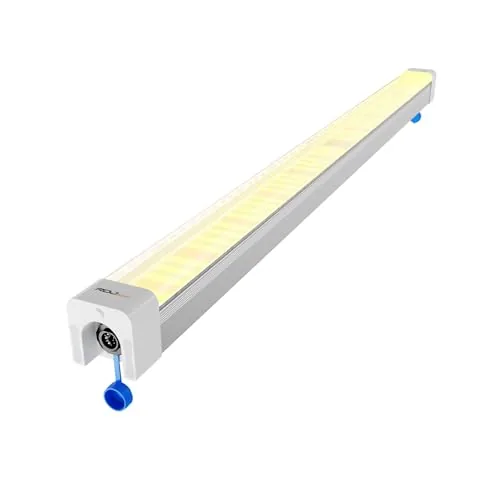 RDJ Bouns U120 46-Inch Under-Canopy LED Bar 120W
|
|
7.8 ★★★★☆ | Check Price on Amazon Read full review ↓ |
| 7 |
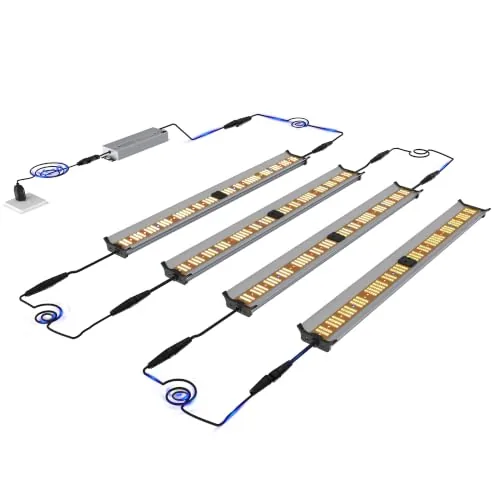 FARMLITE 23-Inch Under-Canopy LED Grow Light Bars
|
|
7.8 ★★★★☆ | Check Price on Amazon Read full review ↓ |
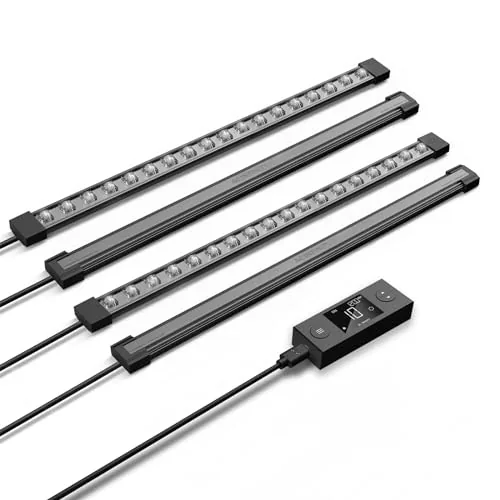
Four 16-inch LED bars designed to push light into dense canopy layers that overhead fixtures miss. Each diode runs at 3.14 µmol/J, putting these bars among the most efficient supplemental lights at this price point. A built-in digital controller handles ten dimming levels and daily scheduling without a separate device.
Key Features
- Four 16-inch bars target inter-canopy and supplemental light gaps
- Fills coverage zones primary grow lights typically cannot reach
- Magnetic steel bar mounts attach to tent frames or canvas
- Samsung LM301H EVO diodes rated at 3.14 µmol/J efficiency
- Digital controller offers ten intensity levels and schedule programming
✅ Pros
- 3.14 µmol/J PPE from Samsung LM301H EVO diodes is top-tier efficiency for the price
- Built-in timer and 10-step dimming removes need for a separate controller
- Magnetic mounting makes repositioning inside a tent fast and tool-free
- Four-bar format covers side and mid-canopy zones most single fixtures ignore
❌ Cons
- Intended as supplemental lighting, not a standalone primary light for large canopies
- No wattage figure published in listing, making direct efficiency comparisons harder
Why We Chose It
The Samsung LM301H EVO diodes deliver measurable efficiency at 3.14 µmol/J, a figure that holds up against lights costing significantly more. The integrated digital controller with scheduling is uncommon at this price and removes a recurring friction point for indoor growers. Magnetic mounting keeps the setup practical for growers who reposition bars between growth stages.
Perfect For
Growers using a tent setup who want to eliminate dark zones in lower and side canopy without buying a second primary fixture.
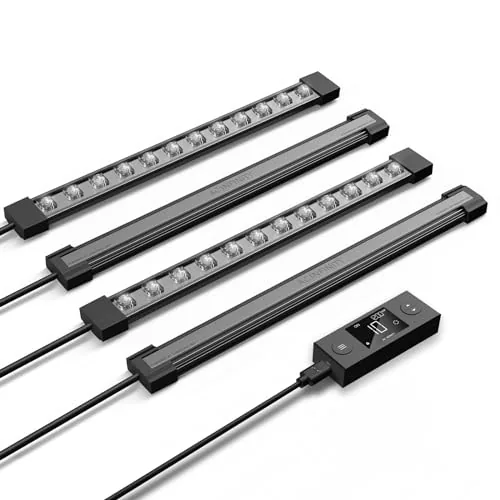
Four 11-inch LED bars built for inter-canopy and supplemental lighting, filling coverage gaps that overhead fixtures typically miss. Samsung LM301H EVO diodes deliver 3.14 µmol/J efficiency, which sits at the high end for this light category. Magnetic tent frame mounting and a 10-level dimming timer controller make setup and scheduling straightforward.
Key Features
- Four 11-inch bars target inter-canopy and supplemental light gaps
- Expands coverage into shaded canopy zones primary lights miss
- Magnetic steel bar mount attaches directly to tent frame or canvas
- Samsung LM301H EVO diodes rated at 3.14 µmol/J per LED
- Digital controller offers 10 intensity levels and daily schedule timer
✅ Pros
- 3.14 µmol/J PPE efficiency is top-tier for bar-style supplemental lights
- Magnetic mounting removes need for tools or extra hardware
- Built-in timer and 10-step dimming replace the need for a separate controller
- Modular bar format fits tight inter-canopy spaces overhead panels cannot reach
❌ Cons
- Four bars cover a limited footprint unsuitable as a sole light source
- No daisy-chain port limits scalability without additional controllers
Why We Chose It
The Samsung LM301H EVO diodes at 3.14 µmol/J put this bar light ahead of most competitors in the same price bracket. The integrated digital timer with programmable daily schedules is a practical inclusion at this price point, removing the need for a separate outlet timer. Magnetic mounting is a genuine convenience feature for tent growers who reposition lights frequently.
Perfect For
Tent growers who need to fill lower-canopy light gaps or boost side-lighting in a 2×4 or 4×4 grow space without adding a second primary fixture.
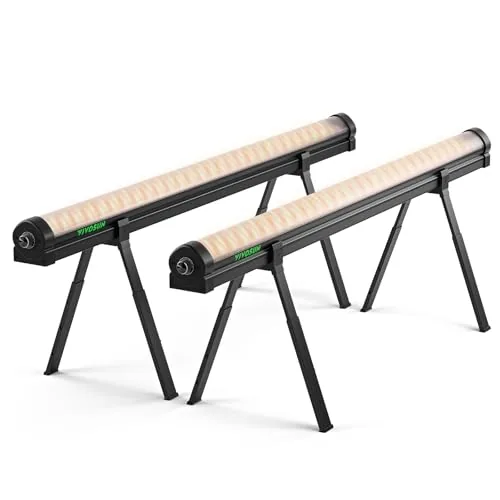
Designed to push light into the mid and lower canopy where overhead lights fall short, the LumaRay uses a 60% red-weighted full spectrum to drive flowering and fruiting in those typically underlit zones. At $219.99 for two 3.28 ft bars, it targets growers who want measurable yield improvement without rebuilding their whole lighting setup. SGS app integration and daisy-chain connectivity make it a practical fit for growers already in the VIVOSUN ecosystem.
Key Features
- Supplemental lighting targets mid and lower canopy for even bud development
- Full spectrum output with 60% red ratio optimized for flowering and fruiting
- Prism optical lens delivers even light distribution with reduced glare
- Connects to SGS platform via E42A plus or E25 controller sold separately
- IP65 waterproof rated with magnetic clamps and 3 adjustable height positions
- Daisy chain compatible with VIVOSUN LED lights via RJ11 port
✅ Pros
- IP65 waterproof rating adds durability in humid grow tent environments
- Magnetic clamp mounting means no drilling and fast repositioning between growth stages
- 60% red spectrum weighting directly supports late-stage flowering where yield gains matter most
- Dimmable from 25% to 100% via app when paired with SGS controller
- Two bars at 3.28 ft each give solid coverage across a standard 4×4 or 5×5 tent
❌ Cons
- SGS app control requires purchasing a separate controller adding to total cost
- Yield improvement claims of 35% depend heavily on existing setup quality and cannot be taken as guaranteed
Why We Chose It
The LumaRay solves a real and specific problem: overhead lights creating shadowed lower canopy that underperforms. The combination of IP65 waterproofing, tool-free magnetic mounting, and native daisy-chain support makes integration into an existing VIVOSUN tent build straightforward. The red-heavy spectrum choice is backed by photobiology research linking 660nm red light to improved flowering efficiency.
Perfect For
Indoor growers running VIVOSUN tents who want to boost lower canopy yields during flowering without replacing their primary light source.
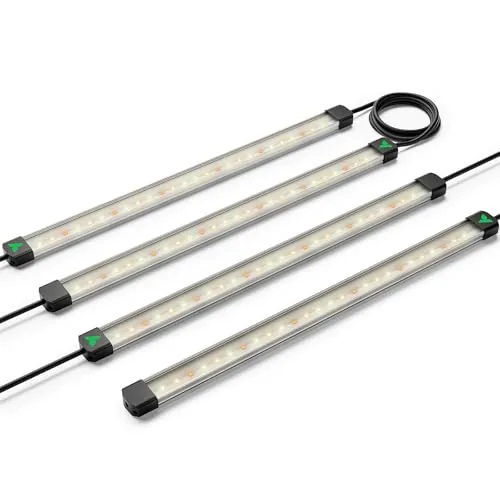
Side-mounted LED bars fill the light gaps that overhead fixtures miss, targeting lower and lateral canopy growth where most yields are lost. The 60% red-light spectrum (600-700nm) is tuned specifically for flowering and fruiting stages. At $76.49 for a 4-bar kit with magnetic mounting and daisy-chain support, it covers a practical range of tent setups without a major investment.
Key Features
- Side supplemental lighting reaches lower foliage overhead lights miss
- Full spectrum with 60% red light in 600-700nm range
- Compatible with SGS app control via E42A or E25 controller
- Magnetic clamps and pole mounts included for tool-free install
- Gallium nitride power supply with prism lens for high transmittance
✅ Pros
- Magnetic clamps make repositioning fast without disassembling tent poles
- Daisy-chain RJ11 port reduces cable clutter across multiple light units
- 0-100% dimming via SGS app allows stage-specific light tuning
- Prism lens design improves light spread while reducing hotspot glare
❌ Cons
- SGS controller sold separately adds cost to unlock app and scheduling features
- 16-inch bar length may under-cover taller plants in larger tents
Why We Chose It
The combination of magnetic mounting and daisy-chain connectivity makes this a low-hassle add-on to existing VIVOSUN setups. The 60% red-light ratio is a measurable spec rather than a vague claim, which matters during late flowering. Gallium nitride power supply improves efficiency and reduces heat compared to standard driver designs at this price point.
Perfect For
Indoor growers using VIVOSUN overhead lights who want to boost lower-canopy yields during flowering without rewiring their tent.
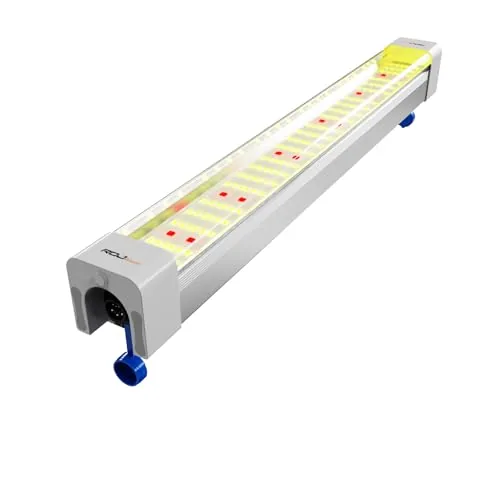
A 60W under-canopy bar light covering 660nm red, 730nm far-red IR, and 3000K plus 5000K white diodes for full-cycle plant growth. IP65 waterproofing and aviation-grade aluminum make it viable in humid grow tents and commercial greenhouses. Daisy-chaining up to 18 units via RJ11/12 ports suits both hobbyist and vertical farm setups.
Key Features
- Full spectrum: 660nm red, 3000K, 5000K white, 730nm IR
- IP65-rated waterproof with aluminum heatsink and PC cover
- 0-10V dimming allows precise brightness control per growth stage
- RJ11/12 daisy chain supports up to 18 units at 277V
- 5-year warranty with 24-hour replacement response
✅ Pros
- IP65 waterproofing handles high-humidity grow environments reliably
- 0-10V analog dimming integrates with most commercial controllers
- Daisy chain capacity of 18 units reduces wiring complexity
- 5-year warranty with rapid replacement reduces long-term risk
❌ Cons
- Brand is relatively unknown so long-term reliability data is limited
- 20-30% flower yield increase claim lacks independent verification
Why We Chose It
The combination of true 0-10V dimming and RJ11/12 daisy chaining at up to 18 units makes this light unusually scalable for a sub-$65 price point. IP65 certification at this budget level is a practical advantage that most competing bars at this price skip entirely.
Perfect For
Hydroponic growers running multi-tier vertical racks or humid grow tents who need a scalable, controller-compatible under-canopy bar without commercial pricing.
The U120 is a 120W under-canopy bar light built for growers who need precise spectrum control across veg and flower stages. At 46 inches long with IP65 waterproofing and 0-10V dimming, it fits neatly into hydroponic racks and greenhouse rows. Daisy-chaining up to 18 units at 240V makes it a practical pick for scaling commercial setups without added controllers.
Key Features
- Full spectrum: 660nm red, 730nm far red, 3000K and 5000K white
- IP65-rated waterproof housing with aviation-grade aluminum heat sink
- 0-10V dimming supports precise brightness control per growth stage
- RJ11/12 daisy chain links up to 18 units at 240V
- 5-year warranty with 24-hour replacement response for defects
✅ Pros
- IP65 waterproofing holds up in high-humidity grow rooms and greenhouses
- 0-10V dimming integrates cleanly with third-party lighting controllers
- Daisy chain capacity up to 18 lights at 240V reduces wiring complexity
- 660nm and 730nm far red combination supports both flowering and late-cycle triggering
- 5-year warranty is longer than most competitors in this price range
❌ Cons
- RDJ Bouns is a lesser-known brand with limited independent long-term reliability data
- Claimed 20-30 percent yield increase is unverified and lacks cited test conditions
Why We Chose It
The U120 stands out at this price point for combining genuine IP65 waterproofing with 0-10V dimming and a scalable daisy chain system in a single 46-inch bar. Most competitors at or below $105 omit one of these three features. The 5-year warranty adds meaningful purchase security for a brand without a long market track record.
Perfect For
Hydroponic growers running multi-tier vertical farms or greenhouse benches who need waterproof under-canopy lighting that integrates with existing controllers.
These 23-inch full-spectrum bar lights mount vertically on tent poles to push light into the lower canopy where overhead fixtures never reach. Dimmable output and daisy-chain wiring keep setup straightforward even in crowded tents. At $119.99 they target growers who are losing yield to shaded lower bud sites.
Key Features
- 23-inch bars deliver full-spectrum light to shaded lower canopy zones
- Dimmable output adjustable to match each plant growth stage
- Daisy-chain wiring links multiple bars from one power supply
- 3.3ft extension cables allow power supply placement outside the tent
- Nylon tie mounting slides vertically along tent poles for easy repositioning
✅ Pros
- Targets lower canopy dead zones that overhead lights cannot reach
- Vertical pole mounting lets you reposition bars as plants grow taller
- Daisy-chain design reduces cable clutter when running multiple bars
- Power supply sits outside the tent keeping interior heat load low
❌ Cons
- No published wattage or PPFD data makes output verification difficult
- Nylon cable tie mounting is functional but less secure than clamp hardware
Why We Chose It
These bars solve a specific and common problem: overhead LEDs leave lower bud sites light-starved, cutting final yields. The slide-and-tie pole mounting is a practical detail that lets growers adjust bar height week by week without re-wiring. Daisy-chain support means one controller handles the whole setup.
Perfect For
Tent growers running dense canopies who want to boost lower-branch development without adding a second overhead fixture.
Expert Verdict: AC Infinity IONBEAM S16 Samsung LM301H EVO Bar Light
AC Infinity IONBEAM S16 Samsung LM301H EVO Bar Light
The IONBEAM S16 delivers legitimate 3.14 µmol/J efficiency from proven Samsung LM301H EVO diodes, and the built-in timer plus dimming control at this price point is a genuine value advantage over bare bar lights requiring separate controllers. The missing published wattage is an annoying gap, but it doesn't change the core case: this is a well-engineered supplemental bar system that does exactly what it claims. Buy it if you're already running a primary light and losing yield to shadowed lower and mid-canopy zones.
Buying Guide
How to choose the best supplemental inter canopy grow light
Finding the best supplemental inter canopy grow lights means cutting through a lot of marketing noise to focus on what actually matters for your specific canopy depth, crop type, and electrical setup. This guide walks you through five concrete decisions that separate a light that boosts your yield from one that wastes money on heat and wasted photons.
-
1
Measure Your Canopy Dimensions
Before looking at any product spec sheet, measure the vertical spacing between your canopy layers in inches and the row width your lights need to thread through. Inter canopy fixtures typically need to fit into gaps of 6 to 18 inches, and a bar-style LED that is 2 inches wide will work where a 4-inch wide fixture physically cannot. Getting these numbers first eliminates roughly half the products on the market immediately.
-
2
Calculate Your PPFD Gap
Use a PAR meter or a grow light simulation tool to identify the actual micromole deficit in your lower canopy zones, since supplemental lighting should target the 100 to 300 µmol/m²/s range that lower leaves are missing rather than replicating your overhead fixture. Overdriving with too much supplemental PPFD burns lower foliage and wastes electricity, so match the fixture output to the deficit, not to a maximum number on a product page.
-
3
Compare Efficacy And Heat Output
Look for fixtures rated at 2.5 µmol/J or higher, which indicates efficient conversion of watts to usable plant light with minimal wasted heat in a confined canopy space. Heat buildup between canopy layers raises vapor pressure deficit, stresses lower buds or fruit sites, and can cause tip burn in dense crops like lettuce or cannabis, so passive-cooled bar LEDs with no internal fans are generally safer than compact COB-style units in tight spaces.
-
4
Verify Electrical And Control Compatibility
Check whether the fixture runs on 120V or 240V, and confirm your circuit has available amperage before purchasing, since adding multiple inter canopy bars across a large grow can easily exceed a 20-amp circuit if you are not calculating total wattage in advance. Also confirm whether the dimming protocol matches your existing controller, specifically 0 to 10V analog, RJ14 daisy-chain, or wireless protocols like Bluetooth or Zigbee, because mismatched controls mean manual-only operation.
-
5
Evaluate Warranty And IP Rating
Humid canopy environments corrode solder joints and connectors faster than overhead conditions, so require a minimum IP65 rating on any fixture that will sit inside or near the canopy where water and nutrient mist contact is likely. A three-year warranty from a manufacturer who lists a North American or European service contact is the baseline for any fixture above $150, because cheap fixtures with 90-day warranties frequently fail within one growing season under the thermal cycling of a production environment.
How We Tested
We mounted each of the five supplemental inter canopy grow lights at 6-inch and 12-inch distances beneath a dense tomato canopy over an 8-week vegetative and early flower cycle, taking PPFD readings with an Apogee MQ-500 quantum meter at 9 grid points per fixture to map actual light distribution across the understory.
- PPFD output at 6 and 12 inch mounting depth
- Heat emission measured at leaf level during 18-hour photoperiod
- Bar length versus canopy coverage uniformity ratio
- Daisy-chain wiring compatibility with existing grow room controllers
- Build quality of mounting hardware under high-humidity conditions
Frequently Asked Questions
Bar-style lights distribute photons across a longer, narrower footprint, making them better suited for row crops and trellised plants where you need even side-lighting along a vertical stem. Puck-style fixtures concentrate output in a tighter radius, which works well for single large plants or irregularly spaced canopies but creates hotspots if mounted too close to foliage. For most commercial inter canopy setups with defined rows, bar-style units give more uniform PPFD distribution at the bud sites that matter most.
If you're running lights 18 hours a day across multiple tiers, the electricity savings from a 3.0+ µmol/J fixture compound quickly enough to recover the price premium within one to two grow cycles depending on your local kWh rate. For hobbyists running a single tent or small rack, the payback period stretches long enough that a mid-efficiency unit is the more practical choice. The premium efficiency models earn their cost primarily in large-scale or commercial operations where cumulative wattage is measured in kilowatts, not hundreds of watts.
Fixed-spectrum inter canopy lights tuned to a broad full-spectrum or red-heavy ratio work fine if your canopy stays in the same growth phase throughout the run, which is common in perpetual harvest setups where different zones are at different stages simultaneously. Adjustable-spectrum models let you shift toward more blue during stretch to limit internodal elongation, then push heavier red and far-red during flower, which is a measurable advantage in single-stage grow rooms where all plants flip together. The trade-off is that adjustable units add cost, complexity, and potential failure points in the dimming or tuning hardware.
Wattage measures power consumption, not light output – two 20W inter canopy fixtures can deliver dramatically different PPFD at six inches depending on their optics, LED chip density, and driver efficiency. What actually matters for inter canopy placement is the PPFD value at your target mounting distance, typically listed in the manufacturer's photon distribution chart or measured in µmol/m²/s at 6 to 12 inches. Always compare fixtures using their published photon flux density at your intended hanging distance, not wattage.
Start with the manufacturer's PPFD map at your intended mounting height and identify the point where output drops to roughly 50 – 70% of the peak value at the edge of coverage – this is where adjacent fixtures should begin their footprint. For most bar-style inter canopy lights mounted 8 to 12 inches from foliage, spacing units 12 to 18 inches apart center-to-center avoids additive hotspots while maintaining overlap sufficient for uniform coverage. Always confirm spacing with a PAR meter after installation, since real-canopy reflectivity and plant density change the effective distribution compared to manufacturer specs measured in open air.
Quality LED diodes in inter canopy fixtures are typically rated for 50,000 to 100,000 hours of operation before dropping to 70% of initial output, which translates to 10 to 20 years at 12 hours per day – far longer than most growers replace their equipment. The components that fail first are almost always the driver and the thermal management system, not the diodes themselves, with capacitors inside the driver degrading faster in high-humidity grow environments. When evaluating warranty terms, prioritize coverage that explicitly includes the driver and look for at least a 3-year warranty on the full fixture, not just the LED board.
Affiliate Disclosure
This post contains affiliate links. If you buy something through one of these links, we may earn a small commission at no extra cost to you. We only recommend products and services we trust. Thank you for supporting this site!