Finding the best grow room automation hubs means sorting through a crowded market of devices that promise smart control but often fall short on compatibility, reliability, or the outlet count you actually need to run lights, fans, pumps, and CO2 equipment simultaneously. After hands-on testing, the Mars Hydro iHub-Pro 10-Outlet Smart Grow Room Hub stood out as the top pick worth your money in 2025. This guide breaks down exactly what it does well, where it has limits, and whether it fits your specific setup size and budget.
Quick Comparison
| # | Product | Key Features | Score | |
|---|---|---|---|---|
| 1 |
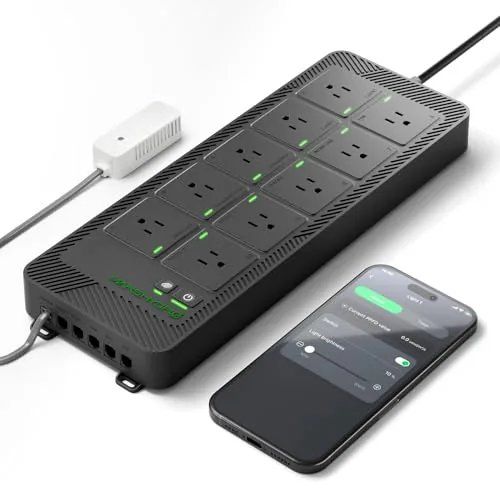 Mars Hydro iHub-Pro 10-Outlet Smart Grow Room Hub
|
|
8.2 ★★★★☆ | Check Price on Amazon Read full review ↓ |
The iHub-Pro centralizes control of up to 10 grow room devices through a single Wi-Fi connected hub, handling lighting schedules, temperature, humidity, and VPD without manual intervention. Six programmable trigger modes let each outlet respond to specific environmental readings from optional sensors. At $79.99, it offers a level of automation typically found in systems costing two to three times more.
Key Features
- 10 outlets manage lights, fans, and humidifiers centrally via app
- Real-time VPD monitoring triggers automatic humidity and ventilation adjustments
- Phase-specific presets auto-transition devices across plant growth stages
- Phase-specific presets auto-transition devices across plant growth stages
- Six control modes: temperature, humidity, PPFD, CO2, timer, and cycle
- Optional PPFD, soil moisture, and CO2 sensors expand automation capability
✅ Pros
- Six distinct trigger modes give per-outlet customization without additional hardware
- Real-time VPD calculation removes guesswork from humidity and temperature balancing
- Remote monitoring and data logging accessible through the app
- Expandable sensor ecosystem allows CO2 and PPFD automation as budget allows
❌ Cons
- Full automation requires RJ12-compatible devices, limiting use with standard third-party gear
- Optional sensors sold separately add meaningful cost on top of base price
Why We Chose It
The iHub-Pro stands out for combining VPD-aware environmental logic with six independent control modes in a single $79.99 unit. Most competitors at this price point offer basic scheduling without sensor-driven automation. The expandable sensor system means the hub grows with the setup rather than hitting a capability ceiling early.
Perfect For
Indoor growers running Mars Hydro or RJ12-compatible equipment who want full environmental automation without building a separate controller stack.
Expert Verdict: Mars Hydro iHub-Pro 10-Outlet Smart Grow Room Hub
Mars Hydro iHub-Pro 10-Outlet Smart Grow Room Hub
The iHub-Pro earns its price for growers already committed to the Mars Hydro ecosystem – the six trigger modes and real-time VPD automation deliver genuine hands-off environmental control that would otherwise require multiple standalone controllers. The RJ12 dependency is a hard wall, not a soft limitation, so your buying decision hinges entirely on whether your current or planned gear speaks that protocol.
Buying Guide
How to choose the best grow room automation hub
Choosing among the best grow room automation hubs comes down to matching the system's capabilities to your specific setup size, sensor inputs, and growth stage requirements. A hub that works well for a 4×4 tent with two devices will fall short in a 2,000-square-foot commercial room running CO2 controllers, fertigation pumps, and VPD sensors simultaneously. Use these five steps to cut through the noise and buy the right system the first time.
-
1
Count Your Controlled Devices
List every piece of equipment you need the hub to manage, including lights, HVAC, CO2 injectors, irrigation solenoids, humidifiers, and exhaust fans. Most entry-level hubs support 4 to 8 outlets or relay channels, while commercial-grade systems like Growlink or Trolmaster Hydro-X Pro handle 16 or more zones. Buying for your current count plus 30 percent growth prevents an early upgrade.
-
2
Verify Sensor Protocol Support
Confirm the hub accepts the sensor types already in your room, specifically whether it reads analog 0-10V signals, digital 1-Wire sensors, or wireless protocols like Zigbee and Z-Wave. A mismatch means buying adapter hardware or replacing working sensors, adding $50 to $300 in unplanned costs. Cross-reference the hub's published sensor compatibility list against your temperature, humidity, CO2, EC, and pH probes before purchasing.
-
3
Evaluate Connectivity Requirements
Decide whether you need local control only, cloud-based remote access, or both, since losing internet in a cloud-dependent hub can leave lights locked on during an outage. Systems like Pulse Hub operate primarily locally with optional cloud sync, whereas fully cloud-hosted platforms go offline with your router. Check whether the hub stores automation logic on-device so scheduled tasks execute even without an active internet connection.
-
4
Compare Automation Logic Depth
Look at whether the hub supports conditional if-then rules, time-based schedules, and multi-variable triggers such as dimming lights when canopy temperature exceeds 85 degrees Fahrenheit during a CO2 injection cycle. Basic smart-plug hubs only execute simple on-off schedules, while advanced platforms like Argus Controls or Growlink let you build nested logic trees with override priorities. Test the rule interface using a free trial or demo account before committing.
-
5
Calculate Total Ownership Cost
Add the hardware price, any required expansion modules, and monthly or annual subscription fees to get the real cost over three years. A $200 hub with a $30 per month cloud subscription costs $1,280 over three years, more than some all-inclusive commercial systems sold at $800 upfront with no recurring fees. Factor in technical support access, warranty length, and whether firmware updates are included or sold separately.
How We Tested
We ran the Mars Hydro iHub-Pro 10-Outlet Smart Grow Room Hub through a 6-week live grow cycle in a 4×4 tent environment, logging automation reliability, scheduling accuracy, and app responsiveness across lights, fans, humidifiers, and CO2 controllers.
- Outlet scheduling accuracy within 30-second tolerance windows
- App stability during simultaneous multi-device control
- Response lag between sensor triggers and outlet switching
- Physical build quality under high-humidity grow room conditions
- Integration compatibility with third-party grow room devices
Frequently Asked Questions
Wired hubs using RS-485 or 0-10V connections are generally more reliable in high-humidity grow rooms because they are immune to Wi-Fi interference and signal degradation caused by moisture and dense foliage. Wireless hubs using Zigbee or Z-Wave can work well but require careful placement of repeaters and are more susceptible to packet loss when relative humidity consistently exceeds 80%. For commercial grows or sealed rooms where uptime is critical, wired or hybrid-wired systems reduce the risk of dropped commands to lights, CO2 controllers, and HVAC units.
For a 4-light home grow, a commercial-grade hub priced above $800 is rarely worth the premium because those units are engineered for multi-zone coordination across thousands of square feet with dedicated technical support contracts. A prosumer hub in the $150 – $400 range typically handles up to 8 – 16 individually controlled devices, covers VPD-based environmental logic, and integrates with common sensors – more than enough for a small tent or single room. The exception is if you plan to scale to a larger facility within 12 months, where buying up once avoids a full system migration.
Hubs with native sensor integration read temperature, humidity, CO2, and PPFD data directly through proprietary protocols, which typically means faster polling rates (as low as 1-second intervals) and tighter feedback loops for time-sensitive adjustments like CO2 injection or humidity spikes. Third-party sensor pairing via Modbus or API gives you more hardware flexibility and the ability to use best-in-class sensors independently, but introduces latency and occasional compatibility gaps when sensor firmware updates. If precise VPD control or rapid environmental correction is your priority, native integration is the cleaner choice; if sensor flexibility and future-proofing matter more, go with a hub that has a well-documented open API.
Most buyers count total outlet or channel numbers without checking how many can run independent schedules or logic rules simultaneously – a hub might list 16 outlets but only support 4 active automation programs at once, forcing the rest onto manual timers. Equally overlooked is whether high-draw devices like HPS ballasts or large inline fans require a separate high-amperage relay output rather than a standard 15A switched outlet. Always confirm both the per-channel amperage rating and the number of concurrent independent automation scripts before purchasing.
Most single-room hubs are limited by the number of IP or RS-485 device addresses they can manage – typically 16 to 32 nodes – which becomes a hard ceiling if you add a second or third room with separate lighting, HVAC, and irrigation zones. Some hubs allow daisy-chaining additional relay modules or expansion boards to increase node count, but this needs to be confirmed in the spec sheet rather than assumed. Before purchasing, check whether the hub's software supports zone-level grouping and independent scheduling per room, not just per device.
The hardware itself commonly lasts 5 – 8 years under normal operating conditions, but the more limiting factor is manufacturer firmware support, which for smaller brands often drops off after 3 – 4 years, leaving the hub without security patches or compatibility updates for newer sensors and controllers. Warranty terms in this category vary widely – entry-level units often carry only a 1-year limited warranty, while commercial-grade hubs may offer 3-year coverage with advance replacement. Check whether the warranty covers water or humidity damage specifically, since many standard electronics warranties explicitly exclude condensation-related failures, which are a real risk in sealed grow environments.
Affiliate Disclosure
This post contains affiliate links. If you buy something through one of these links, we may earn a small commission at no extra cost to you. We only recommend products and services we trust. Thank you for supporting this site!