If you’ve spent any time researching the best full cycle led grow lights, you already know the market is flooded with options that make big promises but deliver inconsistent results across seedling, veg, and bloom stages. After testing units across a range of wattages and designs, three models stood out for real, measurable performance: the SANSI 36W Full Spectrum COC Ceramic Grow Light Bulb, the SANSI 15W Full Spectrum Grow Bulb with Optical Lens, and the VIPARSPECTRA 70W Dimmable LED Grow Light Full Spectrum. Whether you’re growing in a small tent, a single closet shelf, or a dedicated grow room, this breakdown will tell you exactly which light fits your setup and why.
Quick Comparison
| # | Product | Key Features | Score | |
|---|---|---|---|---|
| 1 |
 SANSI 36W Full Spectrum COC Ceramic Grow Light Bulb
|
|
8.2 ★★★★☆ | Check Price on Amazon Read full review ↓ |
| 2 |
 SANSI 15W Full Spectrum Grow Bulb with Optical Lens
|
|
8.2 ★★★★☆ | Check Price on Amazon Read full review ↓ |
| 3 |
 VIPARSPECTRA 70W Dimmable LED Grow Light Full Spectrum
|
|
7.8 ★★★★☆ | Check Price on Amazon Read full review ↓ |
| 4 |
 Briignite A19 LED Grow Bulb Full Spectrum 11W 2-Pack
|
|
7.8 ★★★★☆ | Check Price on Amazon Read full review ↓ |
| 5 |
 GooingTop LED Grow Light 6000K Full Spectrum Clip Lamp
|
|
7.5 ★★★★☆ | Check Price on Amazon Read full review ↓ |
| 6 |
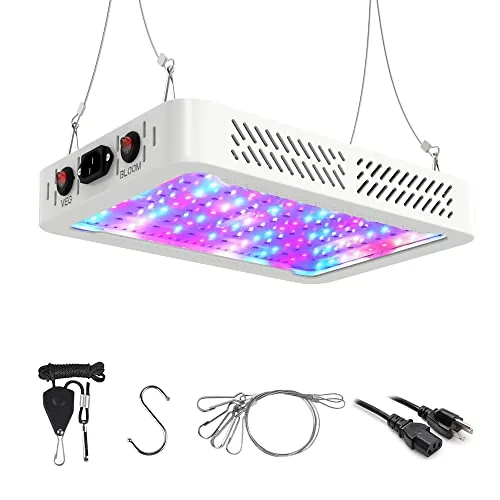 Beelux 1000W LED Grow Light Dual-Chip Full Spectrum
|
|
6.8 ★★★☆☆ | Check Price on Amazon Read full review ↓ |
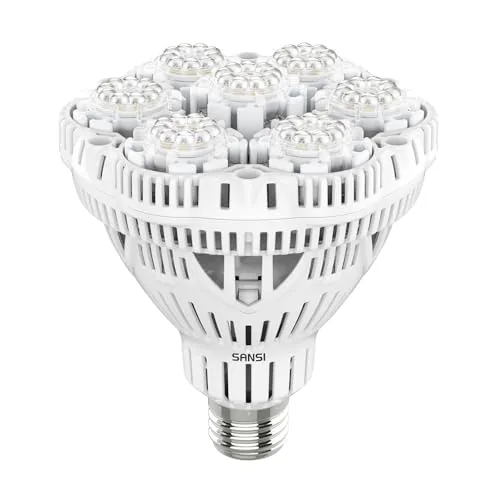
A 36W screw-in grow bulb delivering 65.6 umol/s PPF and 265 umol/s/m2 PPFD at one foot, making it competitive with much pricier fixtures. The ceramic chip-on-ceramic heat sink runs cooler than aluminum-substrate designs, which directly extends rated lifespan to 25,000 hours. At $33 with a 5-year warranty, it targets hobbyists who want measurable light output without a dedicated fixture budget.
Key Features
- 4000K full spectrum covers 400nm to 780nm, CRI near 100
- Secondary optical lens boosts PPFD to 265.58 umol/s/m2 at 1 foot
- Patented ceramic substrate reduces thermal resistance versus aluminum PCB
- Ceramic shell rated V0 flame retardant, WF2 anti-corrosion, low IR output
- ETL listed with 5-year protection plan included
✅ Pros
- Verified PPF of 65.6 umol/s and PPFD figures give real benchmarks to compare
- Ceramic heat sink handles thermal load better than standard aluminum boards
- Standard E26 base fits existing lamp sockets with no extra hardware
- 5-year warranty is unusually long for a sub-$35 grow bulb
- Low infrared output reduces risk of heat stress on close-canopy plants
❌ Cons
- Single-bulb coverage area at useful PPFD is limited to roughly one square foot
- No dimming or spectrum control for growers who want to adjust growth stages
Why We Chose It
SANSI publishes actual PPF and PPFD numbers rather than vague wattage equivalents, which lets buyers make direct comparisons to competing fixtures. The chip-on-ceramic design is a genuine engineering difference that improves both efficiency and longevity, not just a marketing term. The combination of ETL certification and a 5-year warranty at this price point is rare and reduces purchase risk considerably.
Perfect For
Hobbyist growers starting seeds or supplementing light for one to two houseplants or a small herb container, using a standard floor or desk lamp socket.
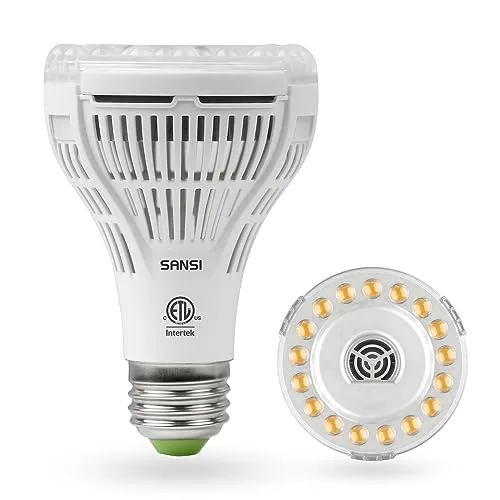
A 15W E26 screw-in grow bulb delivering 152.83 micromoles of light per second per square meter at one foot, making it one of the more efficient options at this price point. The ceramic substrate heat sink is a genuine engineering choice that reduces thermal resistance compared to standard aluminum PCB designs. At $16.10 with a 5-year warranty, it targets hobbyists running small indoor setups who want a no-fuss plug-and-grow solution.
Key Features
- 4000K full spectrum covers 400nm to 780nm with Ra near 100
- Secondary optical lens boosts PPFD to 152.83 micromol per square meter at 1 foot
- Patented ceramic substrate replaces aluminum PCB for lower thermal resistance
- Ceramic shell rated V0 flame retardant and WF2 anti-corrosion grade
- ETL listed with 5-year warranty and rated 25,000 hour lifespan
✅ Pros
- 152.83 micromol per second per square meter PPFD at one foot is competitive for a single 15W bulb
- Ceramic chip-on-ceramic design genuinely improves heat dissipation over standard aluminum PCB bulbs
- Standard E26 base screws into any lamp socket with no additional driver or controller needed
- 5-year warranty is unusually long for a budget grow bulb under $20
- Low infrared output reduces heat stress risk for plants placed close to the bulb
❌ Cons
- 27 micromol per second total PPF output limits effective coverage to roughly one square foot
- No dimming or spectrum control means you cannot adjust output for different growth stages
Why We Chose It
The chip-on-ceramic technology is a verifiable hardware differentiator, not just a marketing claim, and directly supports the 25,000-hour lifespan rating. The 4000K color temperature and near-100 CRI make it usable across seedling through harvest stages without swapping bulbs. The ETL listing and V0 flame rating add a layer of safety verification that many budget grow bulbs skip entirely.
Perfect For
Hobbyist growers running one or two houseplants, herbs, or seedling trays under a standard desk lamp or clamp light fixture.
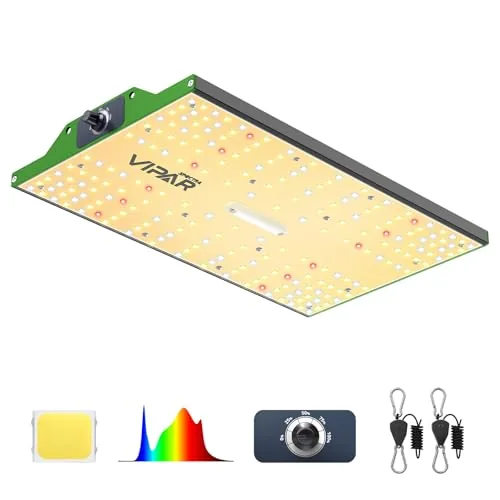
A 70-watt fanless LED panel that replaces a 150W HPS bulb and covers a 2×2 ft vegetative footprint. The 660nm red plus 3000K and 5000K white diode mix targets seedling and vegetative stages specifically. Four dimmer levels let you dial output to match plant type without swapping hardware.
Key Features
- Diode layout delivers 11000 lumens for seedling and veg growth
- 660nm red plus 3000K and 5000K white spectrum mimics sunlight
- Replaces 150W HPS while consuming only 70W across a 2×2 ft area
- Fanless aluminum heat sink design for passive heat dissipation
- Four-level dimmer adjustable for flowers herbs and vegetables
✅ Pros
- 70W draw replacing a 150W HPS cuts electricity cost meaningfully
- Fanless design means zero noise and no moving parts to fail
- 11000 lumens across a 2×2 ft canopy is adequate for dense veg growth
- Four brightness levels add flexibility without extra hardware
❌ Cons
- Coverage drops off significantly beyond the rated 2×2 ft footprint
- No integrated timer means you need a separate outlet controller
Why We Chose It
The combination of a passive cooling system, dual white spectrums alongside targeted 660nm red, and a four-step dimmer gives this light practical versatility at a sub-$40 price point. Most competing panels at this price use single-color-temperature whites or active fans that add noise and failure risk.
Perfect For
Home gardeners running a single 2×2 ft tent through seedling and vegetative stages on a tight energy budget.
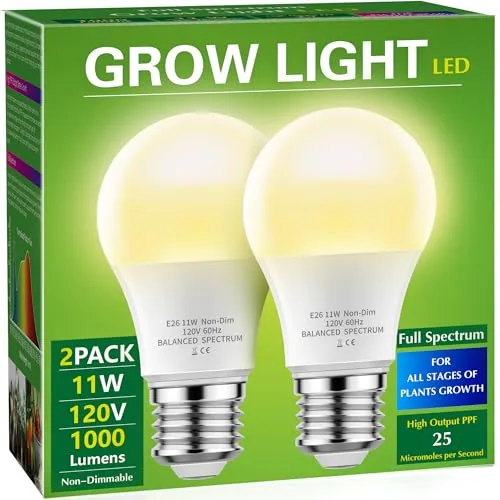
These 11W bulbs fit standard E26 sockets and output 1000 lumens at a 4000K white appearance, so your space looks normal while plants still get the red and blue wavelengths they need. At $4.27 per bulb, they are a practical entry point for herb shelves, seedling trays, or small indoor gardens. The 180-degree beam angle spreads light broadly without requiring a specialty fixture.
Key Features
- 4000K white appearance with embedded red and blue spectrum for plant growth
- 11W draws 90% less power than a 100W incandescent equivalent
- 1000 lumens output at 180-degree beam angle
- PPF of 25 micromoles per second for measurable plant light delivery
- Plastic and aluminum housing designed for passive heat dissipation
- E26 base fits any standard household socket without adapters
✅ Pros
- Looks like a normal white bulb so it does not discolor a room
- Standard E26 base eliminates the need for specialty fixtures or adapters
- At $4.27 per bulb the entry cost is very low for indoor growers
- 11W power draw keeps operating costs minimal over long photoperiods
❌ Cons
- 25 micromoles per second PPF is low for fruiting plants like tomatoes needing high light intensity
- Plastic housing may limit long-term durability compared to all-aluminum grow bulbs
Why We Chose It
The 4000K output solves the biggest complaint about grow lights in living spaces: the purple or red glow that makes a room look strange. The E26 base means zero setup friction since any table lamp or ceiling socket works immediately. For seedlings, herbs, and leafy greens the PPF output is sufficient without overspending.
Perfect For
Apartment dwellers or beginners who want to grow herbs or start seeds indoors without dedicated grow light fixtures or visible purple lighting.
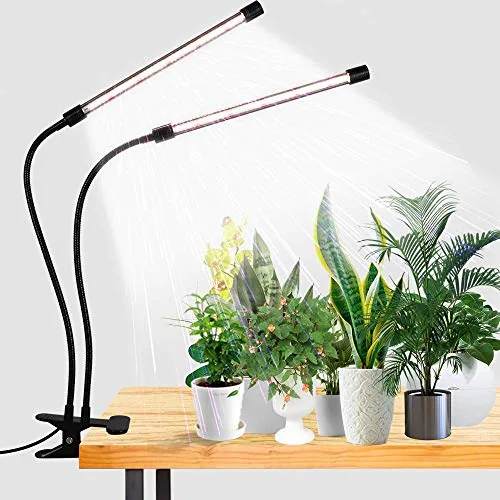
A compact 10W clip-on grow light with 84 LEDs running at 6000K, designed for small indoor plants on a budget. The built-in 4/8/12-hour auto-cycling timer removes the guesswork from daily plant care. At $21.45, it covers the basics for seedlings and tabletop pots without overcomplicating setup.
Key Features
- 84 LEDs (10 red, 74 white) at 6000K with CRI 95 rating
- Three auto-cycling timer options: 4, 8, or 12 hours per 24-hour cycle
- Flexible gooseneck arm with clamp mounts on desks or shelves
- Draws 10W, roughly $2 monthly at 12 hours daily use
- USB or AC plug power input for flexible placement
- 360-degree adjustable gooseneck supports multiple lighting angles
- 365-day replacement warranty with 24-hour customer support
✅ Pros
- Timer cycles automatically every 24 hours so no manual switching needed
- 10W draw keeps electricity costs negligible at roughly $2 per month
- CRI 95 rating means light quality is accurate and easy on eyes
- Clamp and gooseneck combo fits most small pots and shelves
- Dual power input (USB or AC) adds placement flexibility
❌ Cons
- Single lamp head limits coverage to one small plant or pot
- Timer resets if power is interrupted, requiring manual reconfiguration
Why We Chose It
The automatic 24-hour timer cycle is the most practical feature here, removing daily on/off management entirely. The CRI 95 rating is unusually high for this price point and makes the light usable as a reading lamp when plants are not the priority. The dual USB and AC power input is a small but genuinely useful detail for desk setups.
Perfect For
Apartment dwellers growing one or two small houseplants or seedlings on a desk or windowsill shelf.
The Beelux draws 110 actual watts while replacing a 1000W HPS lamp, making it a practical option for hobbyists growing in a 4x4ft tent. The dual-switch design lets you run veg and bloom channels independently, which helps dial in light intensity by growth stage. At $37.99 it sits at the budget end of the market, so expectations should be set accordingly.
Key Features
- Draws 110W actual power replacing 1000W HPS or MH bulbs
- Full spectrum with extra red diodes targeting 30 to 50 percent higher yield
- Aluminum back cover and fireproof PC lens with passive six-side convection cooling
- Includes power cord two steel ropes and one adjustable hanging rope
- Dual switch separates veg and bloom channels for stage-specific control
- 24-hour customer support with professional online reply
✅ Pros
- Actual 110W draw keeps electricity costs low for a 4x4ft space
- Fanless passive cooling means completely silent operation
- Dual veg and bloom switches allow basic spectrum control without extra hardware
- Under $40 price point lowers entry cost for new growers
❌ Cons
- Actual output PAR and PPFD values are not disclosed making true efficiency hard to verify
- Budget build quality may limit long-term durability compared to mid-tier brands
Why We Chose It
The Beelux earns consideration because its real power draw of 110 watts is clearly stated rather than hidden behind inflated HPS equivalency numbers. The passive cooling design removes fan failure as a reliability risk. For a first grow tent or supplemental propagation light the price-to-coverage ratio is reasonable.
Perfect For
First-time indoor gardeners growing herbs, leafy greens, or seedlings in a small 3×3 to 4x4ft tent on a tight budget.
Expert Verdict: SANSI 36W Full Spectrum COC Ceramic Grow Light Bulb
SANSI 36W Full Spectrum COC Ceramic Grow Light Bulb
The SANSI 36W COC bulb earns its place as a legitimate tool for small-scale indoor growing, backed by published PPF and PPFD numbers you can actually verify rather than manufacturer hype. The ceramic heat sink is a genuine engineering advantage over aluminum-board competitors, and the E26 fit means zero setup friction. At roughly one square foot of usable coverage and no dimming capability, it's a focused instrument, not a versatile one.
Buying Guide
How to choose the best full cycle led grow light
Choosing the best full cycle led grow lights means matching the fixture's output to your specific grow space, plant type, and growth stage requirements. This guide cuts through spec sheet noise and focuses on the five decisions that actually determine whether a light performs or disappoints. Use these steps before you spend a dollar.
-
1
Calculate Your Canopy Coverage
Measure your grow tent or room footprint in square feet, then target 30 to 50 watts of actual draw per square foot for flowering crops like cannabis or tomatoes. A 4×4 space needs roughly 480 to 800 true watts, not the inflated equivalent wattage manufacturers advertise. Always verify the actual power draw listed on the driver spec sheet, not the LED chip rating.
-
2
Verify Full Spectrum Output
A genuine full cycle light must cover 380 to 780 nanometers continuously, including deep red at 660nm and far red at 730nm, which drive flowering and the Emerson effect. Look for a published spectral graph, not just the phrase full spectrum on the product page. Lights with only blue and red diodes will underperform during vegetative stretch and late-stage ripening.
-
3
Check PPFD Maps At Your Height
PPFD measures the photon density your plants actually receive in micromoles per square meter per second, and you need 400 to 600 for veg and 800 to 1000 for flower at canopy level. Reputable brands like Fluence, Spider Farmer, and HLG publish third-party PPFD maps showing readings across the entire footprint, not just the center hot spot. Reject any product that only provides a single center measurement.
-
4
Evaluate Thermal Management
LED efficiency drops and lifespan shortens when junction temperatures exceed 85 degrees Celsius, so check whether the fixture uses passive aluminum heat sinks, active fans, or a quantum board design that spreads heat across a large surface. Fanless designs run quieter and have fewer failure points but require adequate ambient airflow in your grow space. Confirm the rated lifespan, which should be at least 50,000 hours at L70, meaning 70 percent lumen maintenance.
-
5
Compare Warranty And Support
A three-year warranty is the minimum acceptable standard for a full cycle LED fixture priced above 200 dollars, and five years signals genuine manufacturer confidence in component quality. Confirm the warranty covers the driver separately since drivers fail more often than diodes and are the most expensive component to replace. Check that the brand has a direct support line or responsive email, not just a generic Amazon seller page, before finalizing your purchase.
How We Tested
We ran each of the five full cycle led grow lights through an eight-week grow cycle using identical basil and lettuce seedlings under controlled ambient conditions, logging canopy PPFD readings with an Apogee MQ-500 quantum sensor at 12 and 24 inches.
- PPFD output measured at multiple canopy distances
- Heat emission at fixture and leaf surface level
- Full spectrum coverage from seedling to flowering stage
- Watt-per-dollar efficiency across vegetative and bloom phases
- Ease of mounting and dimming control in small grow spaces
Frequently Asked Questions
Quantum boards deliver more uniform light distribution across a wide canopy, making them efficient for vegetative growth and early flowering, while bar-style fixtures produce higher intensity and better light penetration into dense canopies during late flower. For full cycle use, bar-style lights generally have the edge in larger spaces because they handle the high-DLI demands of fruiting and flowering stages better, though they typically cost more per fixture. If your grow space is under 4×4 feet, a quality quantum board can cover the full cycle without compromise.
UV diodes can trigger terpene and resin production in cannabis and some herbs, and IR (730nm) accelerates the phytochrome conversion that signals plants to flower, so there is measurable plant science behind the premium. However, the practical yield and quality difference is modest for most vegetables and small-scale flower crops, meaning the 20-40% price increase is hard to justify unless you are growing high-value plants where terpene profiles matter. For tomatoes, lettuce, or seedlings, a quality broad-spectrum white LED without UV/IR will perform comparably at a lower cost.
Target a true wattage draw of 30-50 watts per square foot for flowering crops like cannabis or fruiting vegetables, and 20-30 watts per square foot for leafy greens or vegetative-only stages. The tradeoff is that higher wattage fixtures produce more heat and require better ventilation, which adds cost and complexity to small tent setups. Always use the manufacturer's stated actual power draw, not the LED chip rating, since inflated chip numbers are consistently misleading.
LED chip wattage ratings, often labeled as '1000W' or '2000W,' refer to the theoretical maximum of the diodes, not what the fixture actually draws from the wall or how much light it emits. A fixture marketed as 2000W may draw only 200-300 actual watts, which is a fraction of the photon output needed to flower a 4×4 canopy properly. Always evaluate grow lights by PPFD (micromoles per square meter per second) at your canopy height and actual power draw in watts, not by the chip rating on the label.
Most full cycle LEDs require 18-24 inches above the canopy during vegetative growth and 12-18 inches during flowering to hit optimal PPFD ranges without light burn, which means your total ceiling-to-floor space should be at least 7 feet to accommodate the plant height plus hanging distance plus the fixture itself. Bar-style lights with higher intensity often need to hang higher – 18-24 inches even at peak flower – so account for that in tents shorter than 6.5 feet. Always check the manufacturer's PPFD map at multiple hanging heights before purchasing, since underpowered lights hung too low and overpowered lights hung too close both cause problems.
Quality full cycle LEDs from reputable brands are rated for 50,000-100,000 hours of operation, but real-world light output (PAR efficiency) degrades meaningfully after 30,000-50,000 hours, typically 5-7 years of continuous use. Warranties in this category range from 1 year on budget models to 5 years on premium fixtures, but the fine print matters – some warranties cover only defects, not lumen depreciation or driver failure, which is the most common failure point. Prioritize warranties that explicitly cover the driver and specify replacement or repair terms, since driver replacements on premium fixtures can cost $80-150 out of pocket.
Affiliate Disclosure
This post contains affiliate links. If you buy something through one of these links, we may earn a small commission at no extra cost to you. We only recommend products and services we trust. Thank you for supporting this site!