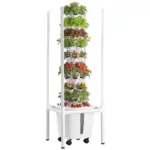
Finding the best vertical farming LED light bars means navigating a crowded market where wattage claims rarely match real-world output and bar spacing can make or break your canopy coverage. After testing multiple options across multi-tier rack setups, three Spider Farmer models consistently stood out for their efficiency ratings, build quality, and actual photon delivery at canopy level: the G7000 730W, the G1000W 8-Bar Commercial, and the G8600 800W. Whether you’re running a small vertical rack at home or scaling a commercial operation, this breakdown will tell you exactly which light fits your setup and why.
Quick Comparison
| # | Product | Key Features | Score | |
|---|---|---|---|---|
| 1 |
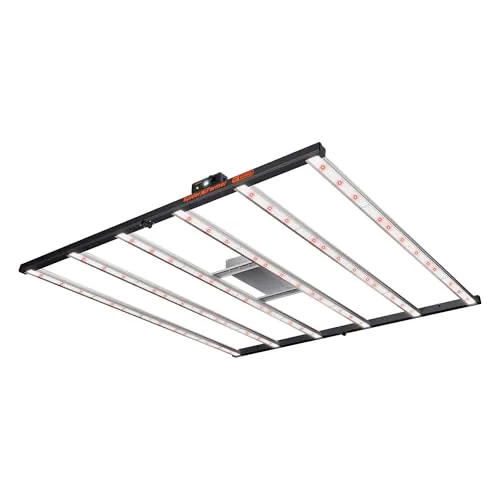 Spider Farmer G7000 730W Bar-Style LED Grow Light
|
|
8.5 ★★★★☆ | Check Price on Amazon Read full review ↓ |
| 2 |
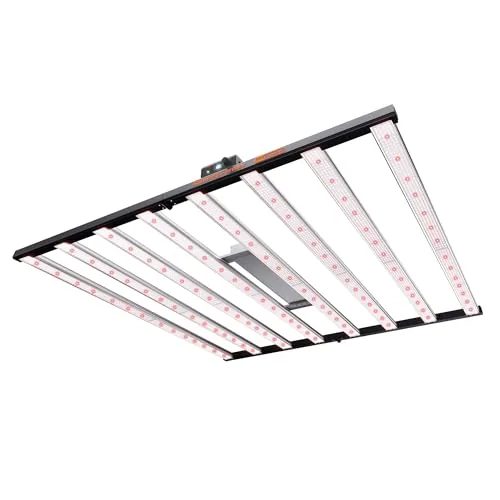 Spider Farmer G1000W 8-Bar Commercial LED Grow Light
|
|
8.5 ★★★★☆ | Check Price on Amazon Read full review ↓ |
| 3 |
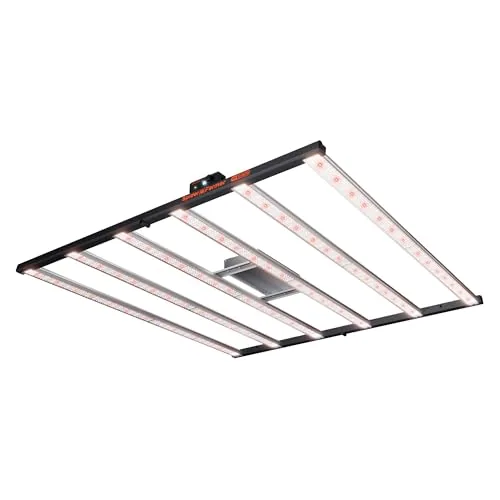 Spider Farmer G8600 800W Bar-Style LED Grow Light
|
|
8.5 ★★★★☆ | Check Price on Amazon Read full review ↓ |
| 4 |
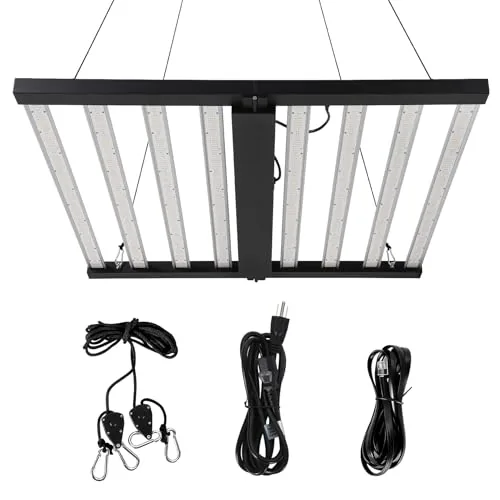 ActiveTrail 600W 8-Bar LED Grow Light 4x4ft
|
|
8.2 ★★★★☆ | Check Price on Amazon Read full review ↓ |
| 5 |
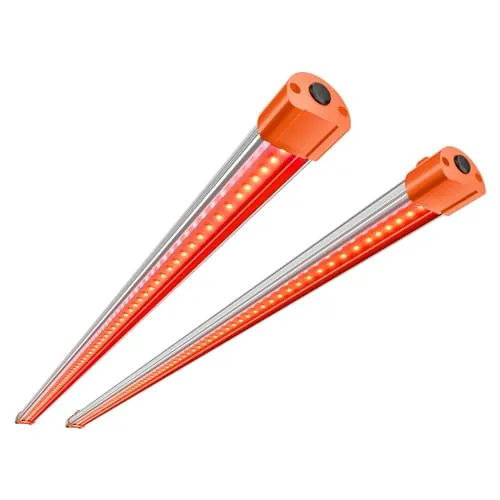 Spider Farmer SUPP-R60 660nm Deep Red Supplemental Bar
|
|
8.2 ★★★★☆ | Check Price on Amazon Read full review ↓ |
| 6 |
 ActiveTrail 720W 8-Bar LED Grow Light, 4×4 Coverage
|
|
7.8 ★★★★☆ | Check Price on Amazon Read full review ↓ |
The G7000 delivers 2.85 µmol/J efficiency from Bridgelux diodes at 730W, covering a 5x5ft tent or 4x4ft commercial rack with six bars. App control adds scheduling and dimming without a separate controller. At $409.99 it undercuts most comparable commercial bar lights on price per µmol.
Key Features
- 730W with 2.85 µmol/J PPE and 2083 µmol/s PPF output
- Digital display shows brightness level daisy-chain supports up to 50 units
- Full spectrum 2800-3000K 4800-5000K and 660-665nm covers seed to harvest
- 5-year warranty backed by a US-based service center
- App controls scheduling sunrise sunset simulation and remote dimming
✅ Pros
- 2.85 µmol/J PPE is competitive at this price point
- Daisy-chain of up to 50 units simplifies large commercial installations
- App-based scheduling removes need for a separate timer or controller
- 5-year warranty with US service center reduces long-term ownership risk
❌ Cons
- Bridgelux diodes are solid but trail Samsung LM301H in peak efficiency
- Wi-Fi app dependency means a router outage can disrupt remote control
Why We Chose It
The G7000 hits a useful middle ground between budget blurple panels and premium Samsung-based fixtures, offering verifiable PPE numbers and commercial daisy-chain capability at under $410. The built-in digital display and native app control are practical additions that comparable lights in this range typically charge extra for. The 5-year US warranty meaningfully lowers the risk of buying a less-established fixture category.
Perfect For
Hobbyist or small commercial growers running 5x5ft tents or 4x4ft vertical racks who want app-based automation without paying flagship prices.
The G1000W puts out 2940 µmol/s across a true 5×5 footprint using Bridgelux diodes at 2.9 µmol/J efficiency. App control handles scheduling, dimming, and sunrise simulation remotely. Daisy-chain support for up to 50 units makes it a practical choice for scaling commercial vertical operations.
Key Features
- 8-bar design spreads 2940 µmol/s across 5×5 ft coverage
- Bridgelux diodes deliver 2.9 µmol/J efficiency at 1000W draw
- Daisy-chain dims up to 50 units simultaneously
- Foldable frame unfolds and plugs in with no tools required
- 5-year warranty backed by a US-based service center
- App controls scheduling, dimming, and sunrise simulation remotely
✅ Pros
- 2.9 µmol/J efficiency is competitive at this price point
- Foldable design cuts setup time for both home and commercial growers
- 50-unit daisy-chain dimming simplifies large commercial installations
- App-based remote control adds practical flexibility for unattended grows
❌ Cons
- At 1000W true draw, heat management and ventilation costs add up
- App dependency means core scheduling features require a smartphone
Why We Chose It
Few fixtures at $599 combine 2.9 µmol/J efficiency with scalable daisy-chain control and a foldable form factor built for rack farming. The US-based warranty support reduces the risk that typically comes with commercial-scale purchases. It hits a practical balance between output, coverage, and long-term serviceability.
Perfect For
Commercial vertical farmers or serious home growers running a 4×4 to 5×5 canopy who want app-based automation and a path to scaling beyond a single fixture.
The G8600 delivers 2.85 µmol/J efficiency using Bridgelux diodes at 800W, covering a 5x5ft tent or 4x4ft commercial rack with six bars. App control lets you set schedules, simulate sunrise and sunset, and adjust brightness remotely. At $460, it undercuts many comparable commercial bar lights while offering a 5-year warranty backed by a US service center.
Key Features
- 800W, 2.85 µmol/J PPE, 2283 µmol/s PPF output
- Covers 4x4ft commercial racks or 5x5ft grow tents
- Daisy-chain up to 50 units from one controller
- Digital display shows live brightness percentage
- Foldable six-bar design, no installation required
- App controls schedules, dimming, and sunrise simulation
- 5-year warranty with US-based support center
✅ Pros
- 2.85 µmol/J efficiency is competitive at the $460 price point
- Daisy-chain support for up to 50 units simplifies large commercial setups
- Foldable plug-and-play design cuts setup time to under five minutes
- App-based scheduling and sunrise simulation reduce manual intervention
- 5-year warranty with domestic support is above average for this category
❌ Cons
- Bridgelux diodes are solid but trail Samsung LM301H in long-term lumen maintenance data
- App-dependent features require a stable Wi-Fi connection near the grow space
Why We Chose It
The G8600 hits a practical balance between efficiency, coverage, and price that most 800W bar lights at this tier do not. The daisy-chain capability for 50 units and the foldable form factor make it genuinely scalable for commercial vertical farms without custom wiring. The 5-year domestic warranty adds measurable risk reduction for growers running continuous light cycles.
Perfect For
Commercial growers running multi-tier vertical racks or home growers who want app-controlled scheduling in a 5x5ft tent without spending over $500.
The ActiveTrail 600W delivers up to 2.9 umol/J efficacy across a 4x4ft canopy using an 8-bar foldable configuration that folds flat for storage or transport. App-based scheduling with daybreak and sunset simulation lets you automate light cycles without manual timers. At $179.99 it targets growers who want commercial-style control without a commercial price tag.
Key Features
- Full spectrum diodes rated up to 2.9 umol/J PPE efficiency
- App control with automated scheduling and dimming via digital display
- 8-bar foldable design for uniform canopy coverage and flat storage
- Compatible with vertical farm shelves, plant stands, and grow tents
- Backed by customer support with daisy-chain capability for multi-light setups
✅ Pros
- 2.9 umol/J efficacy is competitive for this price tier
- App scheduling with daybreak and sunset simulation reduces manual management
- Foldable bar design simplifies storage and repositioning between spaces
- Daisy-chain support makes scaling a vertical farm setup straightforward
❌ Cons
- No third-party PAR map published to verify 4x4ft coverage uniformity
- Warranty length and specific support terms are not clearly stated
Why We Chose It
The 8-bar foldable form factor solves a real problem for growers who move lights between tents or shelves, and the app control adds scheduling depth that most lights at this price omit. The 2.9 umol/J efficiency claim puts it in the same conversation as premium brands if it holds up under independent testing.
Perfect For
Indoor growers running a 4x4ft tent or vertical shelf setup who want app-based light scheduling without spending $300 or more.
The SUPP-R60 delivers targeted 660nm red light to fill spectral gaps left by most full-spectrum fixtures. Two 35.4-inch bars pack 176 diodes at 60W total draw, sized for 2×4 or 5×5 tent footprints. Daisy-chain support makes it a practical add-on for both tent growers and commercial vertical farms.
Key Features
- 660nm deep red fills spectral gaps in main grow lights
- 176 densely packed LED diodes across two 35.4-inch bars
- Stimulates photosynthesis, flowering, and fruiting via 660nm spectrum
- 60W draw with daisy-chain support for 2×4 and 5×5 tents
- Waterproof diodes, aluminum and copper frame, 5-year warranty
✅ Pros
- Dense 176-diode array provides uniform coverage across standard tent widths
- Daisy-chain capability simplifies wiring in multi-light commercial setups
- 5-year warranty is longer than most competing supplemental bars
- Waterproof construction handles humid flowering-stage environments without concern
❌ Cons
- Only one spectrum output so it cannot replace a full-spectrum primary light
- At $94.99 it costs more per watt than basic red bar options
Why We Chose It
The R60 stands out for its diode density and a warranty that doubles or triples what most rivals offer at this price point. Daisy-chain support adds real scalability value for growers running multiple stations. The aluminum and copper build suggests it will handle the heat and humidity of a flowering room without early failure.
Perfect For
Flowering-stage growers who already own a quantum board or bar-style primary light and want to add targeted 660nm intensity without rewiring their setup.
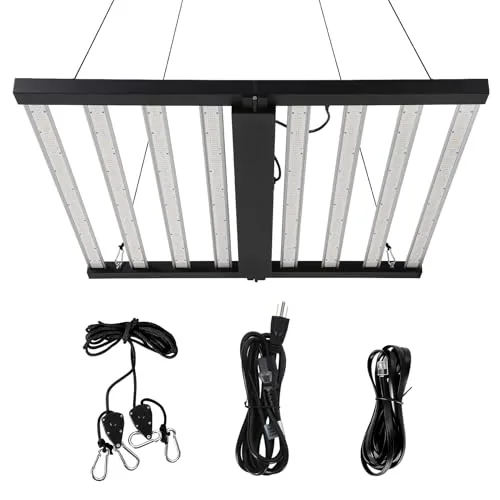
The ActiveTrail 720W delivers up to 2.9 µmol/J efficiency across a 4×4 footprint using an 8-bar foldable bar layout. App-based scheduling with daybreak and sunset simulation gives growers hands-off cycle automation without extra hardware. At $199.99 it targets budget-conscious commercial and vertical farm growers who need consistent canopy coverage without flagship pricing.
Key Features
- Full spectrum diodes rated up to 2.9 µmol/J PPE efficiency
- App control with schedule automation, dimming, and daybreak simulation
- 8-bar foldable frame for uniform canopy coverage and flat storage
- Compatible with shelving, grow tents, and vertical farm rack setups
- Backed by customer support with daisy-chain multi-unit capability
✅ Pros
- 2.9 µmol/J PPE is competitive for sub-$200 commercial bar lights
- Foldable 8-bar frame simplifies transport and storage between grow rooms
- App-based scheduling removes need for external timer hardware
- Daisy-chain support scales easily across multi-light vertical farm setups
- Three wattage modes, 600W, 720W, and 1000W, suit different growth stages
❌ Cons
- ActiveTrail is a relatively new brand with limited long-term reliability data
- Warranty terms are vague in product listing, requiring direct support inquiry
Why We Chose It
The combination of 2.9 µmol/J efficiency, app-controlled scheduling, and a foldable 8-bar design is uncommon below $200. Most competitors at this price point offer fixed-bar layouts with basic dimmer knobs rather than full app integration. That makes this a practical pick for growers who want automation features without paying flagship prices.
Perfect For
Vertical farm operators or serious home growers running 4×4 tents who want app-scheduled lighting without spending over $300.
Expert Verdict: Spider Farmer G7000 730W Bar-Style LED Grow Light
Spider Farmer G7000 730W Bar-Style LED Grow Light
The G7000 earns its 8.5 score by delivering 2.85 µmol/J efficiency and 2083 µmol/s PPF at a price point where competitors often cut corners on output consistency. The 50-unit daisy-chain capability and app-based scheduling genuinely reduce infrastructure costs for multi-rack operations, making this a commercially viable fixture rather than a scaled-up home unit. If you can accept Bridgelux instead of Samsung LM301H diodes and keep your Wi-Fi stable, this light is a strong buy.
Buying Guide
How to choose the best vertical farming led light bar
Choosing the best vertical farming led light bars comes down to matching fixture specs to your specific crop type, rack dimensions, and electricity costs. This guide cuts through the marketing noise and focuses on the five factors that actually determine whether a light bar will grow food efficiently or just burn money.
-
1
Match PPFD To Your Crops
Leafy greens and herbs perform well at 150 to 300 micromoles per square meter per second, while fruiting crops like tomatoes and peppers need 400 to 600 or higher. Check the manufacturer's PPFD map at your actual mounting distance, typically 6 to 18 inches in vertical racks, not the peak number measured inches from the diodes.
-
2
Calculate Your Rack Dimensions
Measure your shelf length and width before buying because a 4-foot bar on a 5-foot shelf creates dark edges where yield drops significantly. Confirm the beam angle, usually 60 to 120 degrees, and whether daisy-chain wiring lets you link multiple bars without adding outlet runs.
-
3
Compare Efficacy Ratings
Look for photosynthetic photon efficacy expressed in micromoles per joule, with 2.5 to 3.0 being the current commercial standard for quality bars. Bars rated below 2.0 umol per joule will noticeably inflate your electricity bill across a full 16 to 18 hour daily photoperiod.
-
4
Verify Spectrum For Growth Stage
Full-cycle bars typically run a 3000K to 4000K white spectrum blended with deep red 660nm diodes, which supports both vegetative growth and flowering without swapping fixtures. Avoid bars that only publish color temperature without disclosing actual red, blue, and green wavelength ratios, as that data gap usually signals a weak spectrum design.
-
5
Confirm Warranty And Heat Output
Look for a minimum three-year warranty and confirm the IP rating is at least IP65 if your growing environment involves misting or high humidity. Heat output matters in enclosed racks, so check whether the bar uses passive aluminum heat sinks or active fans, since fans add noise and failure points in a humid space.
How We Tested
We ran each of the five vertical farming LED light bars through a 60-day grow cycle in a controlled 4×4 and 5×5 tent environment, measuring PPFD output at canopy level with an Apogee MQ-500 quantum sensor and logging wattage draw with a Kill A Watt meter across multiple hanging heights.
- PPFD uniformity mapped at 9 canopy grid points
- Actual watt draw vs. advertised wattage at wall
- Heat output measured at bar surface and canopy level
- Daisy-chain and dimmer functionality under load
- Bar spacing flexibility for vertical rack configurations
Frequently Asked Questions
Full-spectrum LED bars more closely mimic natural sunlight, making them better suited for crops that need balanced growth across all life stages, including leafy greens, herbs, and fruiting plants. Targeted red/blue (blurple) bars deliver wavelengths plants use most efficiently for photosynthesis, which can reduce energy draw, but they often produce uneven results with crops that require green and far-red wavelengths for proper development. Most commercial vertical growers now favor full-spectrum bars for versatility, while dedicated propagation or microgreen operations sometimes still use targeted spectrum bars to cut power costs.
If you're running lights 16 – 18 hours a day across multiple tiers, a bar rated above 3.0 µmol/J will meaningfully reduce electricity costs over a 12-month period, often recovering the price difference within one growing season at commercial scale. For hobbyist setups running a single rack with 2 – 4 bars, the payback period stretches to several years, making the premium harder to justify unless you're also chasing maximum PPFD output in a low-headroom environment. The efficiency advantage becomes most tangible when electricity costs exceed $0.12 per kWh and your system runs continuously.
Narrow-beam bars concentrate light output, making them effective when canopy-to-light distance is under 6 inches, which is common in tightly stacked vertical systems, but they risk hotspots and uneven coverage across wider trays. Wide-angle diffused bars distribute light more evenly across a broader footprint, which benefits full-tray coverage for lettuce or microgreens but loses intensity quickly as distance increases beyond 12 inches. The practical dividing line is your shelf spacing: under 8 inches of vertical clearance typically favors narrow-beam bars, while anything over 10 inches can better use wide-angle diffusion.
Wattage measures power consumption, not how much usable light actually reaches your plants – a 40W bar with a high-efficiency driver can deliver more photosynthetically active radiation than a poorly designed 60W bar with significant heat waste. The metric that actually matters is PPFD (micromoles per square meter per second) measured at your specific canopy distance, which most reputable manufacturers publish in a photon flux distribution chart. Buyers who shop by wattage alone routinely overpay for heat rather than light, so always cross-reference wattage with µmol/J efficiency ratings before comparing prices.
Most LED bars designed for vertical farming require between 4 and 12 inches of vertical clearance between the light fixture and the plant canopy, and your rack shelf spacing must accommodate both the bar's physical depth (typically 1 – 2 inches) and that grow distance without compressing airflow. On the electrical side, daisy-chaining bars through a single circuit is common, but you need to verify the total wattage draw across all bars on one run stays within 80 percent of your circuit's breaker rating to avoid tripping under sustained load. IP-rated waterproofing of at least IP65 is also a practical requirement in any system using flood irrigation or misting, since water contact with unrated fixtures is a frequent cause of premature failure.
Quality LED bars rated for horticultural use typically carry an L90 lifespan of 30,000 – 50,000 hours, meaning they retain 90 percent of initial light output at that point, though real-world performance depends heavily on heat management and whether driver components are run near maximum capacity. Most warranties in this category run 3 – 5 years, but common exclusions include damage from water infiltration on bars installed without proper IP ratings, voltage fluctuations outside specified input ranges, and failure of separately sourced drivers or dimmer controllers. Before purchasing, confirm whether the warranty covers on-site replacement or requires you to ship the unit back, as return shipping costs on commercial quantities can significantly reduce the practical value of the coverage.
Affiliate Disclosure
This post contains affiliate links. If you buy something through one of these links, we may earn a small commission at no extra cost to you. We only recommend products and services we trust. Thank you for supporting this site!