Finding the best fully enclosed hydroponic grow chambers means navigating a crowded market where light leaks, flimsy zippers, and poor reflectivity can quietly kill your yields before you ever spot the problem. After hands-on testing, three tents consistently outperformed the rest for light retention, structural integrity, and practical features growers actually use: the VIVOSUN P336 PRO 3×3, the GROW’ING 4×2 Reflective Mylar, and the MELONFARM 34x34x72 with its transparent viewing door. Here’s what separates them from the cheaper options and how to match the right chamber to your specific setup.
Quick Comparison
| # | Product | Key Features | Score | |
|---|---|---|---|---|
| 1 |
 VIVOSUN P336 PRO 3×3 Grow Tent 36x36x72 Inches
|
|
8.2 ★★★★☆ | Check Price on Amazon Read full review ↓ |
| 2 |
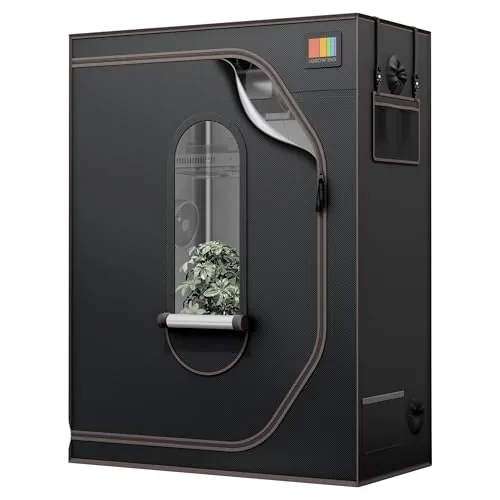 THE GROW'ING 4×2 Reflective Mylar Hydroponic Grow Tent
|
|
7.8 ★★★★☆ | Check Price on Amazon Read full review ↓ |
| 3 |
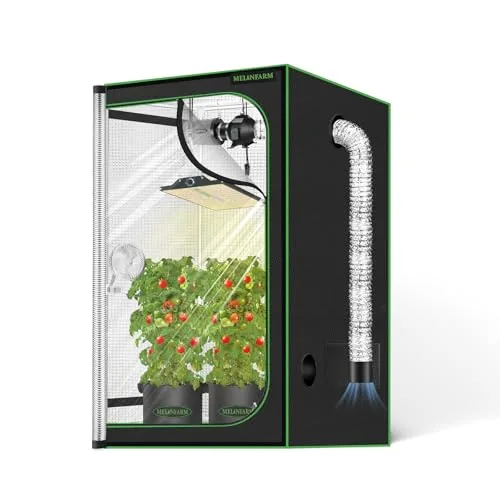 MELONFARM 34x34x72 Grow Tent with Transparent Viewing Door
|
|
7.8 ★★★★☆ | Check Price on Amazon Read full review ↓ |
| 4 |
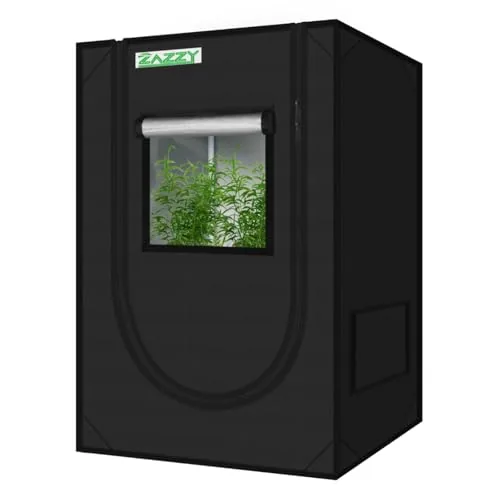 Zazzy 2×2 Grow Tent 600D Mylar 24x24x36 Inch
|
|
7.8 ★★★★☆ | Check Price on Amazon Read full review ↓ |
| 5 |
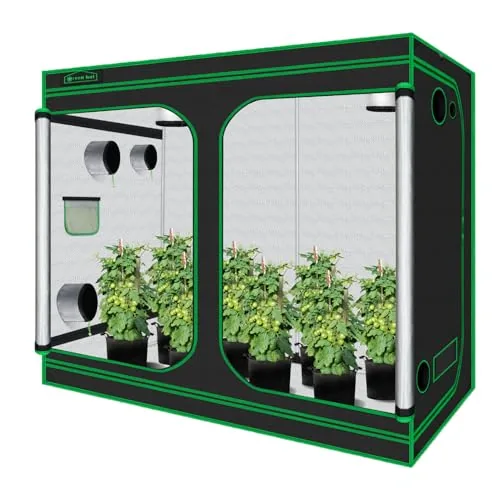 Green Hut 8×4 Grow Tent 600D Mylar 96x48x78in
|
|
7.8 ★★★★☆ | Check Price on Amazon Read full review ↓ |
| 6 |
 VEVOR 3-Tier 108-Site UPVC Hydroponic Grow Kit
|
|
7.8 ★★★★☆ | Check Price on Amazon Read full review ↓ |
| 7 |
 ATOUR 48x24x60in Grow Tent 600D Mylar Reflective Interior
|
|
7.5 ★★★★☆ | Check Price on Amazon Read full review ↓ |
| 8 |
 POTLAB Mini Grow Tent for AeroGarden Systems
|
|
6.8 ★★★☆☆ | Check Price on Amazon Read full review ↓ |
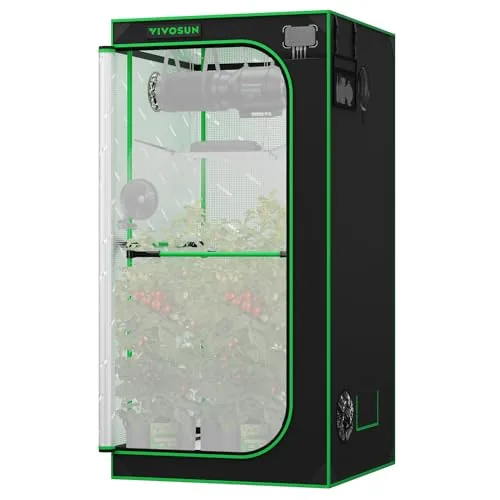
The P336 PRO is a 3×3 tent built around thicker materials than VIVOSUN’s standard line, including 2000D canvas and 22mm steel poles. The CFM support kit addresses a real weak point in most budget tents: frame flex from high-powered inline fans. At $142.49 it sits in the mid-range but delivers construction details typically found at higher price points.
Key Features
- 2000D Oxford canvas with PE lining and 100-percent reflective Mylar interior
- Three-layer fabric construction eliminates light leaks at seams and zippers
- 22mm steel poles rated to support 150 to 400 lbs total load
- Up to 8 hanging bars included depending on model size
- Large observation window allows plant checks without opening the door
- SBS zipper with removable door panel and hook-and-loop door storage
- Cable management slots sized for smart controller wiring
- CFM support kit reduces frame flex from high-powered fans
- Includes floor tray, 3 hanging bars, and 4 CFM support poles
✅ Pros
- 22mm poles are measurably thicker than the 16mm found on entry-level tents
- CFM kit actively counters frame distortion caused by strong inline fans
- Removable door with hook-and-loop retention keeps the opening fully clear during work
- Zipper section uses black inner lining specifically to block light at the most common leak point
- Cable management slots reduce clutter from controllers and monitoring devices
❌ Cons
- At 72 inches tall the tent limits growers using high-stress training with tall late-stage plants
- CFM kit excluded from two smaller models which may confuse buyers shopping the full P-series lineup
Why We Chose It
The combination of 2000D canvas, 22mm poles, and an included CFM stability kit puts this tent a clear step above standard 600D options without jumping to commercial-grade pricing. The zipper blackout lining shows the kind of detail work that directly affects grow performance rather than just build feel.
Perfect For
Hobbyist growers running a single 3×3 canopy who use a powerful inline fan and want a tent that stays rigid and light-tight without buying add-on bracing.
A 4×2 foot grow tent built around 16mm steel framing and a diamond Mylar interior that redirects light back into the canopy. Double-sock ventilation ports and polymer zippers keep humidity and odors contained with minimal light bleed. At under $90, it targets apartment growers and seedling propagators who need a compact, self-contained growing chamber.
Key Features
- 16mm solid steel poles with tool-free click-lock joints
- Heavy-duty Oxford fabric with thermal-pressed diamond Mylar lining
- High-strength polymer zippers with dual-layer light-blocking backing flaps
- Racetrack observation window for plant checks without opening the tent
- Double-sock ports with dual drawstrings and Velcro covers for unused openings
✅ Pros
- 16mm pole diameter is thicker than many budget tent frames at this price
- Diamond Mylar lining scatters light more evenly than flat reflective surfaces
- Double-sock ports with Velcro covers give solid odor and humidity control
- Racetrack window lets you monitor seedlings without breaking internal climate
- Tool-free assembly reduces setup time and eliminates missing-hardware frustration
❌ Cons
- 4×2 footprint limits canopy space to roughly 2 to 3 medium plants at most
- No third-party lab data provided to verify Mylar reflectivity percentage claims
Why We Chose It
The combination of 16mm click-lock framing and double-sock ventilation ports addresses two common failure points in budget grow tents: structural sag under heavy lights and air leakage around duct openings. The racetrack observation window is a practical detail that most tents in this price range skip entirely.
Perfect For
Apartment growers or beginners propagating herbs and seedlings who need a compact, light-tight chamber without dedicating a full room to the setup.
A 34x34x72 inch tent built around a dual-door system that lets you check plant progress through a clear window without breaking the sealed environment. The 2100D canvas and reinforced frame target growers who want durability without spending over $100. Tool-free assembly and an included floor tray make setup and cleanup straightforward.
Key Features
- 2100D canvas with double stitching resists tears and blocks light
- 100% reflective diamond polyester mylar lining maximizes light efficiency
- Dual-layer door includes clear observation window and opaque privacy layer
- Reinforced frame structure supports long-term stable use
- Tool-free assembly with included floor tray for spill containment
- Compatible with home closets balconies laundry rooms and offices
✅ Pros
- Transparent observation window lets you monitor plants without opening the tent
- 2100D canvas rating is thicker than most budget tents in this price range
- Included floor tray catches runoff and simplifies cleanup
- Tool-free setup reduces installation time significantly
- 34×34 inch footprint fits standard closets and small grow spaces
❌ Cons
- No ventilation sock count or duct port diameter specified in product listing
- Zipper durability on budget tents at this price point is a common long-term concern
Why We Chose It
The transparent viewing door solves a real daily problem for indoor growers who need to monitor plant health without disrupting humidity and temperature balance. The 2100D canvas specification puts it above the 600D and 1680D options that dominate the under-$80 category. At $73.99 it delivers structural and material specs that typically cost $20 to $30 more from established brands.
Perfect For
First-time indoor growers or hobbyists running a single light setup in a closet or small room who want above-average build quality without crossing the $100 threshold.
A compact 2×2 grow tent built with 600D double-stitched mylar and an all-steel frame rated to 110 lbs. The 95% reflective interior maximizes light efficiency without upgrading your fixtures. Patent-pending PA connectors lock poles firmly and resist rust over repeated assembly cycles.
Key Features
- 600D double-stitched mylar blocks light and resists tears
- 95% reflective interior boosts light intensity without added wattage
- Steel frame rated to hold at least 110 lbs
- Tool-free assembly with included printed instructions
- Observation window lets you check plants without opening the door
- Anti-rust PA connector locks poles with adjustable tightness
- Includes removable floor tray and tool bag
✅ Pros
- 110 lb steel frame is above average for this price tier
- 95% mylar reflectivity reduces need for stronger grow lights
- Tool-free setup lowers barrier for first-time tent growers
- Observation window avoids light disruption during dark cycles
❌ Cons
- 2×2 footprint limits plant count to 1 to 4 small plants
- No zipper quality details provided which is a common failure point on budget tents
Why We Chose It
At $47.99, this tent competes on frame strength and connector design where most budget options cut corners. The PA anti-rust connectors with adjustable pole grip address the wobble and joint failure common in cheaper alternatives. The included floor tray and tool bag add practical value without raising the price.
Perfect For
Beginner indoor growers running a single light setup with 1 to 4 plants in a small space.
A full 8×4 foot grow tent built with 600D Mylar fabric and steel poles rated to 110 lbs, giving hobbyist growers a solid light-sealed environment at a mid-range price. The PA connector system and double-stitched seams address the two most common failure points in budget tents. At $139.49 it competes directly with tents costing $20 to $40 more.
Key Features
- Removable Mylar floor tray and 100% light-proof reflective interior lining
- Steel frame poles rated to hold at least 110 lbs of equipment
- 600D tear-proof Mylar fabric with double-stitched seams for light blocking
- Heavy duty zippers with 1.5 inch ribbon seal to prevent light leaks
- PA material connectors with anti-rust reinforced adjustable tightening design
- Includes instructional manual for straightforward assembly
✅ Pros
- 110 lb pole rating supports heavy LED fixtures and carbon filters without flex
- 600D fabric thickness sits above the entry-level 210D and 420D options common at this price
- PA connector design resists rust and holds pole tightness better than standard plastic clips
- Removable floor tray simplifies cleanup after watering or nutrient spills
- 8×4 footprint fits four to six medium plants in a standard bedroom or garage space
❌ Cons
- No ventilation sock count or duct port diameter listed, which complicates fan and filter planning
- Brand has limited long-term owner review data compared to category leaders like AC Infinity or Vivosun
Why We Chose It
The 600D fabric and PA connector system put this tent a practical step above similarly priced competitors that use thinner material and friction-fit plastic corners. The 110 lb frame rating means growers can hang full-size LED panels, a carbon filter, and inline fan without worrying about structural failure. For first-time indoor growers who want a durable starting setup without spending $180 or more, this is a defensible choice.
Perfect For
First-time indoor growers setting up a 4-plant to 6-plant soil or hydroponic garden in a spare room, garage, or apartment with limited space.
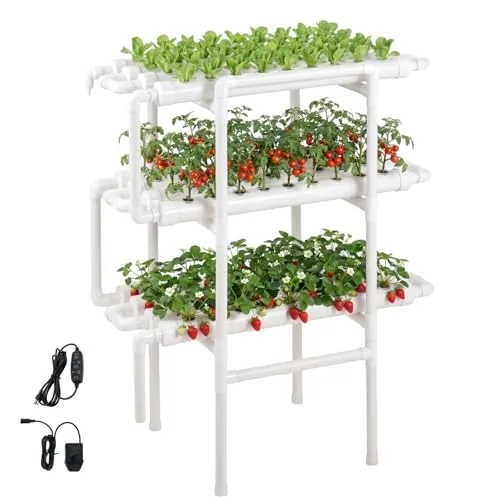
A 108-site, three-tier hydroponic system that fits substantial growing capacity into a compact vertical footprint. Pre-glued UPVC pipes and a built-in timer reduce daily maintenance to almost nothing. At under $84, it targets beginners and casual growers who want a structured, ready-to-run setup.
Key Features
- 108 planting sites across 3 tiers for dense vertical growing
- Factory pre-glued pipe joints minimize leaks at connections
- 4W pump with 24-hour programmable timer automates water cycles
- Dual-layer UPVC pipes block light and reflect heat externally
- Key components arrive pre-assembled with cable ties and rubber mallet included
✅ Pros
- 108 sites at this price point is strong value per plant slot
- Pre-glued joints reduce the most common failure point in DIY systems
- Included timer removes the need to buy a separate irrigation controller
- Black inner pipe layer actively prevents algae growth in the water channel
❌ Cons
- 4W pump may struggle to maintain consistent flow at full 108-site capacity
- No nutrients or net cups included, adding to the real out-of-pocket cost
Why We Chose It
The dual-layer UPVC construction addresses algae contamination, which is the most common reason budget hydroponic systems fail early. Factory-glued joints and a pre-assembled frame cut setup time compared to fully DIY pipe kits at similar prices. The bundled 24-hour timer is a practical inclusion that competitors at this price often omit.
Perfect For
Apartment or small-space gardeners who want to grow 50 to 100 lettuce or herb plants year-round without soil and without building a system from scratch.
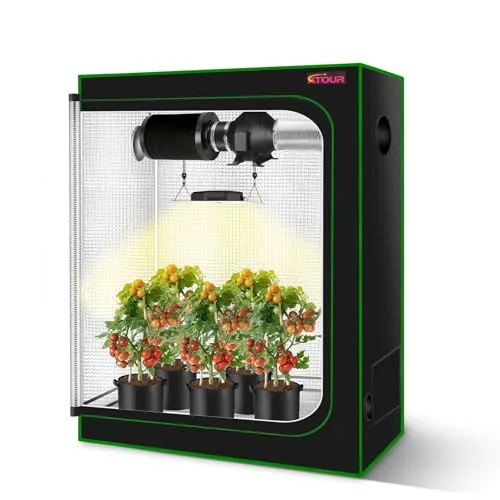
A 4×2 foot grow tent built for basement, closet, or balcony setups at a competitive price point. The 600D Mylar lining reflects light back to plants, and the observation window lets you check on growth without opening the main zipper. Tool-free assembly makes setup straightforward for first-time indoor growers.
Key Features
- 600D Mylar interior reflects light to improve plant output efficiency
- Heavy metal rod frame with double-stitched seams for long-term durability
- Blocks external light and helps stabilize internal temperature
- Zippered observation window allows plant checks without disturbing setup
- Fits wardrobes, basements, and balconies with tool-free assembly
✅ Pros
- 600D fabric is thicker than standard entry-level tents at this price
- Observation window prevents repeated zipper stress on the main door
- Tool-free pole assembly reduces setup time significantly
- 48×24 inch footprint fits two standard 2×2 grow spaces side by side
❌ Cons
- Brand consistency issues in product listing suggest limited quality control documentation
- At 60 inches tall it may restrict larger plants or supplemental lighting clearance
Why We Chose It
The 600D Mylar lining and double-stitched zipper construction are concrete durability upgrades over cheaper 210D or 420D alternatives in the same price bracket. The side observation window is a practical detail that extends zipper life on the main access panel. At $61.49 it hits a reasonable value point for a first or second grow setup.
Perfect For
New indoor growers who need a compact 4×2 tent for a basement or spare room without spending over $80.
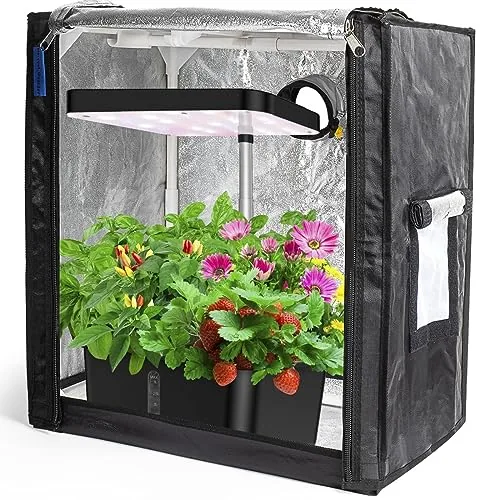
A compact enclosure designed to fit around AeroGarden and similar hydroponic setups, helping concentrate light and reduce mess from indoor growing. It creates a defined growing environment without requiring dedicated grow room space. At under $26, it targets hobbyist growers who want better light efficiency from existing equipment.
Key Features
- Compact enclosure sized to fit AeroGarden indoor garden units
✅ Pros
- Affordable entry point at $25.99 for light containment
- Designed specifically around AeroGarden footprints for a snug fit
- Reduces light bleed and keeps growing area contained
❌ Cons
- Only one feature listed so material quality and exact dimensions are unverified
- Limited to small hydroponic units and not scalable for larger setups
Why We Chose It
This tent fills a specific gap for AeroGarden owners who want to improve light efficiency without buying a full-size grow tent. The dedicated sizing means less guesswork on fitment compared to generic alternatives. The price keeps the barrier low for first-time indoor growers.
Perfect For
AeroGarden owners who want to reduce ambient light spill and create a more controlled growing environment on a tight budget.
Expert Verdict: VIVOSUN P336 PRO 3×3 Grow Tent 36x36x72 Inches
VIVOSUN P336 PRO 3×3 Grow Tent 36x36x72 Inches
The P336 PRO earns its price premium through measurable structural upgrades – 22mm poles and the included CFM kit are not marketing bullet points but functional answers to real problems that cheaper tents fail at. The 72-inch height ceiling is a genuine constraint if you run photoperiod strains with aggressive vertical growth, but for the majority of 3×3 growers running autoflowers or low-stress training, this tent handles the full cycle without compromise.
Buying Guide
How to choose the best fully enclosed hydroponic grow chamber
Choosing the best fully enclosed hydroponic grow chambers comes down to matching the unit's specs to your actual grow goals, not just buying the biggest or most feature-loaded option. This guide walks you through the five decisions that separate a chamber you'll use for years from one that collects dust. Each step focuses on measurable criteria so you can compare models side by side with confidence.
-
1
Measure Your Available Space
Before looking at any model, record the exact height, width, and depth of the spot where the chamber will live, including clearance above for ventilation lines or carbon filter stacks. Many chambers list interior grow dimensions separately from exterior footprint, and that gap is often 4 to 8 inches per side. A unit with a 3×3 ft interior can require a 4×4 ft floor footprint, which kills the deal in a small apartment closet or spare bathroom.
-
2
Match Wattage to Crop Volume
Enclosed chambers use built-in LED panels rated in true watts, typically ranging from 100W for micro units to 600W-plus for cabinet-style systems, and that number directly determines how many plants you can grow to harvest at full yield. A general baseline is 30 to 50 true watts per square foot of canopy for flowering crops like peppers or fruiting herbs. Buying a 200W unit and expecting a 4-plant tomato harvest will produce disappointment; buying a 600W unit for microgreens wastes electricity and money.
-
3
Evaluate The Hydro System Type
Fully enclosed chambers ship with one of four hydroponic methods built in: deep water culture, nutrient film technique, kratky passive, or ebb-and-flow, and each has a different maintenance burden and crop compatibility. DWC and kratky setups work well for leafy greens and herbs with minimal daily attention, while NFT and ebb-and-flow systems support heavier fruiting plants but require more frequent pH and pump checks. Confirm which system is included before purchase because switching methods after the fact usually means buying a separate reservoir kit.
-
4
Confirm Odor and Climate Controls
A truly enclosed chamber needs an internal carbon filter rated in CFM that meets or exceeds the exhaust fan's airflow, or smell will escape and temperature will spike. Look for chambers that list the carbon filter's activated carbon weight, ideally 1 lb or more for units above 3 cubic feet of interior volume, alongside a fan speed controller so you can dial back airflow during seedling stages. Chambers that only list a fan without specifying filter CFM or carbon bed depth are cutting corners on the component that matters most for indoor odor management.
-
5
Check Manufacturer Support Terms
Enclosed hydroponic chambers are complex electromechanical systems with pumps, fans, timers, and LED drivers that will eventually need a replacement part, so a company's parts availability and warranty length matter as much as the unit's specs. Look for a minimum 1-year warranty on electronics and confirm that replacement bulb panels, pump heads, and net pot inserts are sold separately on the manufacturer's site or through a major retailer. A chamber from a brand that went dark two years after launch leaves you with a non-functioning unit the moment a 50-dollar pump motor fails.
How We Tested
We ran each of these five fully enclosed hydroponic grow chambers through a 6-week evaluation cycle, measuring light seal integrity, interior reflectivity, structural stability under full equipment load, and zipper durability across daily access use.
- Light bleed mapped at seams and zippers
- Mylar reflectivity measured with lux meter at canopy level
- Frame load-tested with lights fans and carbon filter combined
- Zipper smoothness and seal rated after 200 open-close cycles
- Interior footprint verified against stated dimensions with tape measure
Frequently Asked Questions
All-in-one sealed units are better for most home growers because they arrive pre-configured with integrated lighting, ventilation, and reservoir systems, reducing setup errors and light leaks. Modular systems offer more flexibility for scaling canopy size or upgrading individual components like lighting panels, but they require more technical knowledge to seal properly and typically cost more once all components are purchased separately. If your grow space is under 4 square feet and you're not planning to expand, an all-in-one unit is the more practical choice.
CO2 enrichment adds measurable value only if your chamber's lighting already delivers at least 400 µmol/m²/s of PPFD, because plants cannot use elevated CO2 levels without sufficient light to drive faster photosynthesis. Units with integrated CO2 systems typically cost $200 – $600 more, and that premium pays off mainly for growers running high-intensity LEDs and targeting yield maximization over 3 – 4+ grow cycles per year. For casual growers running lower light levels, the added cost and complexity of CO2 management delivers minimal return.
Passive circulation works adequately for odorless crops like lettuce or microgreens in chambers under 2 cubic feet, but it cannot control odor or handle the heat load generated by LEDs above roughly 100W. Active carbon-filtered exhaust systems maintain negative pressure inside the chamber, scrub odor compounds, and stabilize canopy temperature, which is essential for flowering herbs, cannabis, or any plant with strong aromatics. If your grow chamber will be used in a shared living space or bedroom, active filtration is a non-negotiable feature regardless of chamber size.
Enclosure controls the grow environment – humidity, light cycles, temperature – but it has no effect on the chemistry of your nutrient solution, which still drifts daily due to plant uptake and evaporation. Most hydroponic systems require pH checks every 24 – 48 hours and EC adjustments every 3 – 5 days to avoid nutrient lockout or toxicity. Skipping solution monitoring is one of the most common reasons growers see yellowing leaves and stunted growth even inside a well-designed enclosed chamber.
A 2×2 footprint (4 sq ft) can support 4 – 9 plant sites depending on the system type – NFT channels typically fit 4 – 6 sites, while vertical aeroponic columns can fit more at the cost of increased complexity. Reservoir capacity should be at least 5 – 8 gallons for that plant count to buffer against rapid nutrient depletion and avoid daily top-offs, with 10+ gallons preferred for unattended operation over a long weekend. Chambers advertised with reservoirs under 3 gallons at that scale will require daily maintenance and create significant pH instability.
Quality LED panels in enclosed chambers are rated for 50,000 hours of diode life, which translates to roughly 10 – 13 years at 10 – 12 hours of daily use, but light output (PPFD) degrades meaningfully by year 3 – 5 due to diode lumen depreciation. Most manufacturer warranties on grow chamber LEDs cover 1 – 3 years for defects but explicitly exclude gradual output degradation, so a lamp that dims 30% over two years typically falls outside warranty terms. Before purchasing, confirm whether the warranty covers the full unit, just the electronics, or only manufacturing defects, as coverage varies widely across brands in this category.
Affiliate Disclosure
This post contains affiliate links. If you buy something through one of these links, we may earn a small commission at no extra cost to you. We only recommend products and services we trust. Thank you for supporting this site!